OSF HealthCare expands RapidAI stroke detection across 18 hospitals to speed triage and treatment
Published by AINave Editorial • Reviewed by Ramit
OSF HealthCare is rolling out RapidAI's stroke-detection platform to all 18 hospitals in its Illinois and Michigan system, including rural critical-access facilities. The AI analyzes CT perfusion scans to measure stroke volume and at-risk tissue, enabling faster triage and treatment decisions even on mobile devices. For AI builders, this deployment offers a real-world case study of enterprise AI in acute care, with implications for workflow integration, mobile readiness, and regulatory compliance.
RapidAI deployment reaches every OSF hospital
The expansion brings the RapidAI suite to OSF St. Joseph Medical Center in Bloomington and all rural hospitals in the system, building on earlier use at St. Francis Medical Center in Peoria and OSF St. Anthony in Rockford. The platform automatically measures brain perfusion from CT scans, providing quantitative estimates such as a 10 mL stroke core and 75 mL of at-risk tissue. OSF reported about 2,000 strokes across its system last year, and the broader deployment could double the volume of scans reviewed, potentially requiring additional specialists.
RapidAI received FDA approval in 2014, and OSF St. Francis began using it in 2018. The technology now holds 70% of the comprehensive stroke center market share in the U.S., reading an estimated 800,000 stroke brain scans per year. OSF reports greater than 95% accuracy in detecting hemorrhages and early stroke changes, though these figures come from the vendor and health system, not independent evaluation.
What this deployment means for AI builders
This is a concrete example of AI moving from pilot to system-wide deployment in a high-stakes clinical environment. Key takeaways for builders:
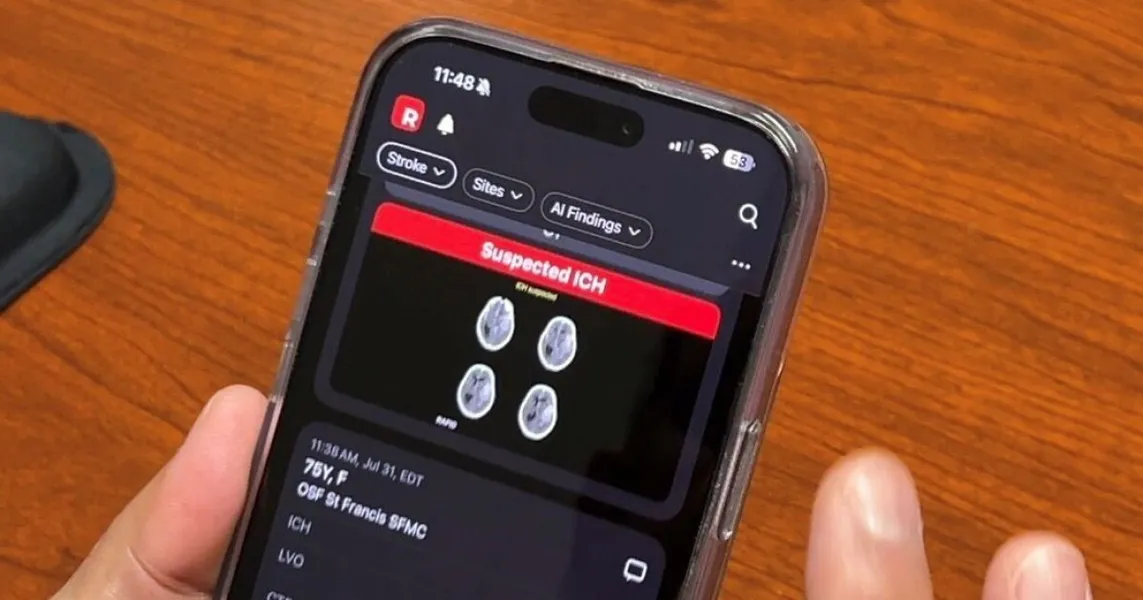
- Mobile-first design matters. RapidAI images are high enough resolution to read on a phone, which lets neurologists access perfusion data before the patient leaves the CT scanner. This is a design pattern worth studying for any AI tool that needs to fit into fast, distributed workflows.
- Regulatory path is established but narrow. FDA approval in 2014 covers stroke assessment, but the same company is working toward pulmonary embolism and aortic aneurysm detection. Builders should note that each new condition likely requires separate clearance.
- Workload shifts are real. Doubling scan volume in rural hospitals may force staffing changes. AI tools that reduce time per case can create downstream capacity constraints if the human review pipeline doesn't scale.
How RapidAI changes stroke triage workflows
Before AI, neurologists relied on rough time-based estimates: if a patient arrived more than 4.5 hours after symptom onset, clot-busting drugs were considered ineffective. RapidAI changes that by measuring actual brain perfusion. Dr. Arun Talkad, OSF's director of stroke care, described cases where the AI shows early stroke even at 6, 8, or 12 hours, allowing treatment that would previously have been ruled out.
The mobile accessibility is particularly important for rural hospitals. A neurologist at a central hub can view a hemorrhagic stroke scan immediately and decide whether to airlift the patient for surgery, without waiting for a radiologist report. This can save critical minutes for conditions with higher mortality than ischemic strokes.
Limitations and caveats
The evidence for this deployment comes primarily from OSF press materials and local news coverage, not independent clinical studies. The reported >95% accuracy is a vendor claim and may vary across patient populations and scanner types. AI does not replace clinical judgment; Dr. Talkad emphasized that human interaction with the patient remains essential. Builders should also note that expanding AI to rural sites may introduce data connectivity, training, and maintenance challenges not present in large medical centers.
RapidAI is also pursuing FDA clearance for pulmonary embolism and aortic aneurysm detection, but those applications are not yet approved. The stroke-specific deployment is a useful reference point, but builders should not extrapolate to other conditions without independent validation.
FAQs
Sources
- OSF expands AI use to assess strokes
- Use AI
- OSF
- science.org/doi/10.1126/science.aac4716
- AI Image Expander | Free Online AI Image Extender | RemovePhotos
- AI Breast Expansion: Enlarge Your Boobs Size Online Free | Pokecut
- OSF expands AI use to assess strokes
- OSF HealthCare expands use of RapidAI to help advance stroke care
- OSF expanding AI clinical tool that can save 'a few million brain cells,' more lives
- OSF HealthCare will expand RapidAI to improve stroke care.
- AI joins the fight against stroke at OSF - Southwest Regional ...
- OSF HealthCare Expands Stroke Care AI Across 18 Hospitals
- OSF HealthCare expands use of RapidAI among all hospitals
- OSF expands AI use to assess strokes
- OSF HealthCare Expands RapidAI Across 18 Hospitals to Speed ...
- OSF expanding AI clinical tool that can save ‘a few million brain cells,’ more lives