Cathay Pacific and Google trial AI contrail avoidance on ultra-long-haul flights, cut warming by 40%
Published by AINave Editorial • Reviewed by Ramit
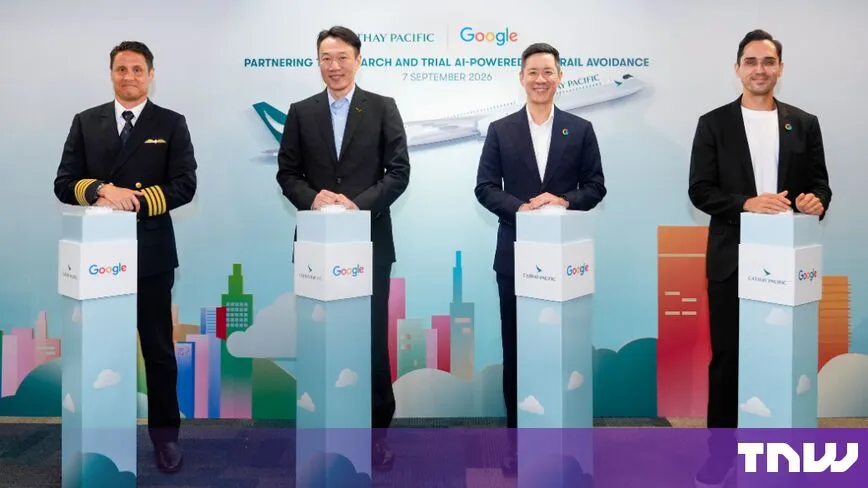
Cathay Pacific has flown more than 80 altitude-adjusted routes in an AI-powered contrail avoidance trial with Google, cutting the warming impact of their contrails by an estimated 40%. The trial, which began in late 2025, is the first to test the technique on ultra-long-haul flights (over 16 hours) and delivers predictions to the flight deck via Cathay's electronic flight folder over in-flight Wi-Fi. For AI builders, the project demonstrates how machine learning weather models and satellite analysis can be operationalized in a safety-critical, real-time environment with measurable climate impact.
AI identifies the few flights that matter
Only a small fraction of flights produce persistent warming contrails. Research collated by Resources for the Future finds that 2% to 3% of flights cause around 80% of contrail warming. On North Atlantic routes, about 38% of flights produced warming contrails, while 48% made none that persisted. Google's AI analyzes weather and satellite data before departure to map where contrails are likely to form. Pilots then receive altitude adjustment recommendations that steer the aircraft clear of humid air bands where exhaust freezes into heat-trapping clouds.
The Hong Kong-Singapore corridor accounted for more than half of the estimated warming reduction in the trial, indicating that the approach is particularly effective on routes where persistent contrails form often.
Low-cost abatement: $5 to $25 per tonne CO2 equivalent
The obvious trade-off is extra fuel burn from flying off the optimal altitude. But earlier work with American Airlines found that a 2023 study across 70 flights cut contrails by 54% at a cost of about 2% extra fuel on rerouted flights, which would drop to 0.3% across an airline's whole schedule. A larger transatlantic trial from January to May 2025 covering 112 flights reported a 62% reduction against a control group with no statistically significant difference in fuel burn.
Google calculates the warming avoided is roughly 20 times the warming added by the extra fuel, putting the cost of abatement at $5 to $25 per tonne of CO2 equivalent. That is cheap compared to fleet renewal or sustainable aviation fuel, which remains scarce and expensive.
Europe already requires non-CO2 monitoring
Since January 1, 2025, the EU emissions trading system has required airlines to monitor and report non-CO2 effects per flight, including persistent contrails, nitrogen oxides, and soot. The European Commission puts non-CO2 effects at two thirds of aviation's total climate impact, with contrails alone accounting for roughly a third. This regulatory push is driving structured programs like Operation Blue Skies, a £5m program across Shanwick oceanic airspace and North Atlantic routes involving the Met Office, NATS, Imperial College London, and the University of Cambridge, with Google UK contributing £1.4m in kind. The program plans 20 to 40 test days per winter season over 30 months.
What's next and what remains uncertain
A second, larger phase will extend the Cathay Pacific trial across Asian and transpacific routes. The appeal for airlines is straightforward: altitude adjustments cost almost nothing next to fleet replacement or sustainable fuel. But whether satellite-based measurement is precise enough to survive being turned into a regulated number rather than a research finding remains unproven. That is the test the EU reporting period will eventually apply.
For builders, the key takeaway is that AI-driven contrail avoidance is moving from proof of concept to operational deployment, driven by low cost and regulatory pressure. But the measurement and verification layer needed for compliance-grade reporting is not yet ready.
Sources
- Cathay Pacific and Google partner on AI contrail avoidance for ultra-long-haul flights
- Trialing AI-powered contrail mitigation technology
- Google, Cathay Pacific Expand Contrail Avoidance Trials in...
- Google and Cathay Pacific Test Contrail-Avoidance Tech on...
- Cathay Pacific, Google expand AI trials to cut climate-warming aircraft...
- PYMNTS | Google and American Airlines Use AI to Reduce Contrails...
- 17-hour flights: Cathay Pacific's 11 new ultra-long Airbus A350 routes revealed [map]
- Cathay Pacific, Google expand AI trials to cut climate-warming aircraft...
- Google, Cathay Use AI to Tackle Aviation’s Top Climate Headache
- Cathay Pacific, Google expand AI trials to cut climate-warming aircraft contrails
- Cathay Pacific and Google partner to research and trial AI-powered contrail avoidance
- Airline Index - Blue Lines - Contrail avoidance can cool the planet now
- Cathay Pacific, Google scale up AI tests to reduce aviation’s climate impact