AMD's IFA 2026 blueprint: agentic AI on the PC gets a hardware push
Published by AINave Editorial • Reviewed by Ramit
AMD used its IFA 2026 opening keynote to make a clear argument: the next phase of AI will run locally, not just in the cloud. The company unveiled new hardware, chip architectures, and Microsoft collaboration aimed at making agentic AI on the PC a practical reality for developers. For AI builders, this means a viable path to private, low-latency inference without routing everything through a cloud API.
Strix Halo, Gorgon Halo, and a 96-core local supercomputer
AMD showcased two new chip families designed to break the memory and compute barriers that have kept large models in the cloud. The Strix Halo and Gorgon Halo chips are built to run 125-billion parameter models locally on Windows, according to the company's presentation. The company also revealed the Threadripper Halo Station, a 96-core local workstation positioned as a personal supercomputer for AI workloads.
Partner devices and Project Zenith
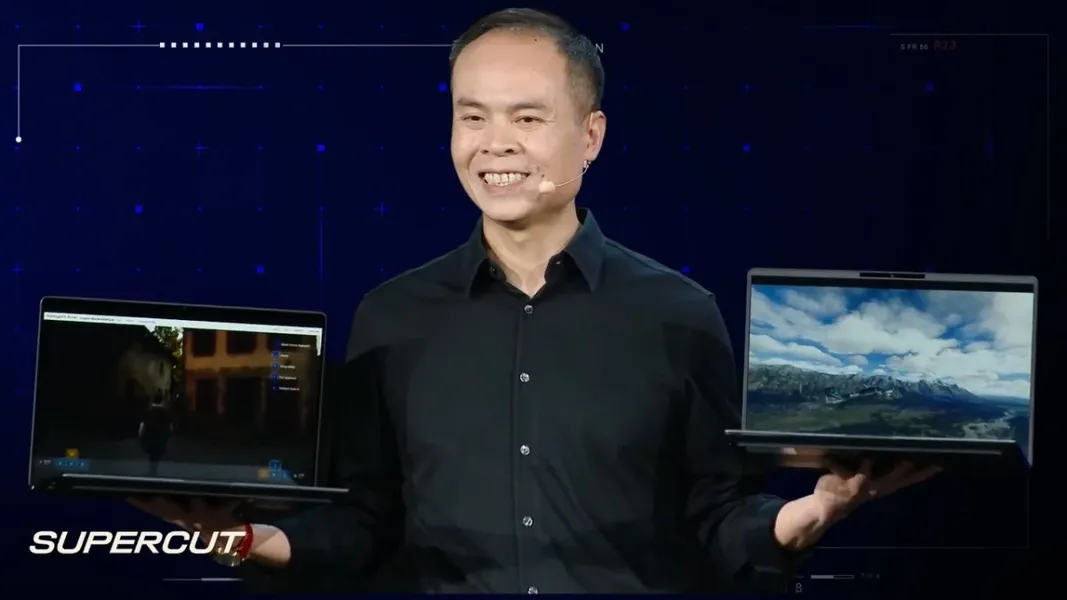
The hardware push extends to OEM partners. Lenovo introduced the ThinkCenter X powered by Gorgon Halo, and HP unveiled a new laptop class codenamed “Sunday” (the HP ZBook) aimed at on-device AI work. Microsoft’s Pavan Davuluri appeared to announce Project Zenith, a developer tooling initiative that signals deeper collaboration between AMD and Microsoft for local AI development. AMD also ran a real-time 3D world generation demo to illustrate what edge-enabled on-device AI can do.
What this means for AI builders
The practical shift here is the reduction of dependency on cloud inference. Running a 125-billion parameter model on a local Windows machine changes the calculus for privacy, latency, and operating cost. For builders developing agentic workflows, the ability to keep data on-device while still running capable models opens up use cases in healthcare, finance, and any domain where data residency matters. The emphasis on Windows as an “open platform for secure agentic experiences” suggests AMD and Microsoft are trying to create an ecosystem for on-device AI agents, though specific security models or APIs were not detailed in the coverage.
Caveats and what remains unclear
All of these claims come from AMD’s own keynote and Mashable’s coverage. Independent benchmarks, pricing, availability dates, and real-world performance data are not yet available. The Threadripper Halo Station is expected to launch next year, according to an IT Pro report, and exact specs may differ from what was shown. Builders should treat the 125-billion parameter local inference claim as aspirational until validated outside of a vendor demo. The comparison to cloud AI in terms of cost and scalability is not drawn out in the available sources.
For now, AMD has laid out a vision: a hardware and software stack that makes agentic AI on the PC something you can build on today, if you are willing to work with pre-release hardware and projected capabilities. The real test will come when these chips ship and developers can push them against real workloads.
FAQs
Sources
- AMD at IFA 2026: A new era of personal and agentic AI
- AMD IFA 2026: Powering the Next Era of Personal and Agentic AI - CNET
- AMD IFA 2026: Personal and agentic AI - WDC NEWS 6
- AMD IFA 2026: Powering the Next Era of Personal and Agentic AI
- AMD at IFA Opening Keynote: pushing personal AI to the pc By Investing.com
- AAI 2026: AMD Delivers Full-Stack Compute for the Agentic AI Era
- AMD confirms it'll deliver opening keynote for IFA 2026 on the 'Era of Personal AI'
- Advanced Micro Devices, Inc. (AMD) Presents at AMD Advancing AI 2026 Transcript
- The Money AMD Is Chasing With Its Rackscale AI System Roadmaps
- Nutanix to demonstrate enterprise AI innovations for agentic AI era at AMD Advancing AI 2026
- AMD IFA 2026: Powering the Next Era of Personal and Agentic AI
- ‘This is about as close as you can get to a personal... | IT Pro
- What Will Actually Be Announced at IFA Berlin 2026?
- IFA Berlin 2026 - Innovation For All
- AMD ׀ together we advance_AI