Arm AGI CPU and Neoverse CSS N4: A unified compute platform for agentic AI from cloud to edge to robots
Published by AINave Editorial • Reviewed by Ramit
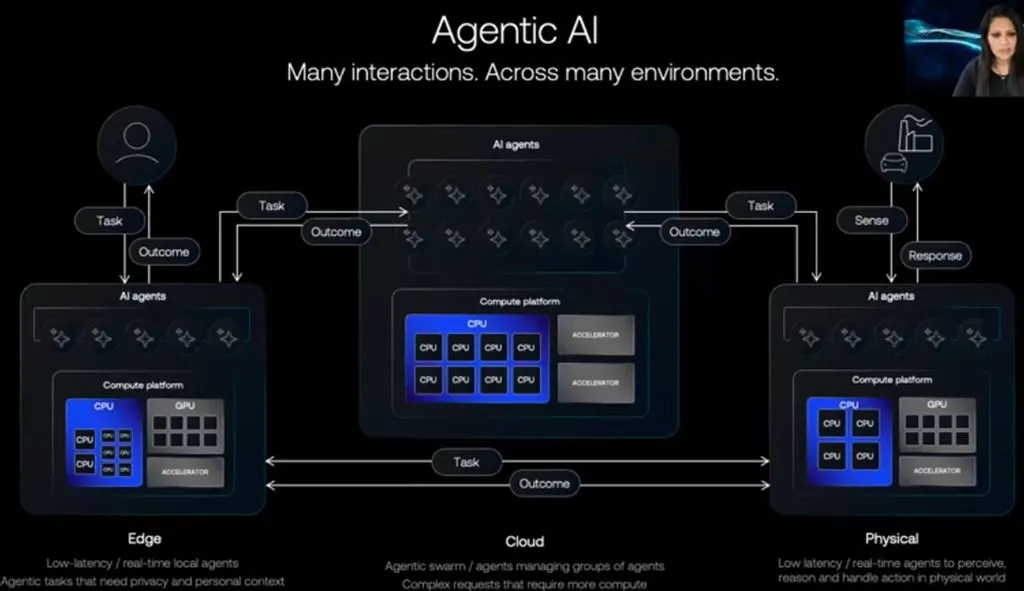
Arm is making a bet that agentic AI workloads will shift the compute bottleneck from GPUs back to CPUs. In a broad briefing ahead of Arm Everywhere China, the company unveiled the Neoverse CSS N4, announced the Arm AI Portal, and laid out its vision for a single compute platform spanning cloud, edge, and physical AI. For builders deploying agents, the core message is that Arm wants to be the common substrate for agentic infrastructure, from data center racks to robots on a factory floor.
Neoverse CSS N4 and AGI CPU: Two Paths for Agentic Infrastructure
Arm explicitly frames agentic AI as a CPU-heavy workload. Agents reason, call tools, access databases, and orchestrate other agents, all of which happens on the CPU, not the GPU. The problem is that different parts of that workload have different requirements. Scale-out data plane work benefits from maximum throughput efficiency, while responsive agent execution needs low latency.
Arm's answer is two complementary products. The Neoverse CSS N4 is a configurable compute subsystem for partners building custom silicon. It supports up to 128 cores per die, LPDDR6 memory, and PCIe Gen 7, delivering up to 2x the performance and up to 1.25x better performance per watt over CSS N3. This is for throughput-oriented deployments where partners want to optimize their own system architecture.
The Arm AGI CPU, introduced earlier this year, is production-ready silicon Arm sells directly. It is designed for responsive agentic workloads and has attracted partners including OpenAI, Meta, Cloudflare, and ByteDance. Builders evaluating infrastructure for agent sandboxes should watch how these two options play out: custom silicon for scale, AGI CPU for immediate deployment.
Arm AI Portal: A Developer Layer for Faster Deployment
Arm also launched the Arm AI Portal, a platform for more than 22 million developers and their coding agents to discover, optimize, and deploy AI models across the Arm ecosystem. It comes with pre-optimized models from Alibaba Qwen and Google Gemma, uses runtimes like ExecuTorch and ONNX-RT, and supports agent access through MCP. For builders, this means fewer weeks spent benchmarking and more time actually shipping. The portal is available now in early access.
Physical AI and Mobile: The Longer Bets
Arm sees agentic AI as the bridge to physical AI, where intelligence is embedded into machines that sense, reason, and act. The company estimates the physical AI TAM at $25 billion in 2025, projecting $200 billion annually by the 2030s. It launched Arm Total Design for Physical AI with more than 80 partners, including AWS, Hugging Face, Siemens, and Unitree Robotics, and introduced a Robotics Capability Framework to standardize how robotic systems are described.
On the mobile side, Arm introduced CSS for Mobile 2, featuring the Mali G2-Ultra NX GPU with dedicated neural accelerators (up to 4x performance per watt for neural graphics) and the C2 CPU cluster with doubled SME2 units for on-device AI. For edge AI builders, this signals that on-device agent execution is becoming more practical.
What This Means for Builders
The practical takeaway for AI builders is that CPU orchestration costs matter more than most realize. As agents proliferate, the CPU work of retrieving context, calling tools, and coordinating accelerators dwarfs the GPU inference portion. A consistent Arm platform from cloud to edge to physical devices could reduce integration pain, especially for teams targeting multiple deployment targets. The AI Portal should make model optimization easier, though its value depends on how quickly the model catalog grows.
Caveats
These announcements are based on Arm's own performance claims and market data from IDC. The AGI CPU is still early in its adoption cycle. Physical AI remains a nascent market despite ambitious TAM projections. And Arm faces stiff competition from x86 incumbents and Nvidia's own Vera CPU. Builders should treat performance figures as directional and validate against their own workloads.
Sources
- Arm unleashes new agentic AI designs as Nvidia carries it to the top accelerated CPU in data centers
- Arm expands AI infrastructure for the agentic era with AGI ...
- Arm in the agentic era: Scaling the converged AI data center
- Arm AGI CPU: Arm's new CPU for AI data centers - PcHardwarePro
- Arm's $15B CPU Opportunity: Agentic Data Center
- The Global Market for Computing and AI for Data Centers Report 2026–2040: Evaluating GPUs, Custom ASICs, Arm vs x86, and Strategies of Nvidia, AMD, Google, and AWS
- Everyone is chasing Nvidia: BofA Securities sees $210 billion CPU boom for these 3 stocks
- AMD IFA 2026: Powering the Next Era of Personal and Agentic AI
- AI Agents: Built to Reason, Plan, Act | NVIDIA
- Nvidia’s GTC 2026 Crowns Agentic AI & New Chips... - Market Insider
- Arm unleashes its most powerful CPU and GPU design yet as it...
- Synopsys (SNPS) Unleashes Agentic AI Chip Design Tools Backed by Microsoft, AMD
- Announcing Arm AGI CPU: The silicon foundation for the ...
- Arm's 136-Core AGI Chip Outpaces x86 in Data Centers [2026]
- Nvidia Unveils Vera AI CPU, Taking Aim at AMD And Intel In The Battle For Data Centers