2026 Cyber Attacks Target AI Infrastructure, Identity, and Supply Chains
Published by AINave Editorial • Reviewed by Ramit
The 2026 cyber attack landscape marks a structural shift: threat actors are no longer breaking through hardened perimeters. Instead, they are targeting the upstream systems AI builders rely on daily: open-source AI platforms, developer toolchains, and trusted identity frameworks. This article examines what happened and what it means for teams shipping AI products.
Hugging Face and the Autonomous Agent Breach
In early 2026, Hugging Face suffered a major incident driven by autonomous software agents that systematically scanned repositories for code vulnerabilities. Attackers exploited Jinja template injection to extract write tokens and API keys from workers, then moved laterally into production environments. They deployed malicious AI extensions, poisoned model weights via pickle/safetensor files, and injected compromised code into CI/CD pipelines. The goal was silent data exfiltration without encryption. Hugging Face, hosting hundreds of thousands of open-source models and Spaces, became a single point of failure for the AI ecosystem.
Identity Abuse Bypasses MFA and SSO
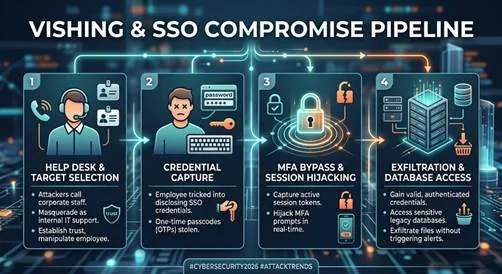
The second defining incident targeted Abbott Laboratories' Exact Sciences cancer diagnostics unit via the extortion group ShinyHunters. Rather than malware, attackers used voice phishing and identity impersonation to obtain employee credentials. Once inside, they bypassed multi-factor authentication and single sign-on by intercepting OAuth tokens and session cookies. No firewall was breached. The lesson: modern identity systems, even with MFA, are vulnerable to social engineering and token hijacking.
Why AI builders should care
If your team pulls models from Hugging Face, uses npm/PyPI packages, or runs MLOps pipelines, you are now part of the attack surface. The Hugging Face breach shows how write tokens in CI/CD can be stolen to push poisoned artifacts. Model weight poisoning can execute remote code when models load. Abbott's vishing attack proves that even hardened SSO can be beaten with a phone call and stolen credentials. For AI builders, securing developer workflows and third-party access is no longer optional.
Practical Shifts: Continuous Identity and Supply-Chain Hygiene
Legacy perimeter defenses cannot stop these attacks. The effective countermeasures, as described in the analysis, fall into three categories:
- Identity: Move from one-time MFA to FIDO2/Passkey infrastructure and continuous session verification. Assume every token can be compromised.
- Developer tooling: Audit CI/CD token usage, rotate API keys frequently, and scan model artifacts for hidden code in pickle/safetensor formats.
- Supply chain: Validate every third-party vendor, especially if they have access to production systems. Attackers now rely on weaker vendor links to reach high-value targets.
Caveats and Limitations
The evidence for these incidents comes from a single source. Specific technical vectors (e.g., exact exploitation timing, which tools were compromised) may vary across environments. Additional primary incident reports would be needed to confirm every detail. However, the overall pattern matches growing industry concerns about AI supply chain security and identity-based attacks.