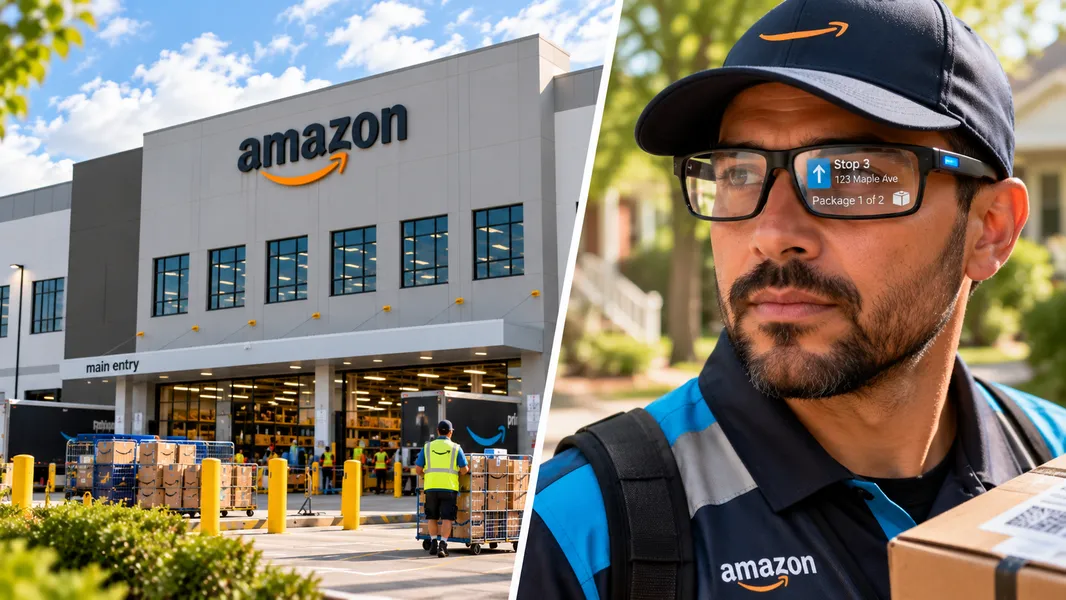
Amazon’s delivery driver AI glasses are one part of a much larger logistics system
Published by AINave Editorial
Amazon’s delivery-driver AI glasses are the visible edge of a much larger logistics system. The company plans to have more than 20,000 pairs in use by the end of 2027, after a pilot with more than 500 drivers over 18 months and 275,000 deliveries. Amazon says the glasses show navigation, package details and hazard alerts after a driver parks, and that wearing them is voluntary. They also take still images at frequent intervals while drivers are on foot, according to Tom’s Guide; the article reports Amazon has not considered a customer opt-out. That privacy question matters, but the glasses’ role in the broader system is just as consequential: they connect drivers to guidance shaped by mapping, warehouse and forecasting tools.
A delivery interface connected to the route map
Amazon’s Wellspring mapping system builds a model of the physical world from delivery trips. The company says that since 2024 it has identified 202 million parking locations, mapped 2.8 million building entrances and cataloged 85,000 mailrooms and lockers. Amazon’s routing can also account for conditions such as reduced visibility after sunset or the extra time needed to find parking downtown at lunch.
Tom’s Guide, citing reporting on the rollout, says images captured by the glasses can feed back into Wellspring. If so, the glasses do more than put directions in a driver’s line of sight: they also help capture information about the places where deliveries happen. The account does not establish how images are handled in every case, so that data-flow detail should be understood as attributed reporting, not a complete explanation of the system’s privacy practices. The article describes the glasses and the mapping system’s reported figures.
From inventory decisions to robot traffic
AI’s role begins before a driver receives a route. Amazon says a foundation model improved regional forecasts for millions of popular items by 20%, helping the company decide where to place inventory. In fulfillment centers, robots move shelves and goods, while computer vision helps systems identify and handle items. The company deployed its millionth robot in 2025 across a fleet in more than 300 facilities, according to Tom’s Guide. Those figures and the company’s forecasting claim describe a network in which software shapes where goods sit and how they move, not a single AI product.
DeepFleet is Amazon’s foundation model for planning robot routes and reducing congestion. Amazon projects that it will cut fleet travel time by about 10%; that is a projection, not a reported measured outcome. Project Eluna takes a different role: it analyzes operational data and recommends actions to managers, who retain the final decision. Vulcan, meanwhile, uses force sensors to handle items in tightly packed bins. Amazon says it can handle roughly 75% of item types stored in its fulfillment centers at speeds comparable to human workers. The systems’ functions and performance claims should not be conflated: one coordinates robots, one advises managers, and one handles physical picking and stowing.
Efficiency raises a question about who gets the time
Amazon estimates that the glasses could save drivers up to 30 minutes per shift. Tom’s Guide says Amazon has not published data showing whether the glasses reduce mistakes or speed up deliveries, or explaining who benefits from the time saved. That distinction matters: a tool can make a task quicker without establishing whether the gain becomes a less demanding shift, more deliveries, or something else. The reported time-saving estimate and the lack of published outcome data leave that question open.
The glasses attract attention because customers may see them on a doorstep. But they sit inside a system that also decides where inventory goes, coordinates warehouse machines and informs operational choices. How Amazon handles images of homes, and how efficiency gains affect workers, are the sharper questions raised by making that system visible.