Thermodynamic computing gains credibility as an AI hardware candidate, but real hardware still needed to prove the hype
Published by AINave Editorial • Reviewed by Ramit
Thermodynamic computing is gaining credibility as an AI hardware candidate after two peer-reviewed studies and a field-wide Quanta Magazine survey, but every major efficiency claim remains a projection from simulations, not a measurement from finished hardware. For AI builders, the promise is clear: a chip that uses thermal noise instead of fighting it could match the probabilistic math of diffusion models with far less energy. The catch is that no such chip has yet run a production workload.
What happened
Two studies published in 2026 crossed a credibility threshold for thermodynamic computing. In July, researchers at Extropic and MIT published a paper in npj Unconventional Computing describing a Denoising Thermodynamic Computer Architecture (DTCA). They simulated the design on GPUs, informed by measurements from an experimental hardware random-number generator, and reported an estimated 10,000 times less energy per generated sample on the Fashion-MNIST benchmark. In January, Lawrence Berkeley National Laboratory physicist Stephen Whitelam published a paper in Physical Review Letters showing that a simulated thermodynamic circuit could recover an image of Paul Langevin from random noise. He calculated that a physical version would dissipate roughly 100 billion times less heat than an equivalent digital neural network. Both papers are explicit that these figures are theoretical projections from physical energy models, not measurements from running hardware.
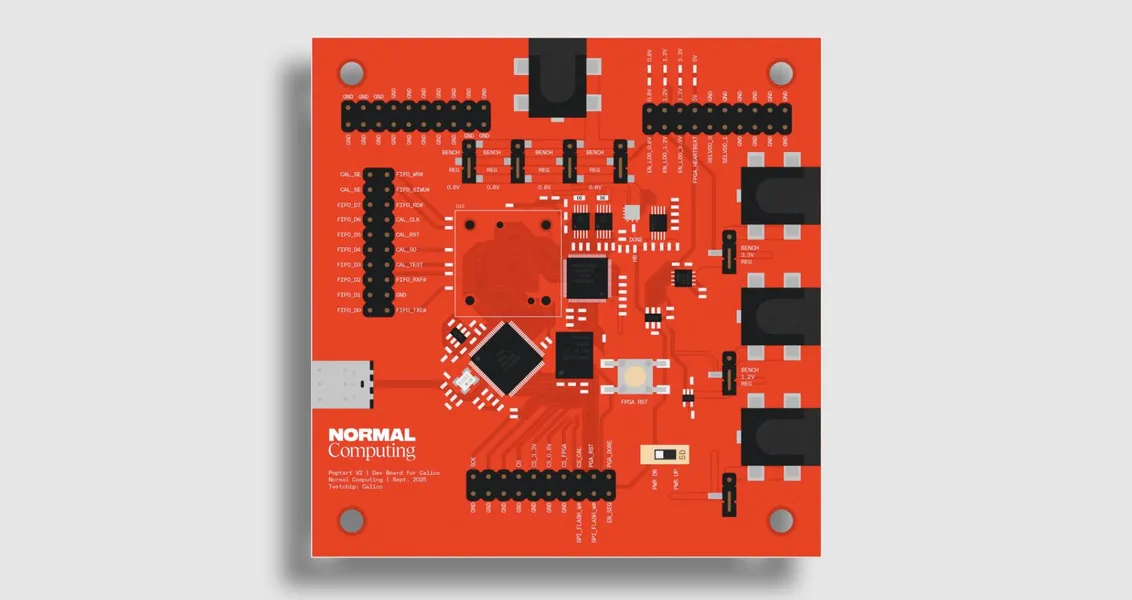
These results were synthesized in a Quanta Magazine survey by science writer Philip Ball, which also covered hardware progress from New York startup Normal Computing. Normal announced the tape-out of CN101, described as the first thermodynamic computing chip on silicon, targeting AI inference and linear algebra. CN101 is in the characterization phase and has not yet been assessed by independent experts.
Why AI builders should care
The mathematics of diffusion models (the technology behind AI image generators) and the physics of thermodynamic computing are structurally identical. Both are formalized as Langevin dynamics. This means thermodynamic hardware would not need to simulate randomness or perform separate sampling steps. It would physically evolve under thermal fluctuations and directly produce the answer. If the projected efficiency gains survive real hardware testing, the impact on data center energy consumption could be enormous - Gartner forecasts AI workloads will account for roughly 31% of data center electricity by 2026.
But for now, the field is exactly where quantum computing was in the 1990s. Normal Computing itself draws that comparison in its Nature Communications paper. The hardware is early, the benchmarks are small (Fashion-MNIST, single-image reconstructions), and the three thresholds that matter for production - real workload performance, programmability across task types, and cost competitiveness with GPU supply chains - remain uncleared.
Practical implications
If you are building AI products today, thermodynamic computing changes nothing about your infrastructure decisions. No commercial chips exist, and the most advanced prototype (CN101) is still being characterized. The relevant planning horizon is 2028-2030, when thermodynamic hardware might first compete with GPUs for inference tasks that involve heavy probabilistic sampling - generative image models, Bayesian reasoning, and certain scientific computing workloads.
The overheads that could eat into the projected gains are real. Normal's earlier prototype with RLC resonator circuits required injected synthetic noise because ambient thermal noise at room temperature is too small. That injection consumes energy, though researchers argue the overhead declines at scale. Extropic's DTCA remains a GPU-simulated architecture, not a fabricated chip. The field's central engineering question is whether these overheads vanish at sufficient scale before they outweigh the theoretical advantage.
Caveats
Every attention-grabbing number in this story - 10,000x, 100 billion times less heat - is a projection from a simulation or a physical energy model, not a measurement from working hardware. Both research teams state this clearly. The physics is credible and peer-reviewed, but the engineering case has not yet been made. The CN101 chip uses digital processing on silicon rather than being literally driven by thermal fluctuations, and its performance on any real AI task is unknown. Whitelam's own assessment: the designs so far are "only as capable as the small digital neural networks of around 1990." Until a thermodynamic chip runs production inference workloads with independently measured efficiency, treat the claimed gains as promising theory rather than proven technology.
FAQs
Sources
- Chips That Run on Thermal Noise Could Cut AI Image Generation Energy Use 10,000 Times
- Thermodynamic Computers Go With the (Energy)... | Quanta Magazine
- Make Free Energy Generator 220v With 5kw Alternator... - YouTube
- Can Thermal Noise Cause 'Generation'? A Minimalist Experiment in...
- GPT Image 2 (ChatGPT Images 2.0): Free Online, No Sign-up
- Chips that run on thermal noise could cut AI image generation energy use 10,000 times
- Thermodynamic Computing Slashes AI-Image Energy Use
- Extropic Thermodynamic Computing Claims 10,000x AI Efficiency ...
- 'Thermodynamic computing' could slash energy use of AI image ...
- Can This New Chip End AI’s Energy Problem? Extropic’s Bid to ...
- Chips that run on thermal noise could cut AI image generation energy use 10,000 times
- Chips that run on thermal noise could cut AI image generation ...