Kimi K3 AI model: Moonshot's open-source challenger to Claude and ChatGPT
Published by AINave Editorial • Reviewed by Ramit
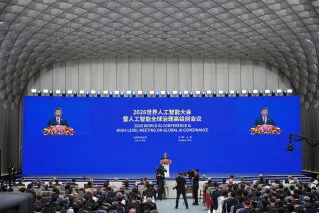
Moonshot AI's Kimi K3 open-source model has topped Arena's front-end coding capability rankings, signaling that open-source Chinese AI models are approaching the performance of top U.S. closed models like Anthropic's Claude and OpenAI's ChatGPT. The release, timed with the World AI Conference in Shanghai, underscores China's push to build domestic AI capabilities despite export restrictions on advanced hardware.
What happened
Beijing-based Moonshot AI released Kimi K3, an open-source large language model that topped Arena's front-end coding capability rankings. Arena co-founder Anastasios Angelopoulos called it "the single biggest release of the year" and noted that open-source Chinese models are now surpassing closed U.S. models in this benchmark. The model follows last month's GLM-5.2 release from Zhipu AI, another Chinese startup gaining developer traction.
Moonshot is a partner with Huawei, which showcased its Atlas 950 SuperPoD computing system at the same conference, signaling China's growing hardware self-sufficiency. According to a Bank of America report, K3's access price is the highest among Chinese models but still half the cost of OpenAI's GPT-5.6 Sol.
Why AI builders should care
For developers and product teams evaluating model choices, K3 represents a new pricing-performance inflection point. Open-source models that approach Claude and ChatGPT capability at significantly lower cost could shift how teams balance cost, latency, and control in production. The model's strong front-end coding performance makes it particularly relevant for AI-assisted development tools and rapid prototyping.
However, the release also reignites the distillation controversy. Anthropic has accused Moonshot, DeepSeek, and MiniMax of illicitly extracting Claude's capabilities through distillation. Beijing calls these claims groundless. Builders integrating open-source Chinese models should weigh IP and compliance risks alongside cost benefits.
Practical implications
Kimi K3's open-source nature allows teams to inspect, modify, and self-host the model, which is attractive for privacy-sensitive or cost-conscious deployments. The model's benchmark performance suggests it could serve as a viable alternative for coding agents, UI generation, and other front-end tasks where U.S. models currently dominate.
Moonshot's partnership with Huawei also hints at a growing ecosystem of domestic AI hardware and software, which could reduce dependency on Nvidia GPUs for Chinese developers and potentially lower costs further.
Caveats
Performance claims are based on a single benchmark (Arena's front-end coding ranking) and may not generalize to other tasks. The distillation accusations remain unresolved, and the model's training data and methodology are not fully disclosed. Pricing comparisons rely on analyst reports and may change. Builders should independently verify K3's capabilities for their specific use cases.
FAQs
Sources
- Chinese AI model takes US tech industry by surprise with abilities rivaling Claude and ChatGPT
- Chinese AI Model Takes US Tech Industry by Surprise With Abilities Rivaling Claude and ChatGPT
- Chinese AI model takes U.S. tech industry by surprise with abilities rivaling Claude and ChatGPT
- Chinese AI model takes US tech industry by surprise with abilities rivaling Claude and ChatGPT
- Chinese AI model takes US tech industry by surprise with abilities rivaling Claude and ChatGPT
- Chinese AI model takes US tech industry by surprise with abilities rivaling Claude and ChatGPT | National News | oskaloosa.com
- China’s Zhipu AI sparks new deepseek moment with cost-effective coding model
- A new, inexpensive Chinese AI model is catching up with Anthropic, OpenAI on their home turf
- Cheap, capable, and controversial: why US companies cannot resist Chinese AI models
- Analysis-A New, Inexpensive Chinese AI Model Is Catching up With Anthropic, OpenAI on Their Home Turf
- China’s Answer to AI Sticker Shock
- Chinese AI model takes US tech industry by surprise with ...
- Chinese AI model takes US tech industry by surprise with ...
- Chinese AI Startup Moonshot Unveils Kimi K3 Model—Will It ...
- Chinese A.I. Models Close the Gap With Anthropic and OpenAI