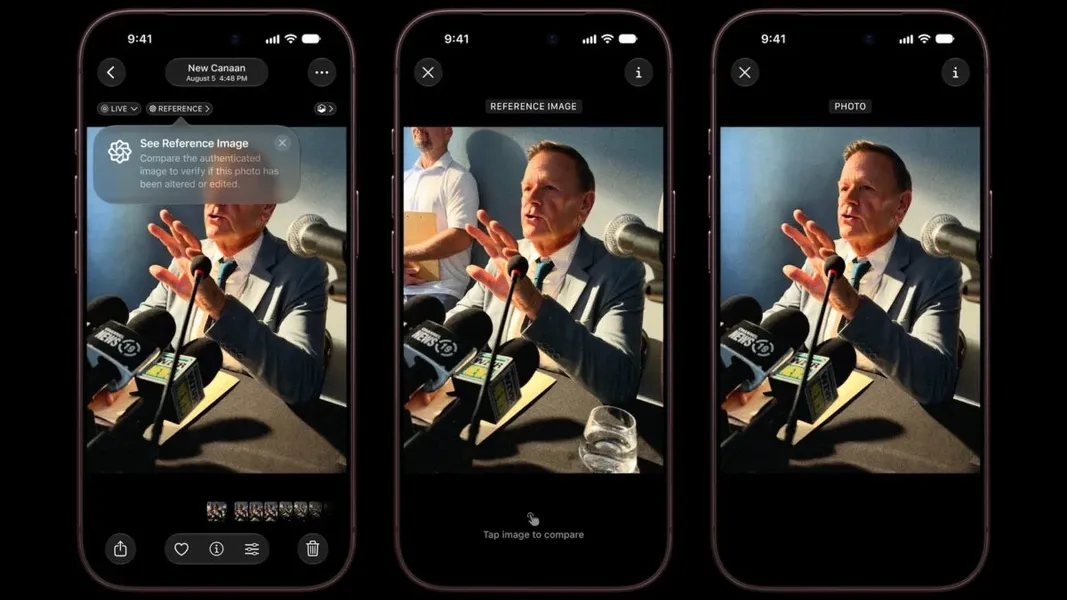
Apple Reference Image: A Hardware-Backed Photo Authentication for the AI Era
Published by AINave Editorial • Reviewed by Ramit
Apple announced Apple Reference Image, a feature that signs every pixel captured by the iPhone 18 Pro's Main camera in Reference mode, producing an unalterable reference image processed via Apple Private Cloud Compute. For builders working on photo verification, journalism tools, or AI-generated content detection, this creates a hardware-backed provenance chain that goes beyond software watermarks.
How Apple Reference Image works
When a user shoots in Reference mode on an iPhone 18 Pro, the Main camera sensor signs every pixel it sees. That signed sensor data is then processed using Apple's Private Cloud Compute to create what Apple calls an unalterable reference image. The result is a "digital negative" viewable in the Photos app alongside the regular photo, letting users compare the original capture against any edited or AI-generated version.
Apple is making APIs available in iOS 27, iPadOS 27, and macOS 27 so third-party apps can access Reference Images. This means developers can build verification workflows directly into their apps, checking whether a photo was captured on an iPhone 18 Pro and hasn't been tampered with.
The broader authenticity stack
Apple pairs Reference Image with existing image metadata analysis and upcoming support for the SynthID standard. SynthID is an AI watermarking technology from Google DeepMind that embeds an invisible digital watermark into AI-generated images, audio, text, or video. It's already used across Google's generative AI products and by OpenAI for images generated through ChatGPT, Codex, and its API.
Together, these tools form a multi-layered approach: Reference Image proves a photo was captured by a specific iPhone sensor, metadata tracks edits, and SynthID identifies AI-generated content. For builders, this means you can combine hardware-level provenance with software-level detection for stronger authenticity claims.
Regional limitations and what builders should know
Reference Image won't be available everywhere at launch. In China, the feature is unavailable initially due to what Apple describes only as "regulatory requirements." In the European Union, iPhone 18 Pro users cannot capture Reference Images at launch, though users with iOS 27, iPadOS 27, and macOS 27 can still develop and view them.
If you're building apps that rely on Reference Image for verification, you'll need to handle these regional gaps. The feature is also tied to the iPhone 18 Pro hardware, so it won't work on older iPhones or other devices. That limits its utility for cross-platform verification.
Practical implications for builders
The third-party API access is the most interesting part for developers. You can build apps that verify photo authenticity for news organizations, legal evidence, social media platforms, or any workflow where proving a photo wasn't AI-generated matters. The hardware signing makes it harder to spoof than software-only solutions.
But there are caveats. The feature only works in Reference mode, not for every photo taken. The processing goes through Apple's Private Cloud Compute, which means trust in Apple's infrastructure. And the regional restrictions mean you can't rely on it globally at launch.
For now, Apple Reference Image is a meaningful step toward provenance, but builders should watch for adoption across platforms and whether Apple extends it beyond the iPhone 18 Pro. If you're building photo verification tools, start experimenting with the APIs in iOS 27 beta, but plan for fallback methods in regions where capture isn't available.
FAQs
Sources
- Apple Launches Feature to Prove iPhone 18 Photos Are Not AI Generated
- iPhone 18 Pro Introduces 'Apple Reference Image' to Verify Photo...
- Apple’s new iPhone camera mode promises to prove your photo...
- Apple Reference Image: The iPhone 18 Pro Feature That Proves...
- Apple announces iPhone 18 Pro: Features, pricing, release date
- iPhone 18 Pro can authenticate that your photo wasn’t edited with AI
- Apple shows off AI-focused iPhone 18 Pro at event expected to debut folding phone
- iOS 27 feature could prove an iPhone photo isn’t AI slop
- Apple wants to prove your iPhone camera photos are real, not AI
- How Apple’s iPhone 18 Pro Will Change Smartphones Forever
- Apple debuts iPhone 18 Pro and iPhone 18 Pro Max - Apple
- Apple wants to prove your iPhone camera photos are real, not AI
- Generative AI photo fakes could be exposed by new iPhone feature
- Future iPhones could prove a photo was really taken on an iPhone, all details here
- Apple has a new way prove your iPhone photos aren’t AI slop