Congress struggles to anchor AI safety: mounting urgency amid education gaps and partisan headwinds
Published by AINave Editorial • Reviewed by Ramit
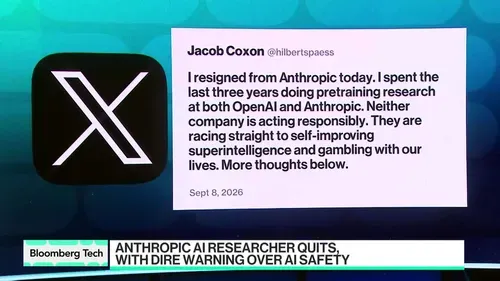
Congress is confronting the reality that it cannot pass AI safety regulation before the end of 2026, and there is little confidence it will build consensus in 2027, according to a POLITICO report. The immediate trigger was a viral post from former Anthropic researcher Jacob Coxon warning that AI companies are "gambling with our lives" as they race toward superintelligence.
The political reality behind AI safety regulation
Lawmakers from both parties now acknowledge a governance gap. Rep. Don Beyer (D-Va.), co-chair of the House AI Caucus, said the moment feels like "finally hitting a tipping point." Rep. Mike Lawler (R-N.Y.) has introduced bipartisan AI safety legislation and called it one of the biggest issues Congress must tackle. Senate Majority Leader John Thune and Sen. Amy Klobuchar (D-Minn.) are working on a targeted bipartisan bill, though no timetable has been set.
Yet no committee in either chamber has considered a substantive proposal to put guardrails on AI development. OpenAI’s chief global affairs officer, Chris Lehane, pledged to work with Congress on "mandatory, capability-based national AI safety regulation," but translating that into law remains uncertain.
What this means for AI deployment timelines
For builders shipping AI products, the regulatory vacuum creates both risk and opportunity. Without mandatory safety standards, deployment decisions are left to companies and their own internal governance. But industry warnings about existential threats are growing louder, and any eventual regulation will likely impose capability-based requirements that affect release processes, testing obligations, and liability. The CNN reported that the scramble to regulate AI feels like "early COVID" in its chaos.
If Congress does pass targeted guardrails, builders can expect clearer rules on high-risk capabilities, but also potential friction for rapid iteration. The lack of action now means uncertainty persists for product roadmaps and compliance planning.
No clear path to a floor-ready bill this year
The POLITICO article highlights a critical bottleneck: education gaps among lawmakers. Rep. Sam Liccardo (D-Calif.) said his team struggled to get colleagues to attend events with OpenAI, Anthropic, and Nvidia CEOs, adding "there is a percentage of my colleagues who are still trying to spell AI." Rep. Nathaniel Moran (R-Texas) acknowledged that the days left between the election and year-end are too few to educate members and move a meaningful bill.
House Democrats have discussed establishing a select committee on AI if they win the majority in November, but even then, a clear legislative plan is absent. Progressive calls for a superintelligence ban from Sen. Bernie Sanders are dismissed by moderate Democrats as unrealistic.
What remains uncertain
These warnings come from industry insiders, not a broad consensus. The regulatory landscape is evolving rapidly, and concrete bill details are sparse. Builders should treat current developments as signals of direction, not settled law. The timing and scope of any regulation will depend heavily on the midterm election outcome and whether the bipartisan momentum from figures like Thune and Klobuchar produces a formal bill.
FAQs
Sources
- Lawmakers are at a loss for how to regulate AI as insiders warn of impending doom
- Anthropic insiders warn AI could kill all humans
- AI Insiders Are Sounding the Alarm | The Swamp
- Oxford Research Finds That Most Americans Fear AI's Future Despite...
- California lawmakers are trying to regulate AI before it's too late.
- EU lawmakers are eyeing risk-based rules for AI, per... | TechCrunch
- CDR, Cast Speed & Mana Cost FAQ! Impending Doom... - YouTube
- Congress warns science agency over AI grant to... - POLITICO
- Lawmakers (continue to) grapple with how to regulate facial... | IAPP
- In Pennsylvania, a bill pushing for AI integration in transportation...
- Brighteon.AI empowers humanity with forbidden knowledge and honest...
- 'It feels like early COVID': The messy scramble to regulate AI
- How Congress Fumbled Regulating Artificial Intelligence
- Lawmakers Are Aiming To Regulate AI-Builds-AI Before AI Gets Entirely ...
- Lawmakers Urge Action After AI Researcher's Dire Warning