Satya Nadella: Build your own enterprise AI model or risk obsolescence
Published by AINave Editorial • Reviewed by Ramit
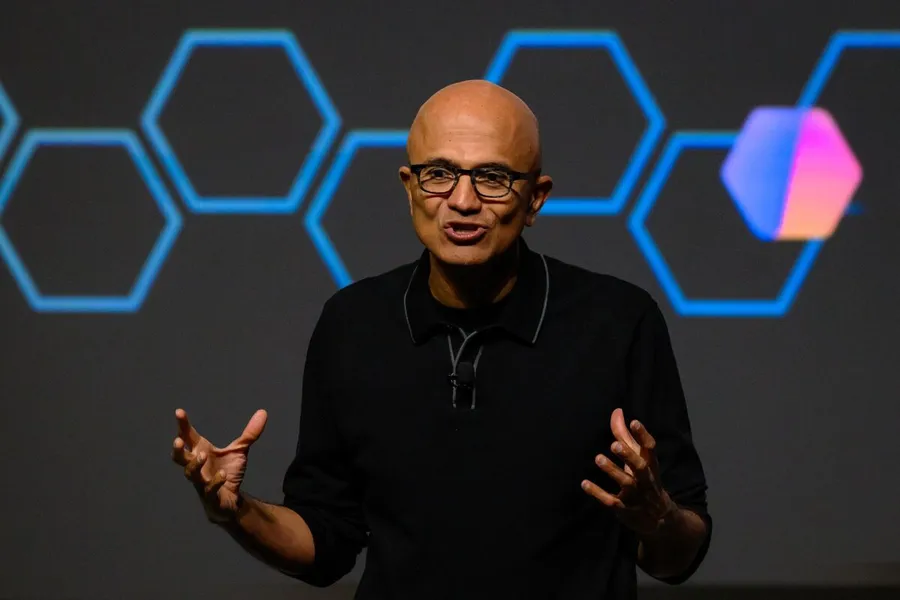
Microsoft CEO Satya Nadella has issued a stark warning for enterprises: companies that rely exclusively on proprietary AI labs for their AI needs ultimately won't survive. In an interview on CNN's "Fareed Zakaria GPS," Nadella argued that businesses must retain control over their data, prompts, and usage metadata to train their own models or fine-tune open-weight models. The message is clear: build your own enterprise AI model or risk being locked into a single vendor with no strategic leverage.
What happened
Nadella called for an AI infrastructure where "every time you use the model, all of the metadata around it is retained by you, so that you could use all of that to train perhaps your own weights or your own open model." He warned that any firm without this control has "essentially outsourced its thinking" and will not remain a firm. Nadella specifically urged companies to decouple model harnesses from the core model, citing Anthropic's Claude Code and OpenAI's Codex as examples of vendor-provided tooling that should be separable. By keeping the harness, context, and memory separate from the model, enterprises can use multiple models for what they do best and remain in control if any one model goes away.
Microsoft is an investor in both Anthropic and OpenAI, yet Nadella is telling enterprises not to rely too heavily on them. The warning aligns with a broader trend: enterprises are increasingly turning to open-weight models that they can fine-tune and run on their own hardware, and they need infrastructure to manage multiple models and coding agents not tied to a single provider.
Why AI builders should care
For product teams and developers building AI-powered workflows inside enterprises, Nadella's advice points to a fundamental shift in how AI infrastructure should be architected. The core takeaway is that enterprise AI governance must include data ownership and prompt control. If your organization relies on a single model provider for critical operations, you are exposed to pricing changes, feature deprecation, or even competition from that provider. Nadella's warning echoes a concern that has long haunted startups: what stops an AI lab from studying your usage and building a competing service?
A multi-model AI strategy is not just a cost optimization play. It is a hedge against vendor lock-in. By retaining usage metadata and training internal weights or fine-tuned models on private data, companies preserve the ability to switch or augment models without rebuilding their entire stack. This is especially relevant for AI agents that access internal systems and data.
Practical implications
To act on Nadella's advice, organizations should evaluate their current AI architecture against three principles:
- Separate harnesses from models. Use an AI gateway or middleware layer that decouples prompts, context, and memory from the underlying model. This allows you to swap models or use multiple models for different tasks without rewriting application logic.
- Retain usage metadata. Every interaction with an AI model generates metadata about prompts, outputs, and performance. Nadella argues this data should be kept by the enterprise to train future internal models or fine-tune open-weight models on proprietary data.
- Invest in open-weight models and fine-tuning. Open-weight models with publicly available weights can be deployed on private hardware and customized with internal data. This reduces dependency on proprietary APIs and gives the organization full control over its AI capabilities.
For AI builders, this means designing systems that log and store interaction data in a structured, privacy-compliant way. It also means building abstraction layers that make model selection a configuration change rather than a code change.
Caveats
Nadella's warning comes with an important caveat: Microsoft stands to benefit from enterprises adopting the kind of alternative infrastructure he recommends, as its Azure cloud business sells AI gateways and related services. The advice is not purely altruistic. Additionally, Nadella clarified that his concern applies only to businesses, not individual consumers. For consumer services, he acknowledged that data sharing is part of the value exchange, especially for free products.
The discussion does not imply immediate regulatory requirements. It outlines strategic considerations and potential risks of single-model dependence. Enterprises should verify Nadella's exact recommendations against their own use cases and regulatory obligations before making architectural changes.
FAQs
Sources
- Satya Nadella says companies that trust one AI for everything may not survive
- Satya Nadella just told every company using AI that you're paying...
- Microsoft CEO Satya Nadella says companies... - video Dailymotion
- Satya Nadella Says He Is 'Haunted' By Microsoft’s Future In The AI Era
- Microsoft CEO Satya Nadella says AI needs to prove its... | NeoGAF
- Satya Nadella warns against AI monopoly, says power can't rest with a few firms
- Microsoft's Satya Nadella says every company should build its own AI model
- Microsoft CEO Satya Nadella says businesses 'pay for intelligence twice,' warns AI can cost companies proprietary knowledge
- Nadella Says Enterprise AI's Future May Depend Less on Frontier Models Than Learning Systems
- Nadella Names OpenAI and Anthropic: AI Giants Must Earn Societal Permission
- cnbc.com/2025/04/29/satya-nadella-says-as-much-as-30percent-of...
- Satya Nadella reveals the one thing companies must do to survive the AI era
- Microsoft CEO Satya Nadella says leaders must earn trust during AI transformation. It starts with 5 words
- Satya Nadella warns AI could leave entire industries struggling if value stays with few companies
- Satya Nadella has issued a shocking warning to companies using AI