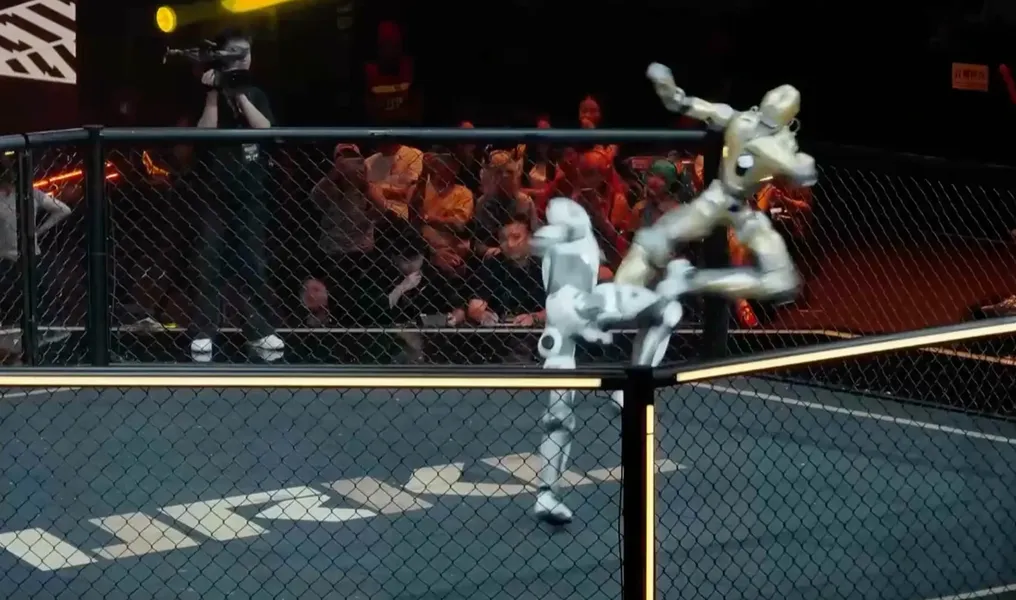
AI-powered humanoid cage matches in Shanghai spotlight public demos and regulatory questions
Published by AINave Editorial • Reviewed by Ramit
AI-powered humanoid robots went head to head in a steel cage match in Shanghai as part of the Ultimate Robot Knock-out Legend (URKL) league, according to Al Jazeera. The event featured autonomous or semi-autonomous machines competing in a regulated arena, showcasing recent progress in robotic actuation, perception, and control. For builders and operators working on humanoid robots, this public demonstration signals growing real-world stress testing and may influence how safety and regulation discussions evolve.
URKL cage match: a public test for autonomous humanoids
The Ultimate Robot Knock-out Legend league hosted the match in Shanghai, with robots operating under varying levels of autonomy. The contest was held within a secured arena, hinting at an effort to contain potential hazards. No specific participant models, technical specifications, or match results were disclosed in the available report, making it difficult to assess the exact capabilities on display.
What a robot cage match signals about the industry
Public cage matches serve as a visible benchmark for robot durability and control under duress. Similar demonstrations at other events have been described as stress tests to prove robots can take a hit and keep working in commercial environments. For builders, this suggests that actuation and impact tolerance are becoming design priorities. At the same time, the spectacle draws attention to unresolved questions around autonomous operation in unpredictable settings, which directly affects deployment planning for factories, warehouses, and public spaces.
Stress tests and scaling challenges
The Shanghai event complements broader industry efforts to move humanoids beyond choreographed demos. Reuters reports that government funding and manufacturing investment are racing ahead of robots' ability to operate without pre-scripted routines. Cage matches accelerate that push by forcing robots to react to real-time physical interactions. However, scaling these machines to reliable commercial use still faces hurdles in battery life, safety validation, and control robustness, as noted by IEEE Spectrum. The URKL match provides another data point for teams evaluating how quickly those gaps are closing.
What the report doesn't tell us
The available coverage lacks details on the specific robots involved, their autonomy levels, sensor suites, or control architectures. No dates, participant rosters, or match outcomes are given. Without technical specifics, the event's value as a reference for builders is limited. It confirms that humanoid combat competitions are happening, but it does not provide enough data to draw concrete takeaways about hardware readiness or software maturity.
Builders should view this as a signal that the industry is rapidly iterating on durability and real-time decision making, but should wait for more transparent technical reports before integrating any specific platform based on such events.
FAQs
Sources
- Humanoid robots fight in cage match in Shanghai
- Humanoid robot - Wikipedia
- Humanoid robots fight in cage match in Shanghai - YouTube
- Humanoid robots fight in cage match in Shanghai
- Brutal Humanoid Robot Cage Match Stops Abruptly When One of the...
- China can build kung fu-fighting robots. But it can’t get them to do factory work
- China's humanoid robots are learning to fight. Developer says robot soldiers are only 5 to 10 years away.
- Humanoid robots fight in cage match in Shanghai – Sciencx
- Advertising Robots Ffighting | TikTok
- Humanoid Robots: The Scaling Challenge - IEEE Spectrum
- Shares in Chinese Humanoid Robot Maker Unitree Soar in Its Shanghai Trading Debut
- World’s top humanoid robot maker surges in blockbuster market debut in China
- Shares in Chinese humanoid robot maker Unitree soar in its Shanghai trading debut
- Humanoid robots fight in cage match in Shanghai | Alto
- Humanoid robots fight in cage match in Shanghai