Optical Memory for AI Accelerators: A Light-Based Approach to Updating Model Parameters
Published by AINave Editorial • Reviewed by Ramit
Cornell Tech researchers have demonstrated a prototype optical receiver that can update AI model parameters stored in DRAM by beaming light directly onto photodiode-equipped SRAM cells, bypassing traditional analog-to-digital conversion. The approach targets the memory bottleneck in AI accelerators by using digital optical communication to move data with potentially lower energy than metal interconnects. But the current proof-of-concept is far from production, with significant density and speed limitations that builders should understand before betting on this path.
What happened
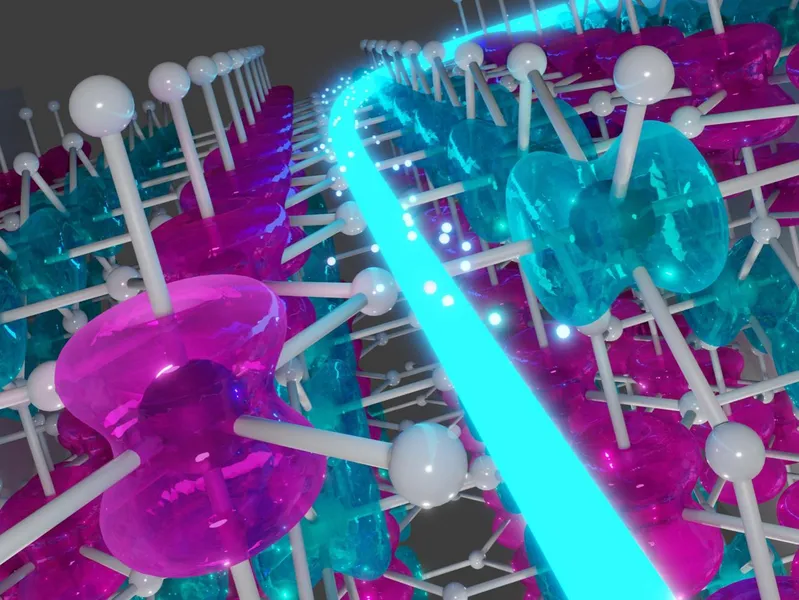
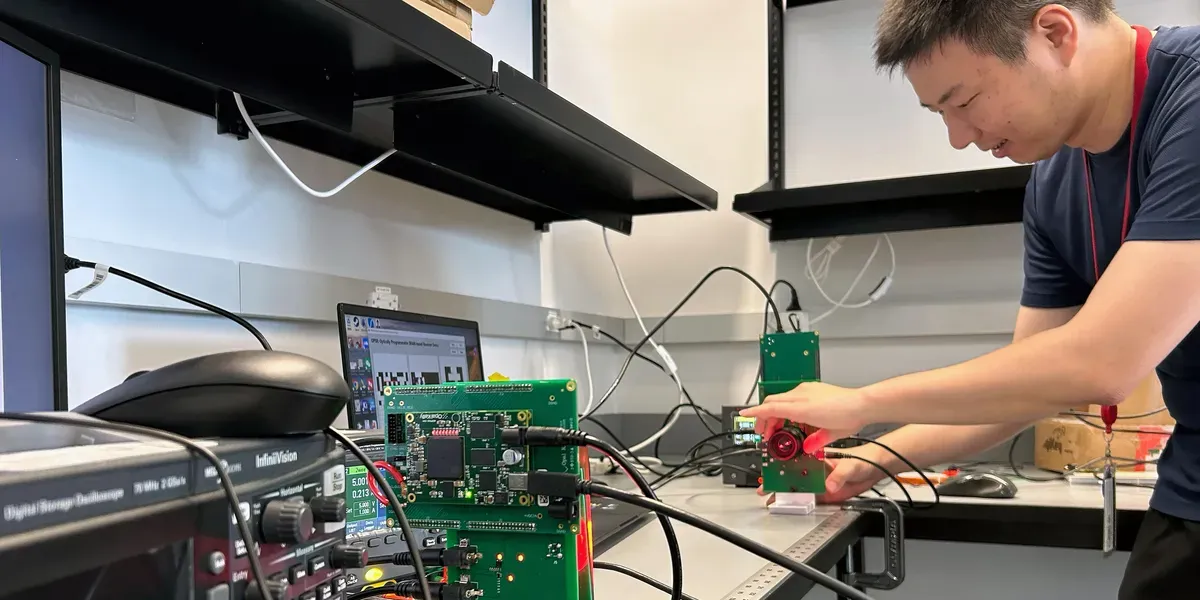
Postdoctoral researcher Yifan He and associate professor Jae-sun Seo presented their optical receiver design at the IEEE/JSAP Symposium on VLSI Technology & Circuits. The system uses a transmitter that beams a rapid sequence of QR-code-like 14x14-bit matrices to SRAM cells modified with photodiodes. Light hitting each photodiode creates a current that flips binary values in the SRAM, directly altering memory without the power-hungry analog circuits typical of optical receivers. A calibration circuit compensates for imperfect alignment between the transmitter and receiver.
Why AI builders should care
The memory bottleneck in AI accelerators is a well-known pain point. Processors have limited on-chip SRAM, so model parameters are stored in DRAM and moved over electrical links that consume significant energy. Optical links can carry data at high bandwidth with less energy loss than metal wires, but conventional optical receivers waste that advantage by requiring analog conversion. This fully digital approach could reduce energy for in-situ model updates, which matters for edge AI and robotics deployments where power budgets are tight.
Practical implications
The researchers plan to shrink the photodiode bit cells through transistor and circuit optimization and CMOS scaling to improve memory density. They are also working with optics groups to build a transmitter capable of updating the light matrix millions of times per second, targeting gigabit-per-second data transfer. Potential applications include AI-enabled warehouses where robots receive model updates via light, and microrobots that are too small for conventional memory architectures.
Caveats
The current hardware is a proof-of-concept with major limitations. The transmitter emits a static 14x14-bit matrix rather than rapidly changing data. The photodiode cells are larger than standard SRAM cells, reducing memory density. Dennis Sylvester, an IEEE Fellow at the University of Michigan, noted that the technology is likely far from commercialization because the larger cells could cancel out the efficiency gains. Achieving real-world deployment requires substantial improvements in update rates, density, and integration with existing chip architectures.