Altermagnetism Wins Europhysics Prize: What It Means for AI Hardware
Published by AINave Editorial • Reviewed by Ramit
The European Physical Society awarded its 2026 Europhysics Prize for Outstanding Achievement in Condensed Matter Physics to Libor Šmejkal, Jairo Sinova, and Tomas Jungwirth for discovering altermagnetism, a third fundamental class of magnetism. The prize ceremony takes place on September 22, 2026, at CMD32 in Graz, Austria. The discovery overturns the 120-year-old two-class taxonomy of magnetic materials and points toward a new generation of spintronic memory that could reshape AI hardware.
What happened
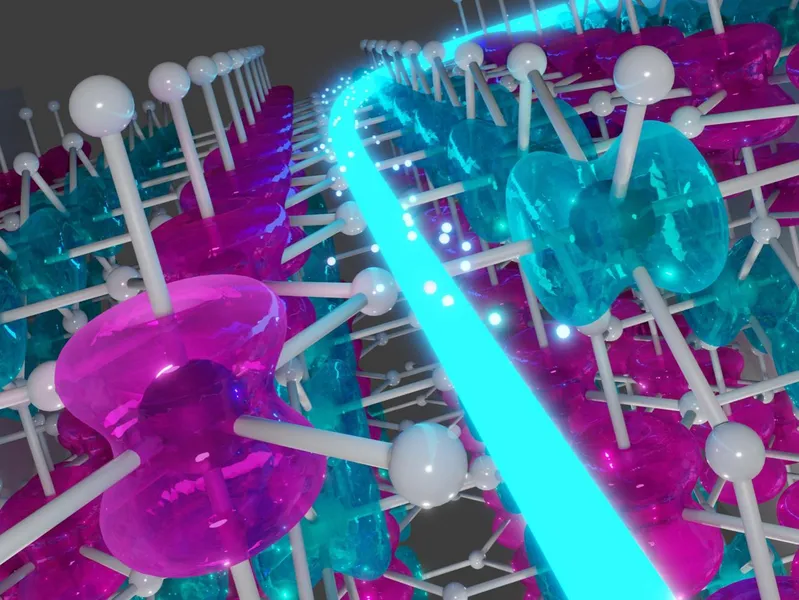
Altermagnetism is a magnetic phase where opposing spin sublattices are connected by rotation or mirror symmetry, not by inversion or translation as in conventional antiferromagnets. This subtle crystallographic difference produces strongly spin-polarized electronic bands in materials with zero net magnetization. The effect arises from non-relativistic exchange interactions, meaning it can appear in light-element, room-temperature materials.
Two materials have been confirmed by independent experimental teams: manganese telluride (MnTe) and chromium antimonide (CrSb). Direct observations of the characteristic d-wave spin splitting were published in February 2024 using angle-resolved photoemission spectroscopy at the Swiss Light Source, followed by nanoscale imaging in December 2024 from the University of Nottingham. The prize citation notes over 200 theoretical candidate materials identified through symmetry-based classification, though most await experimental validation.
Why AI builders should care
Modern AI data centers are constrained by memory bandwidth and energy per operation. Altermagnets combine two properties that conventional magnetic materials cannot deliver together: zero stray magnetic fields (enabling dense packing without crosstalk) and strongly spin-polarized currents (enabling efficient read/write operations). They operate naturally at terahertz frequencies, orders of magnitude faster than the gigahertz dynamics of ferromagnets.
Spintronic memory based on ferromagnets (STT-MRAM) is already entering commercial production on advanced microprocessor chips. A July 2026 review in Nature Physics explicitly positions altermagnetic spintronics as the next evolutionary step from STT-MRAM. For builders shipping AI inference and training infrastructure, a memory technology that is non-volatile, terahertz-fast, and free of magnetic cross-talk would represent a generational shift from today's DRAM and NAND flash.
Practical implications
The physics pathway is clear, but the engineering gap is significant. Confirmed altermagnets MnTe and CrSb have validated spin-split band structures, but they are not yet optimized for semiconductor fabrication. The 200+ theoretical candidates include many that may prove unstable at room temperature or difficult to process at scale. The cautionary case of ruthenium dioxide (RuO₂) illustrates the challenge: multiple independent studies found no magnetic order in pristine bulk RuO₂, with apparent altermagnetic signals in thin films attributed to strain or surface effects.
Researchers across the US, Europe, Japan, and Asia are actively working on materials validation. The commercial timeline depends on which candidate materials can be confirmed as room-temperature, bulk-stable altermagnets and then integrated with existing semiconductor processes. This is an open question, not a near-term product roadmap.
Caveats
- RuO₂ has been largely ruled out as an intrinsic bulk altermagnet. Reported signals in thin films likely arise from epitaxial strain or surface ferrimagnetism, not bulk altermagnetism.
- The 200+ predicted candidates are theoretical; most have not been experimentally demonstrated.
- Commercial-scale altermagnetic memory requires materials that are stable, manufacturable, and compatible with semiconductor fabrication at room temperature. That work is ongoing.
- The Europhysics Prize has historically preceded Nobel Prizes, but that does not guarantee rapid commercial deployment.
FAQs
Sources
- Third Form of Magnetism Earns Europe's Top Physics Prize: Could Reshape AI Hardware
- Prize honors discovery of altermagnetism as a third fundamental class...
- All Nobel Prizes 2025 - NobelPrize.org
- Blueprint - AI Hardware Design Tool
- Magnetism and Magnetic Materials | TikTok
- Third form of magnetism earns Europe's top physics prize: Could reshape AI hardware
- All Nobel Prizes in Physics - NobelPrize.org
- Magnetism And Matter | Question Discussion| Class 12 Physics...
- Third form of magnetism earns Europe's top physics prize: Could reshape AI hardware
- Revolution in Physics: Scientists Unveil Third Form of Magnetism...
- Third form of magnetism earns Europe's top physics prize: Could reshape AI hardware
- 2026 Europhysics Prize honors discovery of altermagnetism as a third fundamental class of magnetism