Gemma 4 Good Challenge Winners Show Private-by-Design Offline AI in Action
Published by AINave Editorial • Reviewed by Ramit
Google announced the winners of the Gemma 4 Good Challenge on August 24, 2026, and the results are a practical blueprint for anyone building AI that must work offline and respect data privacy. Fourteen winning projects, selected from over 1,600 entries, demonstrate that Gemma 4 models running on Raspberry Pi 5, budget laptops, and mid-range Android phones can handle real-world tasks from flood early warning to cancer vaccine design. The key takeaway for builders: private-by-design, edge-first AI is no longer theoretical.
Fourteen offline AI projects that work in the real world
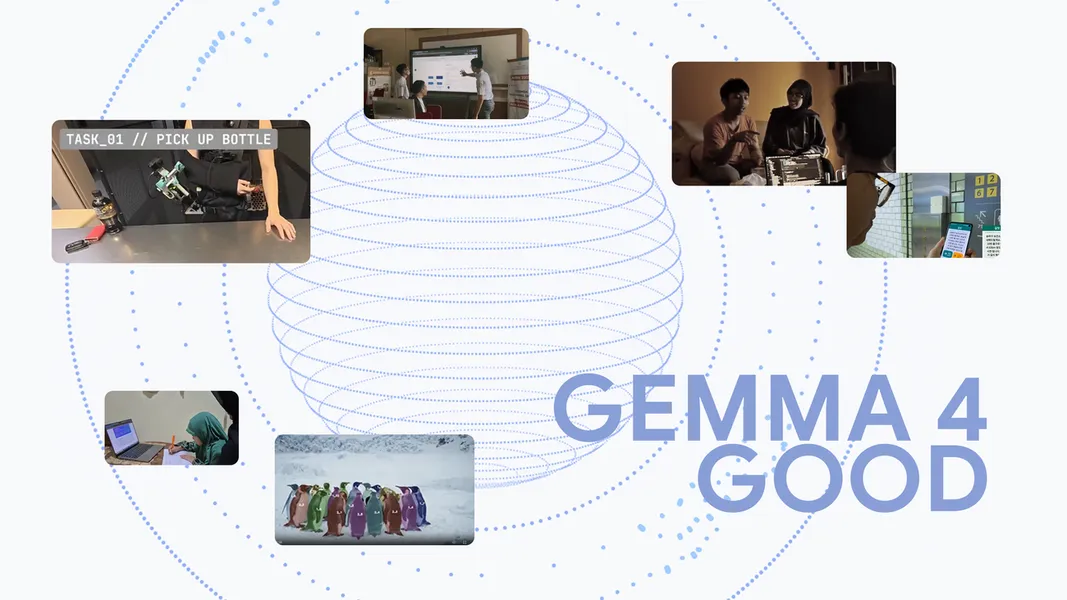
The Gemma 4 Good Challenge was a Kaggle competition asking participants to build solutions for real-world problems using Gemma 4 models. The winners span an impressive range of domains:
- GEM-4 uses a Vision-Language-Action architecture to physically assist elderly and disabled individuals via a robotic arm controlled by a fine-tuned Gemma 4 E2B model.
- Trido turns a voice-controlled digital whiteboard into an offline classroom tool, generating mind maps and quizzes with a locally hosted Gemma 4 E2B.
- PreVillage helps rural Nepali citizens navigate government services through a voice-first WhatsApp interface backed by a self-healing RAG loop on a Raspberry Pi 5, running at 7.5 tokens/sec.
- TrueVoice detects voice-cloning scams at the edge by analyzing vocal anomalies with Gemma 4 E4B's audio capabilities.
- Gem-Care fine-tuned Gemma 4 E2B to recognize non-normative speech, reducing word error rate from 32.7% to 19.0%.
Other winners include PenguinAgent (offline wildlife data analysis), DEMENTOR (dementia care with edge cameras), Acuífero Vigía (flood early warning), CodeBuddy (offline Python tutoring for Indonesian students), Project Rosie (canine neoantigen vaccine design), Gilbeot (on-device walking navigation), PathOS (histopathology screening), MindBridge (Hindi-dialect psychiatric evaluation), and KawanIsyarat (sign language translation on mid-range Android). All run entirely offline.
Why edge AI with Gemma 4 is now a practical option
For AI builders, these projects prove that the toolchain around Gemma 4 is production-ready. Participants used LiteRT, Cactus, Ollama, llama.cpp, and Unsloth to deploy models ranging from Gemma 4 E2B (roughly 2B) to 31B on constrained hardware. The Gemma 4 12B developer guide confirms that multimodal inference is possible on a 16GB laptop using the first encoder-free architecture in the Gemma family. This eliminates API costs and latency, and keeps sensitive user data on the device.
Several projects highlight architectural innovations worth studying. KawanIsyarat uses memory-aware model routing that dynamically loads and unloads Whisper to preserve VRAM for Gemma. PreVillage's self-healing RAG loop restarts automatically when the database changes. Project Rosie employs deterministic templates for vaccine manufacturing specs to avoid hallucination. These patterns are directly reusable.
What builders can learn from these deployments
The challenge demonstrates that offline AI can address underserved markets: education in no-connectivity schools, healthcare in rural clinics, and public service access for populations without reliable internet. The Gemma 4 safety page emphasizes that on-device execution simplifies data governance. For builders, the immediate opportunity is in assistive technology, field research tools, and privacy-critical workflows where existing cloud-dependent solutions fall short.
What to keep in mind before building on these examples
All project descriptions come from Google's announcement and have not been independently verified by AINave. Performance claims like Gem-Care's WER improvement are judge-reported and may vary with different hardware or datasets. Deployments in regulated sectors like healthcare and public administration require additional validation. The challenge is a strong proof of concept, but production hardening, cost of fine-tuning, and long-term maintenance remain open questions for each specific use case.
The Gemma 4 Good Challenge offers a concrete inspiration catalogue. The models and inference stacks are ready; the remaining work is in application design for environments where the cloud is not an option.
FAQs
Sources
- How developers build AI for good with Gemma 4
- From Cloud to Local AI: What Google Gemma 4 Means for Developers
- Welcome Gemma 4: Frontier multimodal intelligence on device
- Gemma 4 is a family of open models, purpose-built for advanced...
- Gemma 4 — Google DeepMind
- Gemma 4 and Qwen 3.6 aren't competing—they're solving completely different probl...
- Ornith Is the Open-Source Coding Model Built for Agents, Not Humans
- This New Open-Weight AI Model Is Built for Video and Robots
- Setting up OpenClaw isn’t as straightforward as the internet wants you to think ...
- Open Source AI Is Moving From Sideshow To Strategy
- Gemma 4 12B: The Developer Guide - Google Developers Blog
- How to Run Google Gemma 4 on Ollama in 2026: Complete Local AI...
- Google unveils Gemma 4, expands lightweight open model lineup for developers
- Google launches Gemma 4 open AI model, it can run on your smartphone
- Google Gemma 4 12B Brings Multimodal AI to 16GB Laptops, Free Under Apache 2.0