CRYPTO 2026 cryptography conference tests post-quantum standards and AI model security
Published by AINave Editorial • Reviewed by Ramit
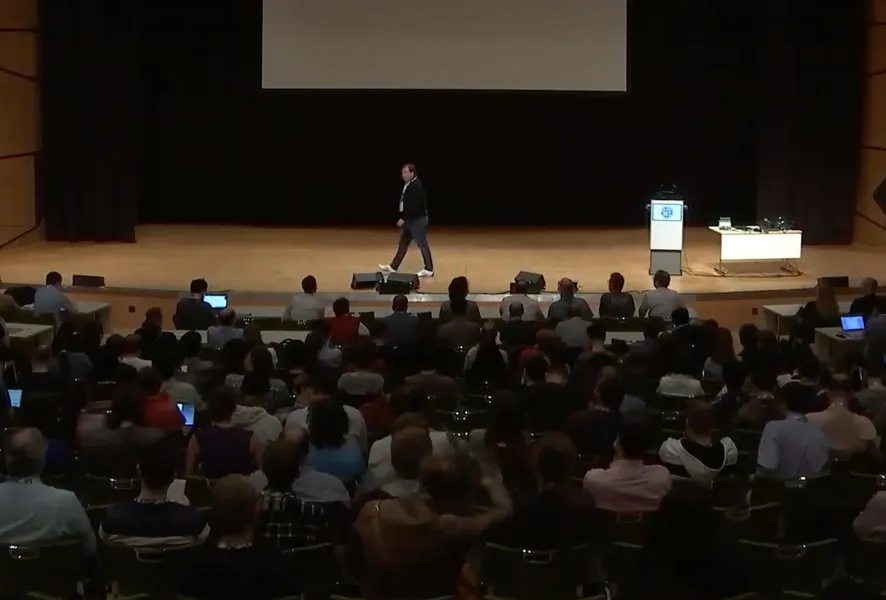
CRYPTO 2026, the 46th International Cryptology Conference, opens today at UC Santa Barbara as the first major cryptology gathering since NIST finalized its post-quantum cryptography standards in August 2024. The program features 189 accepted papers across ten Springer LNCS volumes, a record in the conference's history, signaling urgent demand to stress-test the lattice mathematics now running on billions of devices.
A new track treats AI models as attack targets
For the first time, CRYPTO includes dedicated sessions on neural network cryptanalysis and machine learning. This goes beyond using neural networks as attack tools against cryptographic algorithms. The new papers apply formal cryptanalytic methods to neural network architectures themselves, treating a trained model as a mathematical object with exploitable internal structure. Topics include algebraic attacks on convolutional networks and cryptanalytic extraction of deep neural network weights from input-output behavior alone.
For AI builders, this is directly actionable. Model extraction attacks represent an intellectual property threat that previously lacked a formal threat framework. The conference also includes a paper on cryptographically robust watermarks for language models, aiming to give AI provenance the same mathematical guarantees as digital signatures.
Post-quantum standards under the microscope
Volume III of the proceedings contains nine cryptanalysis papers targeting NIST's ML-KEM, ML-DSA, and SLH-DSA standards. Key results include an improved quantum algorithm for 3-tuple lattice sieving (affecting NTRU and LWE-based schemes) and a concrete hardness gap analysis between standard LWE and the module variant used in ML-KEM. Another paper introduces a technique for lattice signature key recovery with direct implications for Falcon (FN-DSA). Engineers who chose key sizes based on NIST's published security levels should monitor these findings.
Zero-knowledge and homomorphic encryption reach production
Zero-knowledge proofs now underpin layer-2 blockchain scaling systems handling billions of dollars. Volume IX of the proceedings is the largest single-subject block with 20 papers on zero-knowledge proofs and succinct proof systems. Soundness bugs found at this conference are not academic; they are vulnerabilities in deployed financial infrastructure.
Fully homomorphic encryption (FHE) is also crossing the practicality threshold. GPU acceleration on H100-class hardware has reduced TFHE bootstrapping to under a millisecond. Two papers from Craig Gentry and collaborators target FHE for matrix arithmetic, the dominant operation in transformer neural networks, pointing toward privacy-preserving AI inference.
Caveats and what remains unclear
These results are conference program highlights based on accepted papers, not verified operational findings. Many claims depend on specific hardware implementations or theoretical assumptions that may not translate directly to production environments. The neural network cryptanalysis track is new, and its practical impact on deployed AI systems will depend on how well the formal methods generalize to real-world model architectures and training pipelines.
What this means for builders
The message is clear: production cryptography is now an active stress test field, and AI models are part of the security perimeter. Teams deploying post-quantum cryptography should follow the lattice sieving and hardness gap results. Teams shipping proprietary models should treat formal model extraction attacks as a realistic threat and evaluate countermeasures like cryptographically robust watermarking. Privacy-preserving AI workloads should track FHE advances for matrix operations, as the latency barriers are falling. CRYPTO 2026 is setting the security agenda for the next cycle of infrastructure.
FAQs
Sources
- CRYPTO 2026 Opens Today: AI Systems Are Now Both Tool and Target of Math Attacks
- The Block: Bitcoin, Ethereum & Crypto News | Live Prices, Data...
- Top 10 Crypto Wallets for Q4 2025: Final Rankings Before 2026
- Карта RedotPay — как оформить и получить в России в 2026 году
- Лучшие биржи с бонусами за регистрацию 2026
- Crypto 2026 opens today: AI systems are now both tool and target of math attacks
- Nvidia launch sends quantum stock surging 251%, mints billionaire
- CRYPTO 2026 Opens Today: AI Systems Are Now Both Tool and ...
- NewsLayer on X: " BREAKING: CRYPTO 2026 Opens Today: AI ...
- AI-Assisted Crypto Attacks Spur Bitcoin Sector to Demand ...
- AI-Driven Attacks Fuel Major Crypto Thefts in 2026 - OECD.AI
- Crypto 2026 opens today: AI systems are now both tool and target of math attacks