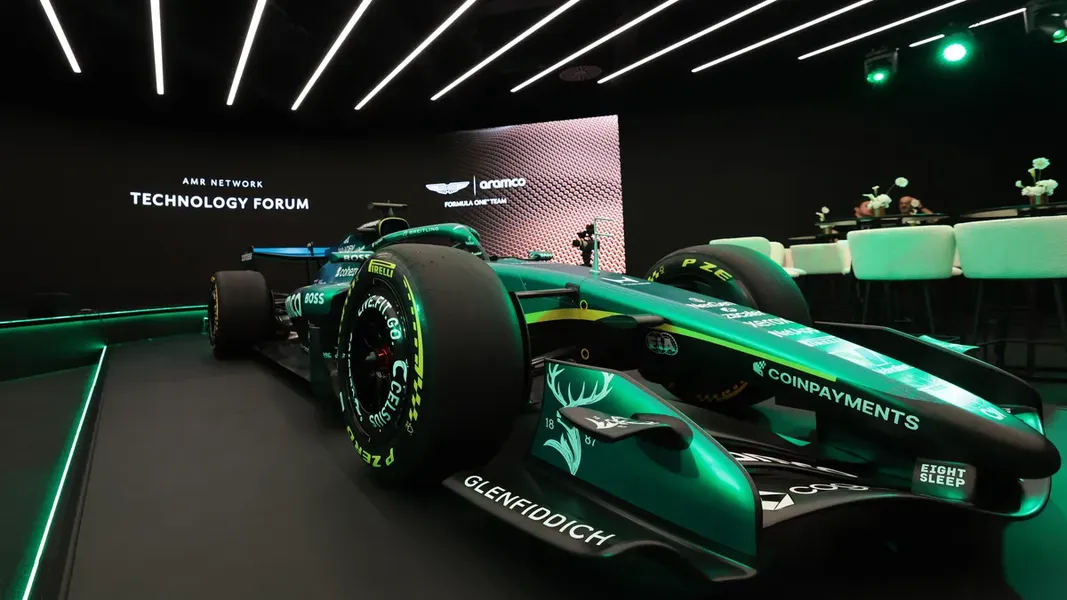
AI in Formula One: The Human-in-the-Loop Edge
Published by AINave Editorial • Reviewed by Ramit
AI in Formula One is being used at Aston Martin Aramco F1 to shorten the path from engineering questions to usable data and faster decisions. The team is exploring AI agents, secure models, and trackside workflows across telemetry data, diagnostics data, and simulation data, but the important constraint is clear: experienced engineers still decide what the output means and what to do next. The team’s approach combines AI assistance with human judgment.
Aston Martin Aramco F1 is treating IT as a performance function
Fabrizio Pilotti, the team’s CIO, describes IT as a way to increase engineers’ operating capability rather than as a department directly designing the car. That means improving fault management, data access, enterprise applications, and trackside systems so specialists can iterate more quickly.
The target is seamless access. For a task such as rear wing design, engineers should be able to obtain the resources they need in the right format and level of detail without waiting months for a new system. The broader direction includes ERP-level improvements and modular infrastructure that can adapt to changing data requirements. Aston Martin Aramco F1 is pursuing this model of flexible, engineer-focused data access.
Secure deployment matters as much as model capability
The team is working with Cohere to explore sovereign AI models and agent-based workflows that can operate within its infrastructure. In this context, the value is not simply asking a general-purpose model to summarize data. It is creating controlled systems that can draw timely insights from sensitive telemetry, diagnostics, and simulation data without requiring trade secrets to leave the team’s environment.
For AI builders, this is a deployment lesson. Firewall-protected AI, data governance, access controls, and token management can determine whether a useful workflow is allowed into production. A model that performs well in a public demo is not automatically suitable for an engineering environment where proprietary data, latency, and operational reliability matter.
The human-in-the-loop is the actual advantage
AI agents are being applied tactically, including in software development and optimization work. They can automate routine analysis, surface patterns, and reduce the time spent moving information between systems. They do not remove the need for the person who understands the vehicle, the assumptions behind the data, and the trade-offs between competing design options.
That distinction is visible in the team’s emphasis on craftsmanship. Adrian Newey’s hands-on design work illustrates why automation does not eliminate domain expertise in a marginal-gains business. AI can expand the number of options an engineer can evaluate, but it cannot independently supply the team’s accumulated judgment or decide which compromise is best.
What builders should take from the F1 workflow
The strongest pattern is a tight feedback loop: identify a problem, use secure systems to gather relevant data, generate options quickly, and return the decision to an expert. This is more useful than treating an AI agent as an autonomous replacement for an engineering team.
Teams building AI products should therefore start with the workflow and its decision owner. Define which data the system can access, what actions it may take, when a human must review an output, and how the result feeds the next iteration. The Aston Martin example is also specific to one team and its partners, so it does not prove that every organization needs sovereign models or that agentic systems will produce measurable performance gains everywhere.
The practical decision rule is simple: deploy AI where it removes waiting and repetitive work, then keep accountability with the person who can distinguish a useful signal from a misleading one. In Formula One, speed comes from the complete loop, not from the model alone.
Sources
- AI in Formula One: Competitive advantage is all about the human in the loop
- AI In Formula One: How Teams Use Machine Learning To Win
- F1’s Human-AI Edge - Lessons for Every Industry - I by IMD
- How AI Is Redefining Engineering In Formula One And Beyond
- In the Driver’s Seat: How AI Is Steering Formula 1 Into The ...
- Your Competitive Advantage Isn't AI, It's Relationships
- F1: AI ENTERS Formula 1 — but the real shift is decision control
- How Oracle Red Bull Racing is driving Formula 1 into the future with cloud, AI and data | Computer Weekly
- How Formula 1 uses AI (& why it matters to you).
- Can Formula 1 embrace AI without losing its soul? - Fast Company