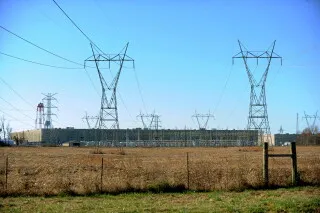
Paducah AI data center: DOE turns Kentucky uranium plant into $100B gas-powered campus
Published by AINave Editorial • Reviewed by Ramit
The U.S. Department of Energy has selected Brookfield Asset Management to develop a $100 billion AI data center complex at the former Paducah Gaseous Diffusion Plant in Kentucky, pairing a 1.8 GW AI campus with 2 GW of natural gas generation and 2.6 GW of battery storage. For AI builders, this project signals a new model for large-scale infrastructure: private-equity-backed, on-site power, and repurposed federal land.
What happened
The DOE chose Brookfield Asset Management to develop and operate the data center at the government-owned Paducah Gaseous Diffusion Plant, a Cold War-era uranium enrichment site that shut down in 2013. NextEra Energy will build and own the power generation components, including 2 GW of natural gas-fired generation, transmission upgrades, and 2.6 GW of battery energy storage to support a new 1.8 GW AI data center campus. Construction is targeted for completion by 2031. The project is part of a broader push to convert former DOE sites into AI infrastructure, following similar plans at the Portsmouth Gaseous Diffusion Plant in Ohio and the Savannah River Site in South Carolina.
Why AI builders should care
This project illustrates a private-equity-driven approach to building AI infrastructure at a scale that few companies can match on their own. Brookfield, which manages over $1 trillion in assets, estimates that 30% of the $100 billion investment goes to construction and power components, with the rest spent on servers, routers, and semiconductor chips. For AI builders, this means a new source of colocation capacity in a region with dedicated power and transmission, potentially lowering the cost and complexity of training and inference workloads. The project also signals that the federal government is willing to repurpose contaminated federal land for AI data centers, which could open up more rural sites for similar developments.
Practical implications
The energy complex is designed to be largely self-sufficient. The 2 GW gas plant would be the largest in Kentucky, and the 2.6 GW battery storage provides buffer for intermittent renewable integration or peak demand. Excess electricity could flow to the regional grid, but a power service agreement must be approved by state utility regulators. Discussions are ongoing with commercial partners to use the data center space. The project also highlights the tension between AI infrastructure growth and environmental concerns. Local groups like Protect McCracken County and the Kentucky Resources Council warn about climate emissions, groundwater contamination from the site's legacy pollution, and the risk that ratepayers could subsidize the power plants. They are urging independent impact studies and careful permitting.
Caveats
The project is still in early stages. Cleanup at the Paducah site is projected to cost about $17 billion through 2065, and the DOE is still working on plans to manage uranium waste stored there. Regulatory approvals from state utility regulators and environmental reviews could delay or alter the scope. The DOE has not disclosed which commercial partners will use the data center space. Environmental groups have raised concerns that the department might try to circumvent permitting processes. AI builders should watch for updates on power pricing, grid interconnection terms, and the final timeline before committing to capacity at this site.
FAQs
Sources
- Federal government to turn a Kentucky uranium plant into an AI data center and gas power complex
- Federal government to turn Kentucky uranium plant into AI data center, gas complex - ABC News
- Federal government to turn a Kentucky uranium plant into an AI data center and gas power complex
- Federal government to turn a Kentucky uranium plant into an AI data center and gas power complex - The Washington Post
- Federal government to turn a Kentucky uranium plant into an AI data center and gas power complex
- Kentucky uranium enrichment site is being transformed into AI campus with gas power - ChinaTechNews.com
- Federal government to turn a Kentucky uranium plant into an AI data center and gas power complex
- Trump is turning old nuclear weapon sites into land for data centers
- Trump Administration Is Repurposing Federal Land for A.I. Data Centers
- Paducah lands $100B AI data center project, one of Kentucky's largest investments
- Federal government to turn western Kentucky uranium plant into AI data center and gas power complex
- Federal government to turn a Kentucky uranium plant into an AI...
- US Department of Energy turns Cold War uranium plant into AI data...
- Kentucky AI Center Trending #90 - Break The Web
- US To Build $100 Billion AI Data Centre At Former Kentucky...
- Former Kentucky nuclear site to become AI data center - Overview