Crusoe and Aalo Plan a Nuclear-Powered AI Data Center Test at INL
Published by AINave Editorial • Reviewed by Ramit
Crusoe and Aalo Atomics are planning a 2027 demonstration at Idaho National Laboratory that would run a nuclear-powered AI data center on a sodium-cooled microreactor system. For AI builders, the important question is not simply whether the reactor can generate electricity. It is whether steady nuclear output can support GPU workloads whose power demand changes quickly.
Aalo-X clears the physics milestone, but not the commercial test
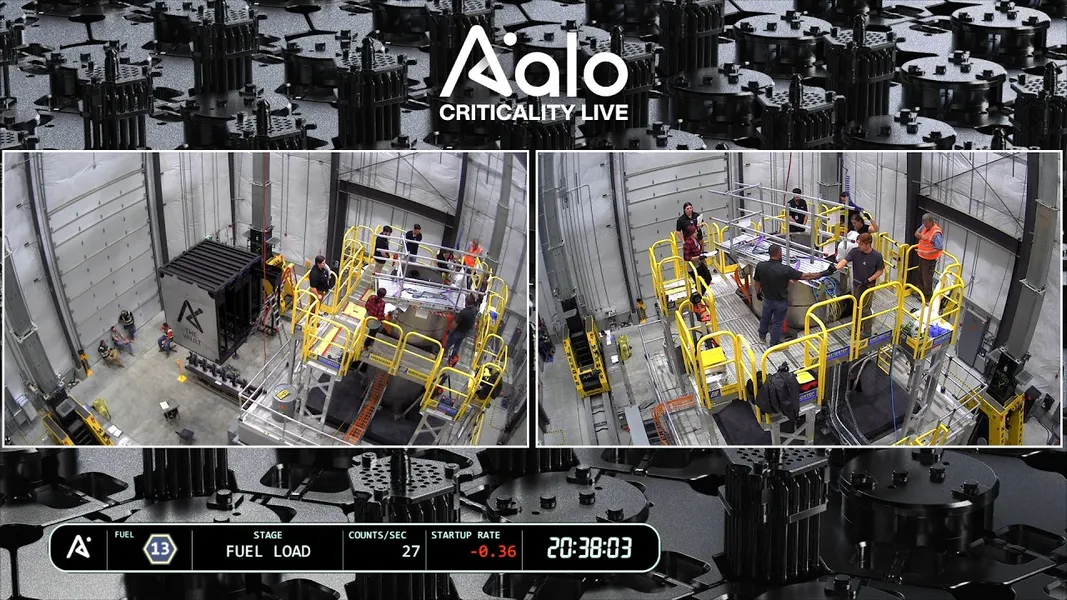
Aalo-X Critical Test Reactor achieved criticality on July 4, 2026. Criticality means the fission chain reaction became self-sustaining and controllable. That validates an important part of the reactor design, but Aalo-X is a zero-power test reactor, so the milestone does not yet demonstrate commercial electricity generation.
The next steps include full-power operation and the planned 2027 INL demonstration. The proposed Crusoe Spark facility would run GPU hardware and produce operational data on how nuclear generation behaves under real inference and training workloads.
The 50 MWe Pod is designed around modularity
Aalo's proposed Pod combines five 10 MWe sodium-cooled reactors with a single turbine. The system is designed to operate at near-atmospheric pressure, use air cooling, and fit on a 2.5-acre site. Aalo says deployment would use 30 prefabricated containers, with a target delivery time of 12 months. These are company design and schedule claims, not independently validated results.
The sodium-cooled reactor architecture is intended to simplify siting and manufacturing. Liquid sodium transfers heat efficiently without the high pressure used by conventional water-cooled reactors. The proposed system also uses passive cooling features and does not require an external water source, which could matter for AI infrastructure in arid locations.
The Pod includes N+1 redundancy: four reactors are intended to maintain the stated output while one is offline. Aalo projects 98% availability for one Pod and 99.9% with redundant turbines, but those figures still require operational validation.
The real test is GPU power variability
Nuclear plants generally provide steady baseload power. Large GPU clusters do not always draw power steadily. Compute and communication phases can create rapid facility-level changes, leaving a mismatch between reactor output and data center demand.
The INL test will examine whether existing data-center batteries and UPS systems can absorb that mismatch. If they can, nuclear co-location may offer AI operators a stable on-site power source with less exposure to grid interconnection delays and renewable curtailment. If they cannot, operators may need additional storage or co-generation, increasing system complexity and cost.
This is why the demonstration matters more than the criticality headline. It should generate an empirical dataset for infrastructure teams deciding how much buffering, power conditioning, and redundancy their AI factory requires.
Deployment still depends on regulation
Aalo and Crusoe have announced a goal of deploying Pods and 50 MWe XMR plants across Crusoe's portfolio by 2029. That target depends on full-power validation, manufacturing scale-up, and NRC authorization, which is required before deployment beyond a DOE test site. Aalo's roadmap also includes Project Ascension and a non-nuclear sodium prototype for testing heat transport and related systems.
For builders, the decision rule is straightforward: treat this as a power-delivery experiment, not an available deployment option. The 2027 results will show whether the nuclear system can match AI workloads in practice. Until then, availability projections, delivery timelines, and the 2029 rollout remain plans rather
Sources
- Nuclear Microreactor Clears Criticality: Crusoe Plans AI Factory Data Center Test
- Crusoe partners with Aalo on nuclear-powered AI data center deployment at Idaho National Lab - DCD
- World’s First Nuclear-powered Data Center Moves Forward as Crusoe Partners with Aalo at the INL
- 'World's first' nuclear-powered AI factory to be built with new partnership
- Aalo, Crusoe Plan 2027 INL Demonstration Pairing Nuclear Power and AI Data Center Load
- Crusoe and Aalo Atomics Form Strategic Partnership with Goal of Deploying First Nuclear-Powered AI Factory
- Valar nuclear startup partners with Nvidia on data center aiming to conserve water
- Valar nuclear startup partners with Nvidia on data center aiming to conserve water
- US lab's Ziacore nuclear microreactor passes zero-power criticality...
- Inside the Next-Gen Nuclear Power Revolution in Idaho’s High Desert
- Valar nuclear startup partners with Nvidia on data center aiming to conserve water
- Three US Microreactors Hit Criticality by July 4 Deadline
- United States Department of Energy tests microreactors - Overview
- Startup unveils 3D-printed nuclear reactor module to power AI data centers
- Criticality for fourth US microreactor to meet 4 July deadline