SBS Transit's FlowOS AI co-pilot tackles bus bunching with human-in-the-loop design
Published by AINave Editorial • Reviewed by Ramit
SBS Transit is trialing an AI co-pilot called FlowOS to reduce bus bunching on its services, with a phased rollout that will cover the entire fleet by the second quarter of 2027. The system combines historical patterns with live bus location data to alert service controllers and suggest actions, but the final decision stays with the human operator.
What FlowOS does and when it ships
FlowOS is currently being tested on Routes 70 and 145. The trial will expand to seven more routes before wrapping up in March 2027, after which SBS Transit plans to deploy the tool across its entire bus fleet in the second quarter of 2027.
The system pulls in historical data, such as observable patterns across different days and times, and combines it with live information like each bus's current location. When two buses on the same route get too close, FlowOS alerts the service controller and suggests corrective steps, such as slowing a bus down or holding it at an interchange.
SBS Transit group chief executive Jeffrey Sim said the tool is meant to help service controllers make better-informed decisions in dynamic road conditions. Ong Jack Sen, head of operations control and support, noted that feedback from controllers indicated it was "cognitively challenging to monitor so many buses."
Why this matters for AI builders
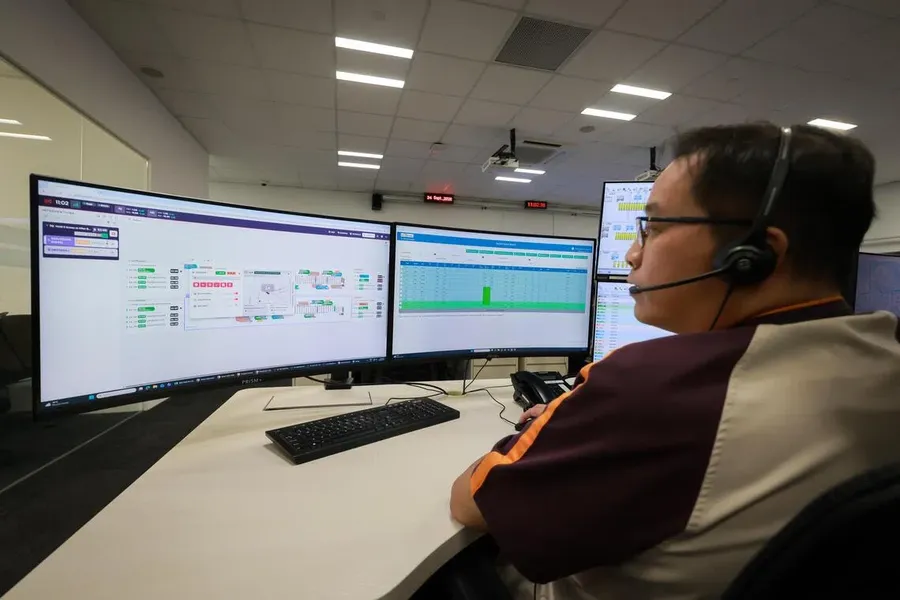
FlowOS is a textbook human-in-the-loop AI application. The service controller retains final authority and can accept, modify, or reject any recommendation. Senior controller Calvin Chan, who oversees 60 to 80 buses across five routes, said he sometimes overrides the algorithm's suggestion, for instance reducing a recommended four-minute slowdown to two minutes based on his instinct.
For builders working on operational AI, this case highlights several practical patterns:
- Reducing cognitive load without removing human judgment. FlowOS automatically identifies buses needing attention and lists them on the left of the screen, eliminating the need for constant manual scanning. The controller still decides the exact response.
- Phased rollout as a risk management strategy. Starting with two routes, expanding to nine, then going fleet-wide after a trial period ending in March 2027 gives time to validate the model and build operator trust.
- Integration with existing command centers. The system runs at the Operations Control Centre at Seletar Bus Depot, where controllers already monitor live operations. FlowOS adds a recommendation layer rather than replacing the workflow.
How predictive alerting works in practice
FlowOS uses historical and live data to predict when buses are likely to bunch and suggests deployment actions from interchanges. The tool surfaces alerts and recommended actions, and the controller can accept, modify, or reject them before instructing drivers.
Chan said before FlowOS he had to manually scan his screen to check for bunching, and the sheer volume of vehicles meant he sometimes missed buses that needed attention. The AI tool now handles that monitoring, freeing him to focus on communication and judgment calls.
Caveats to keep in mind
The available source is a single news article, so fine details about FlowOS's architecture, training data, model type, and performance metrics are not disclosed. No pricing, benchmark results, or long-term outcome data are available. The system's effectiveness will depend on how well the historical patterns generalize to new routes and how consistently controllers trust and use the recommendations. Operator judgment can and does override the AI, which is by design but means actual impact may vary across shifts and individuals.
For AI builders evaluating similar transit applications, FlowOS is worth watching as a real-world deployment of a human-in-the-loop co-pilot at city scale. The phased rollout and operator autonomy are sensible design choices, but the lack of public performance data makes it hard to assess the model's accuracy or ROI.