Quintessent raises $40M to scale quantum-dot frequency comb lasers for AI data centers
Published by AINave Editorial • Reviewed by Ramit
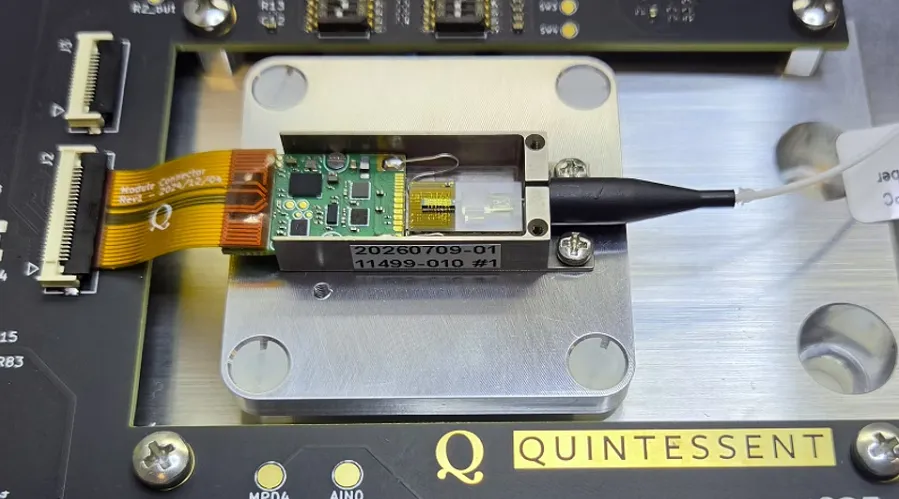
Quintessent, a Santa Barbara startup spun out of UCSB, has raised $40 million in Series A funding to ramp up production of its quantum-dot frequency comb lasers for AI data-center optical interconnects. The company claims its gallium arsenide quantum-dot approach delivers 40% lower power consumption, higher reliability at elevated temperatures, and fewer supporting components than conventional quantum-well lasers. For builders operating large GPU clusters, this kind of optical interconnect improvement directly affects network bandwidth, power budgets, and total cost of ownership.
What Quintessent is building and why it matters for AI clusters
Most data-center network lasers use quantum wells: nanosheets of two materials that generate light. Quintessent replaces them with quantum dots: spherical nanostructures made from a single material, gallium arsenide. Electrons move through gallium arsenide several times faster than through silicon, enabling faster laser pulses and higher switching speeds. The result is a comb laser that generates light at eight wavelengths simultaneously, with the potential to scale to more. Each wavelength can carry a separate data channel, boosting aggregate throughput per fiber.
The company says its comb laser requires fewer supporting components for amplification and voltage regulation, which lowers cost. It also claims the device uses about 40% less power and operates more reliably at high ambient temperatures. In dense AI clusters where heat and power are constant constraints, those improvements matter. The technology builds on research from John Bowers' lab at UCSB and has been in development for over a decade.
The funding and path to productization
The Series A was led by Cycle Capital, with participation from Goldman Sachs, Susquehanna International Group, Osage University Partners, and others. It follows an $11.4 million seed round in 2024. CEO Alan Liu said the company is transitioning from tech development to a product-focused company. The funds will go toward manufacturing ramp and reliability improvements. Future products may include signal amplifiers to improve connection reliability across AI data-center networks.
Quintessent has existing manufacturing partnerships that hint at its supply chain strategy. It has collaborated with IQE for over a decade to transition quantum-dot laser technology to large-scale production. It also achieved the world's first heterogeneous integration of quantum dot lasers in a foundry silicon photonics process with Tower Semiconductor. These relationships suggest Quintessent is building toward volume production rather than staying in the lab.
What this means for AI infrastructure builders
For teams designing or operating AI clusters, optical interconnects are a growing bottleneck. As GPU counts scale into the thousands, the network between accelerators must keep up without consuming disproportionate power or floor space. Quintessent's multiwavelength comb laser could reduce the number of laser sources needed per link, simplify transceiver design, and improve thermal reliability. If the claimed 40% power savings hold in production, the impact on data-center power usage effectiveness (PUE) and operational cost could be significant.
However, several caveats apply. All performance and efficiency claims come from the company itself and have not been independently verified in the provided sources. Pricing, deployment timelines, and specific integration requirements are not disclosed. The technology is still moving from development to product, and scaling quantum-dot laser manufacturing at foundry volumes is a known challenge. Builders should watch for third-party benchmarks and real-world deployment data before making procurement decisions.
For now, Quintessent's funding and partnerships signal that quantum-dot frequency comb lasers are moving closer to commercial reality. If the technology delivers on its promises, it could become a key component in next-generation AI data-center networks.
FAQs
Sources
- Quintessent bags $40M to develop lasers for AI clusters - SiliconANGLE
- Optics & Photonics News - Quintessent Targets Lasers for AI
- Quintessent Targets Lasers for AI
- Quintessent lands $11.5M to advance optical interconnects | optics.org
- IQE and Quintessent partner on QD lasers for AI - Compound...
- Tower Semiconductor and Quintessent... - Tower Semiconductor
- Quintessent Raises $40 Million to Advance AI Optical Interconnects
- Optics startup Quintessent secures $40M to revolutionize interconnects for AI
- Santa Barbara-based Quintessent raises $40M in Series A
- IQE and Quintessent partner on Quantum Dot for AI | IQE Corporate
- Quintessent Relies on Flexcompute to Develop Optical... - YouTube