Local AI on Apple Silicon: 7x RAM Reduction with Dynamic Weight Loading
Published by AINave Editorial • Reviewed by Ramit
Local AI on Apple Silicon just got a lot more interesting. The open source Turbo Fieldfare project demonstrates dynamic weight loading, running a 26-billion-parameter model with only 2 GB of active memory, a roughly sevenfold reduction in RAM usage. For builders, this means larger models can run on consumer hardware, but the trade-offs around storage speed and thermals matter.
How dynamic weight loading squeezes a 26B model into 2GB
Instead of loading the entire model into RAM, Turbo Fieldfare offloads inactive weights to storage and fetches them on demand. This "LLM in a Flash" approach relies on Apple's unified memory architecture, which lets the CPU and GPU share data without explicit transfers, making frequent reads from storage practical. The technique works best with mixture-of-experts models, which activate only the relevant sections for each token, keeping most weights idle on disk.
The result: a 26B parameter model runs with just 2 GB of active memory, compared to the 14 GB+ a dense model would typically need. That's a 7x reduction in memory footprint, and it opens the door to running models up to twice the size of your available RAM.
What this means for builders shipping local AI
For developers who want to run LLMs on Macs with limited memory, this is a meaningful shift. An 8 GB machine that previously capped out at a 7B model in Q4 quantization can now potentially handle a 13B or larger MoE model, depending on storage speed and thermal headroom. The practical rule from SitePoint's guide still holds for dense models: match RAM to parameter count. But dynamic loading changes the equation for modular architectures.
Apple Silicon's unified memory is the key enabler. Because RAM is effectively VRAM, the GPU can access weights streamed from storage without copying across a PCIe bus. This is why Apple Silicon Macs are dramatically faster than Intel Macs for local inference, as local-llm.net notes.
Complementary optimizations are already landing. Ollama's MLX preview reuses cache across conversations and lowers memory utilization, and 9to5Mac reports a large speedup on all Apple Silicon devices. These tools don't do dynamic weight loading, but they make the overall local AI experience smoother.
The hard limits: storage I/O, thermals, and model architecture
Dynamic weight loading shifts the bottleneck from RAM to storage. Slower SSDs or variable NAND quality can cause delays and inconsistent performance. Thermal throttling is another concern, especially on fanless entry-level Macs, where sustained reads from storage can heat up the chip and reduce throughput. Higher-end chips like the M2 Max offer better memory bandwidth and thermal management, making them better suited for demanding workloads.
Not every model benefits. Dense, non-modular models can't selectively activate weights, so they still require traditional memory capacities. And future model designs may not be compatible with this approach, limiting its long-term applicability.
Practical guidance for your Mac setup
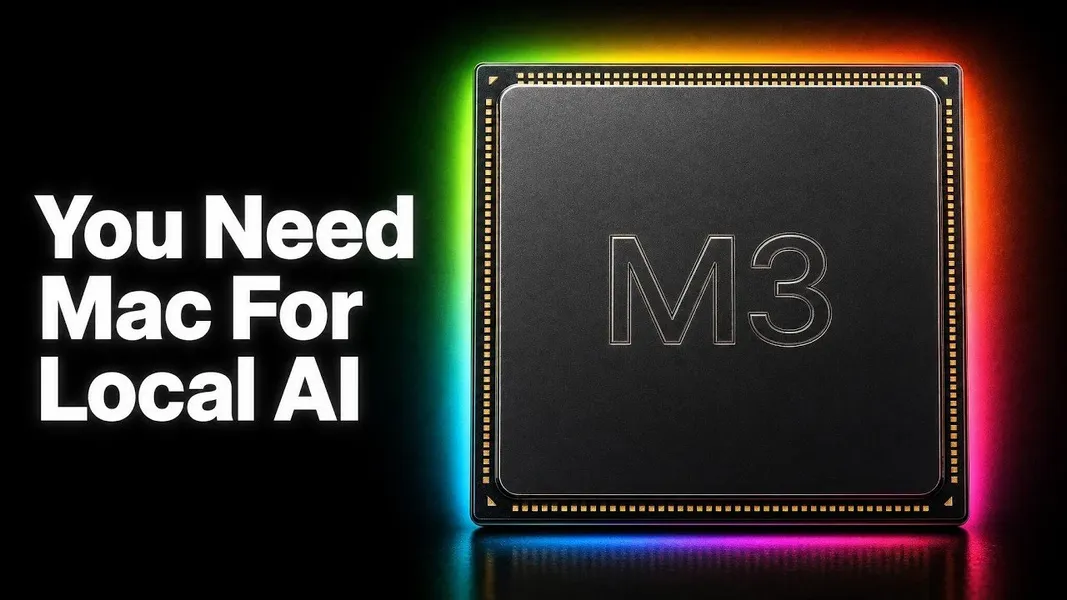
If you're planning to run local AI on Apple Silicon, start with a mixture-of-experts model and test on your actual hardware. The YouTube demonstration shows a Gemma model with 1.35 GB resident and 12.9 GB on SSD, streaming at 23 tokens per second on an M3 Max. Your results will vary based on storage speed, RAM, and thermal headroom.
For dense models, the old rules still apply: an 8 GB machine handles a 7B Q4 model, while 32 GB comfortably runs a 30B Q4 model. Dynamic weight loading is a promising addition, but it's not a universal solution. Test it, measure the token throughput, and watch for thermal throttling during long generation runs.
The bottom line: if you're building on-device AI features and your models are MoE-based, this technique can unlock larger models on modest hardware. Just budget for fast storage and be ready to tune for thermals.
FAQs
Sources
- Apple Silicon AI Performance: Local Al on Apple Silicon Uses 7X Less RAM
- Run Local AI on Apple Silicon with Just 2GB of RAM | Turbo Fieldfare | Stork.AI
- Local LLMs Apple Silicon Mac 2026 | M1 M2 M3 Guide
- Running Local LLMs on macOS: Apple Silicon Optimization Guide | local-llm.net
- Running AI Locally on Apple Silicon | by r00tb33r | Medium
- Apple Silicon Can Run Local Al with Just 2GB of RAM Using Turbo Fieldfare
- Local AI On Apple Silicon uses 7X Less RAM - YouTube
- Local AI On Apple Silicon uses 7X Less RAM - the-stack - Art of Smart
- Ollama is now powered by MLX on Apple Silicon in preview · Ollama...
- Local AI on Apple Silicon: Optimizing Ollama for... | Local AI Ops
- Meet oMLX : Apple Silicon’s Fastest Local AI Model Runner
- Your Mac Is a Local AI Supercomputer You're… | Think Different
- Ollama adopts MLX for faster AI performance on Apple silicon - 9to5Mac