Enterprises hedged Claude Fable 5 before the outage revealed a deeper governance gap
Published by AINave Editorial • Reviewed by Ramit
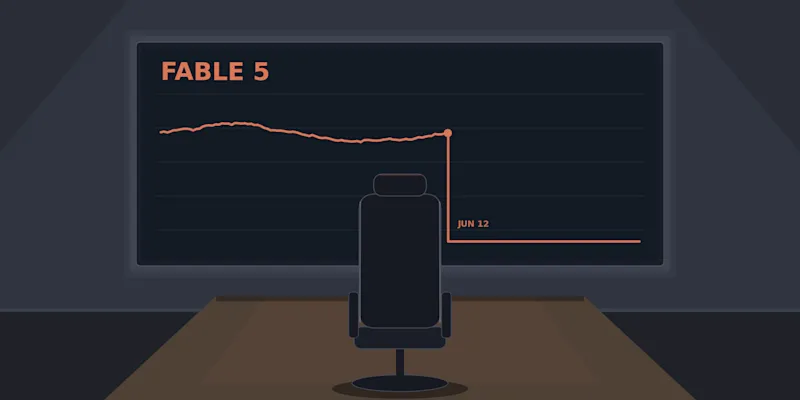
On June 12, a U.S. export-control order pulled Anthropic's Claude Fable 5 offline for every customer with no warning and no restoration timeline. The model returned weeks later with tighter safeguards, after China's Z.ai released its open-weights GLM-5.2 into the vacuum. New VentureBeat Pulse Research, surveying 145 enterprises during the blackout, reveals that two-thirds had already hedged their model strategy before the order came down. But the outage also exposed a deep "Control Gap" between how fast enterprises deploy AI and how little of it they can observe, own, or govern.
What happened
Claude Fable 5 launched on June 9 with pricing at $10 per million input tokens and $50 per million output tokens. Three days later, an emergency export-control directive from the U.S. government barred access by foreign nationals. Anthropic, with no way to verify nationality in real time, suspended the model globally. The outage lasted about two and a half weeks until the U.S. Commerce Department lifted the controls on June 30.
During the blackout, Chinese lab Z.ai released its open-weights GLM-5.2, while OpenAI previewed its GPT-5.6 line. The incident followed earlier cost shocks: Uber burned through its entire 2026 AI coding budget in four months after Claude Code adoption hit 84% of its engineers, and Microsoft canceled most internal Claude Code licenses in its Windows and Microsoft 365 division.
Why AI builders should care
The survey's central finding is that enterprises are already hedging aggressively. 51% run a hybrid posture blending closed frontier models with open-weight models deployed on their own infrastructure, and 16% are moving core workflows off closed APIs entirely. The remaining 32% remain all-in on closed ecosystems, candid about why: self-hosting overhead still outweighs the savings for them.
But model dependency is only the visible symptom of a deeper problem. The survey introduces a "Control Gap" between deployment and governance. Only 10% of enterprises have automated monitoring that would catch an AI model drifting, misbehaving, or failing in production. Nearly a third rely on humans reviewing critical AI outputs, and roughly a quarter would learn of a failure only when end users report it.
The consequences are real. 79% of enterprises have already taken a financial or operational hit from autonomous agents, most often shadow AI (49%) where departmental teams run unauthorized agentic pipelines on corporate credit cards, or uncaught infinite-loop bills (25%) racking up thousands in token costs.
Practical implications
Organizational accountability is the most cited barrier. 32% name the absence of a single owner or accountable team as their top governance barrier. Only 38% say a central team actually governs AI behavior across platforms today. Vendor opacity follows at 25%, and missing tooling at 16%.
The surface being governed is fragmented. 85% of enterprises run two or more platforms that each claim to be the primary AI layer -- ERP, ITSM, productivity suite, data platforms each with their own AI and controls. Just 8% have consolidated to one platform.
Enterprise AI leaders at Liberty IT and Morgan Stanley describe a different approach. They build an "AI backbone" of independently replaceable components, combining governance, observability, and orchestration. As Liberty IT's Brian Craig put it: "You can't lock in right now in one vendor and even one framework. You need to keep being able to have the flexibility with that backbone to be able to hook into different models." A similar pattern is emerging with smaller, specialized models paired with semantic routing to burn premium tokens only on tasks that genuinely need frontier-scale reasoning.
Which vendors face defection? Microsoft leads at 30% as the vendor most likely to be downsized, followed by OpenAI at 21%, Anthropic at 15%, and Google at 6%. Actively cutting at least one provider is now more common than expanding across all of them.
Caveats
The survey data comes from 145 self-selected respondents at organizations with 100+ employees, with 41% in technology/software and over half from companies with 2,500 or more employees. The sample is directional, not statistically representative. The survey fielding spanned the Fable 5 blackout, so responses may reflect a specific moment of heightened concern. Self-hosting overhead calculations may shift as inference costs continue to fall 70-80% per year.
FAQs
How are enterprises hedging Claude Fable 5 after the outage?
A VentureBeat Pulse Research survey of 145 enterprises found that 51% blend closed frontier models with open-weight models on their own infrastructure, while 16% are moving core workflows off closed APIs entirely. That means about two-thirds had already built hedge strategies before the June 12 Fable 5 outage. The remaining 32% stayed committed to closed ecosystems, primarily because the operational overhead of self-hosting still outweighed the savings.
What is the difference between frontier models and open-weight models?
Frontier models are powerful closed-weight models typically accessed via proprietary APIs. Open-weight models have publicly available parameters that organizations can deploy on their own infrastructure, giving them full control over hosting, governance, and data residency. The survey showed many enterprises use a hybrid strategy of frontier models for general reasoning and open-weight models for specialized execution.
What governance gaps exist in enterprise AI deployments with multiple platforms?
The most common governance gap is the absence of a single accountable owner (32%), followed by opaque vendor ecosystems (25%) and missing observability tooling (16%). Only 38% of enterprises have a central team that actually governs AI behavior across platforms. Most organizations lack a control plane that abstracts cost, drift, and model choice away from end users.
Why do organizations rely on multiple AI platforms and what challenges arise?
85% of enterprises run two or more platforms that each claim to be the primary AI layer, including ERP, ITSM, productivity suites, and data platforms each with their own AI and controls. This fragmentation creates governance challenges around cost management, model drift detection, and security. Organizations typically adopt multi-platform strategies to avoid vendor lock-in and access different capabilities, but struggle with observability and accountability across them.
Sources
- Enterprises lost Claude Fable 5 for a few weeks. New data shows two-thirds had already built their hedge
- Enterprises lost Claude Fable 5 for a few weeks. New data shows...
- Introducing Claude Fable 5 - YouTube
- Anthropic Restores Claude Fable 5 After U.S. Lifts Jailbreak-Linked...
- AI Dev Weekly #15: Fable 5 Banned, GLM-5.2 Open Weights, Gemini...
- Claude Fable 5: A Mythos-Class Model You Can Use | DataCamp
- Anthropic restores Claude Fable 5 after US restrictions lifted
- US lifts export controls on Anthropic’s Fable 5, clearing the model’s return
- Anthropic brings back Claude Fable 5 after the US lifted export controls0 0
- Claude Fable 5 cleared to return as US lifts Anthropic’s export control restriction [U: Now available]
- Fable 5 and Mythos 5 Return Together with New Claude Sonnet 5
- Fable 5 Online Free - Mythos-Class AI Chat 2026
- Claude Fable 5: Anthropic releases a 'safe' version of Claude Mythos
- AI researcher claims he's already bypassed Anthropic's Fable 5 guardrails
- New Claude Fable 5 AI a major disruption risk for IT firms: Report
- 4 Things You Should Know About Fable 5
Latest Tech News