AI Agents Built by Different Teams Can Finally Work Together Without Custom Glue Code
Published by AINave Editorial • Reviewed by Ramit
If you have ever maintained custom handoff functions so one LangGraph agent could talk to a Pydantic AI agent, you know the glue code problem. The Agent2Agent Protocol (A2A) is the open standard designed to solve it. Announced by Google at Google Cloud Next in April 2025, A2A enables AI agents to discover each other, exchange information securely, and coordinate actions regardless of their underlying frameworks. By mid-2026, the protocol had passed 150 supporting organizations, and all three major cloud platforms had embedded it natively.
What happened
A2A is an open standard that lets agents built by different teams or vendors interoperate without custom integration code. It uses HTTP, Server-Sent Events, and JSON-RPC 2.0 for transport. Two concepts are central:
- Agent Card: A JSON document hosted at a well-known URL where an agent advertises its capabilities, supported formats, and authentication requirements.
- Task: The unit of work a client agent creates and sends to a remote agent, receiving status updates and results through the same channel.
The important distinction is how A2A relates to MCP, the standard introduced by Anthropic in 2024. MCP connects an agent to tools, databases, and external services. A2A connects agents to each other. MCP is the tool layer; A2A is the cross-agent layer.
By April 2026, Azure AI Foundry, Amazon Bedrock AgentCore, and Google Cloud had all integrated A2A natively. IBM also merged its independently developed Agent Communication Protocol into A2A, a strong signal of ecosystem consolidation.
Why AI builders should care
The value of A2A is not in every setup. If you have two agents you control running in the same codebase, A2A is overhead. It earns its value when agents come from different teams, different vendors, or different frameworks and need to interoperate without custom glue code.
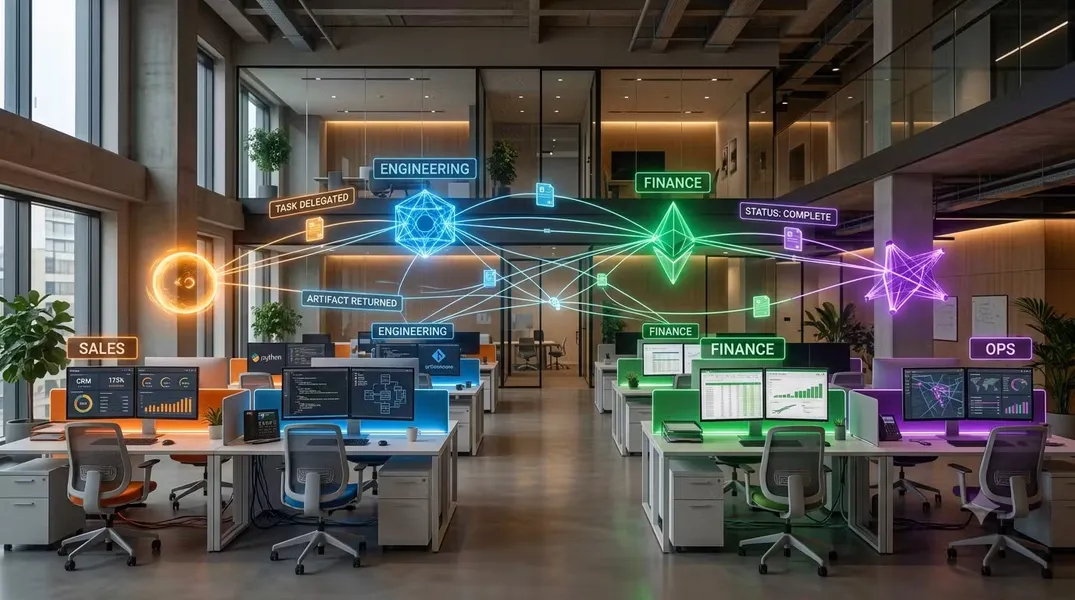
For platform teams or anyone building agent infrastructure that multiple teams will use, A2A shifts the problem from maintaining hand-rolled integration functions to implementing a standard interface. An orchestration agent discovers a specialist agent via its Agent Card, creates a Task, and gets the result back. The internal implementation of the remote agent is invisible. It could be LangChain, CrewAI, a custom script, or a Vertex AI agent.
Practical implications
The security architecture addresses real multi-agent risks. OAuth 2.0, PKCE, dynamic client registration, and RFC 8707 Resource Indicators prevent token leakage, where a rogue server could trick a client into obtaining tokens valid for other services. The token propagation problem is worth thinking about now: when Agent A delegates to Agent B, which token does Agent B use for downstream calls?
Latency is the other practical concern. Every A2A handoff adds an HTTP round-trip. For tasks that take seconds, that is noise. For synchronous user-facing flows, you need to budget carefully which delegations are worth the overhead.
Keep your integration surface minimal. The spec is stable enough to build on, but the ecosystem is still maturing. Do not abstract so heavily that you cannot update your implementation when the protocol evolves.
Caveats
Early adopters report compliance blind spots around token approval and operational overhead from cross-agent orchestration. Many AI agent demos in 2025 did not need A2A, they needed better prompts, tools, permissions, retry logic, and logs. The protocol is about 12 to 18 months behind MCP on maturity. If you are building a single agent or a small fixed set, monitor and read the spec. If you are building a platform where multiple teams deploy agents, implement it now.
FAQs
What is the A2A protocol and how does it enable different AI agents to work together?
A2A is an open standard announced by Google in April 2025 to enable AI agents to discover each other, exchange information securely, and coordinate actions across different frameworks. It complements MCP, which handles external tooling and data access, while A2A handles inter-agent coordination. Key concepts include Agent Cards for capability discovery and Tasks for delegation.
How do MCP and A2A work together in multi-agent orchestration?
MCP connects an agent to tools and data sources, acting as the tool layer. A2A connects agents to one another for delegation and coordination, acting as the cross-agent layer. In a production system, an agent uses MCP to query a database and A2A to delegate a subtask to another agent.
What security measures are used for cross-agent coordination (OAuth 2.0, PKCE, RFC 8707)?
The protocol uses OAuth 2.0 and PKCE to secure authorization and prevent interception. Dynamic client registration and RFC 8707 Resource Indicators are used to close token leakage vulnerabilities where a rogue server could trick a client into obtaining tokens valid for other services.
Which platforms support A2A integration (Azure AI Foundry, Amazon Bedrock, Google Cloud)?
By mid-2026, Azure AI Foundry, Amazon Bedrock AgentCore, and Google Cloud had all integrated A2A natively into their platform offerings. The Linux Foundation also reported about 150 supporting organizations.
Sources
- AI Agents Built by Different Teams Can Finally Work Together Without Custom Glue Code
- AI Agents Built by Different Teams Can Finally Work Together...
- AI Agents Built by Different Teams Can Finally Work Together...
- Google Finally Answered the Question Nobody Was... - DEV Community
- Inside A2A: How Google’s Agent2Agent Protocol Actually Works
- How Non-Programmers Are Building Custom AI Agents in Minutes
- AI Is Finally Doing Real Work In Ad Ops (But Only When It Works With Your Existing Tech)
- AI agents are getting their own search engine
- Meet The $250 Million Startup Challenging Salesforce With AI Agents
- The AI Agents That Actually Work Don’t Post On Social Media
- A2A without the Hype: Lessons from Debugging a Real Multi-Agent...
- The 10 Hottest Agentic AI Agents, Tools And Products Of 2026 (So Far)
- Imagine if your Teams or Slack messages automatically turned into secure context for your AI agents — PromptQL built it
- Agent Orchestration 101: Making Multiple AI Agents Work as One
- How to Coordinate Multiple AI Agents: The Definitive Guide for 2026 - Developers Digest
Latest Tech News