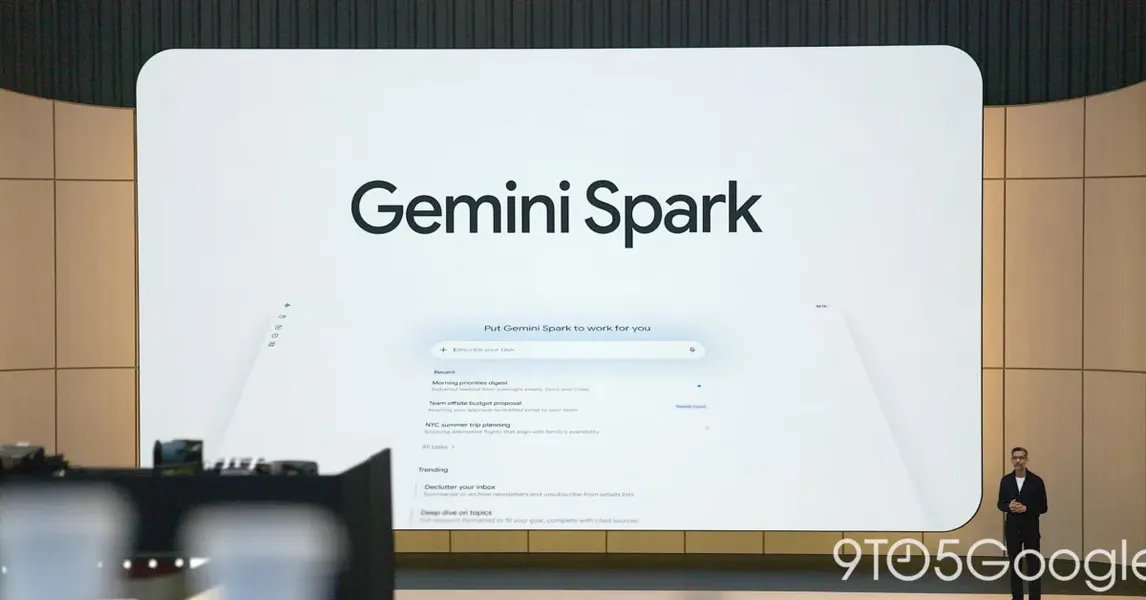
Gemini Spark expands third-party app integrations and MCP support with real-time topic updates
Published by AINave Editorial • Reviewed by Ramit
Google's 24/7 cloud AI agent Gemini Spark now connects to third-party apps, supports the Model Context Protocol (MCP) for custom integrations, and can track topics in real time. For anyone building AI workflows or agent-based products, these updates turn Spark from a chat agent into a practical cross-app orchestrator.
What happened
Google rolled out two major updates for Gemini Spark, the always-on personal AI agent available to Google AI Ultra subscribers. The first is expanded app integrations. On the first-party side, Spark can now access Google Keep and Tasks. You can ask Spark to scan your Keep notes and convert them into action items in Tasks. On the third-party side, Spark now integrates with Canva, Dropbox, Instacart, OpenTable, and Zillow Rentals. This means you can design flyers, access and share files, order groceries, reserve tables, or schedule apartment tours directly through Spark.
The second update is Model Context Protocol (MCP) support. You can add any custom app by entering its MCP server URL at the bottom of gemini.google.com/apps. This lets Spark contextually access external services beyond the pre-integrated set.
Google also announced that Gemini Spark can now intelligently track topics and react to events in real time. These updates roll out first on web and mobile over the coming week, with macOS support arriving in the coming weeks.
Why AI builders should care
For AI builders, the real news is MCP support. The Model Context Protocol is an emerging standard that lets AI agents connect to external tools and data sources through a defined interface. By adopting MCP for custom app links, Google is signaling that Spark can be extended beyond its built-in integrations. This matters if you are building SaaS products, internal tools, or consumer apps that would benefit from agentic orchestration.
The Keep to Tasks pipeline is a concrete example of an agentic workflow. Spark scans unstructured notes in Keep, extracts action items, and writes them into Tasks. For product teams, this pattern of unstructured-to-structured data transformation is directly applicable to your own agent designs.
Real-time topic tracking also shifts Spark from a reactive chat tool to a proactive monitor. For builders, this suggests a future where Spark-style agents could watch for changes in connected systems and trigger workflows without a user prompt.
Practical implications
If you are building on Google's ecosystem, these updates change what Spark can do for your team or your users.
- First-party workflows: Spark can now act as a bridge between Keep (brain dump storage) and Tasks (structured to-do lists). This is a natural fit for personal productivity automation.
- Third-party integrations: The initial set of Canva, Dropbox, Instacart, OpenTable, and Zillow Rentals covers design, file management, shopping, dining, and housing. If your product serves these categories, consider whether Spark might become a distribution channel for your service.
- MCP for custom apps: Adding a custom app via MCP server URL opens the door for building Spark-connected tools. Google's official support page provides the setup steps. There is currently no public submission form for inclusion beyond manual MCP linking.
- Timing: Web and mobile support rolls out within a week. macOS support is expected in the coming weeks. No Android or iOS native app timeline has been shared.
Caveats
These features require a Google AI Ultra subscription. The third-party integrations are rolling out gradually, and initial reports from I/O 2026 mentioned Canva, OpenTable, and Instacart with over 30 more planned for summer. The current announcement adds Dropbox and Zillow Rentals. MCP custom app linking is available now, but the builder experience for testing and debugging custom MCP servers on Spark is not yet documented in detail. Real-time topic tracking capabilities and their limits have not been specified beyond the announcement.
FAQs
What third-party apps does Gemini Spark now support?
Gemini Spark now integrates with Canva, Dropbox, Instacart, OpenTable, and Zillow Rentals. These integrations enable tasks like designing flyers, accessing files, ordering groceries, reserving tables, and booking apartment tours directly through Spark. Support is rolling out first on web and mobile.
How does MCP work with Gemini Spark and how do I connect custom apps?
You can connect any custom app by adding its Model Context Protocol (MCP) server URL at the bottom of gemini.google.com/apps. Once linked, Gemini Spark can contextually access that external app during your conversations to execute tasks. Google's official support page provides the setup instructions.
Can Gemini Spark convert Keep notes into Tasks and action items?
Yes. You can ask Spark to scan your notes in Google Keep and turn them into action items in Google Tasks. This is a first-party workflow that transforms unstructured notes into structured to-do items.
When will macOS support for Gemini Spark be available?
macOS support for Gemini Spark is expected in the coming weeks. Web and mobile support is rolling out over the next week.
Sources
- Gemini Spark now supports 3rd-party apps, including MCP, adds real-time topic updates
- Gemini Spark Gets 3rd-Party App Support, Real-Time Updates
- Gemini Spark: Google's 24/7 Cloud AI Agent Now Executes Tasks ...
- Connect & manage custom apps for Gemini Spark in the Gemini ...
- Gemini Spark Is Live. Here's the Builder's Map to Get Your ...
- Google's New Gemini AI Model and Tools Are All About Agents Now
- Gemini Spark is now rolling out and it hopes you will trust an AI more than apps
- Google announces Gemini Spark to quietly run your digital life for you
- Google's Gemini Spark announced: Meet the AI agent that could run your life
- Gemini Spark now supports 3rd-party apps, including MCP, adds ...
- Google unveils Gemini Spark — a '24/7 personal AI agent'
- Google's Gemini Spark is the first AI agent built for people who don't know what an AI agent is
- ‘Gemini Spark’ is Google’s upcoming AI agent in the Gemini app
- Gemini Spark now supports 3rd-party apps, including MCP, adds real ...
- Gemini Spark now supports 3rd-party apps, including MCP, adds real ...