Agentic AI today: What it is, how it works, and what builders need to know
Published by AINave Editorial • Reviewed by Ramit
Agentic AI is the layer that turns a language model into something that acts. Instead of generating text or images, an agentic system books a flight, edits a file, or calls an API. For AI builders, the practical question is not whether agents are coming, but how to deploy them without introducing bugs, data leaks, or over-reliance on automation.
What happened
In a recent MIT News interview, associate professor Phillip Isola defined agentic AI as AI that takes actions in the world, either physical (robotic manipulation) or digital (booking a flight). This contrasts with generative AI, which produces stories, poems, or images without executing real-world actions.
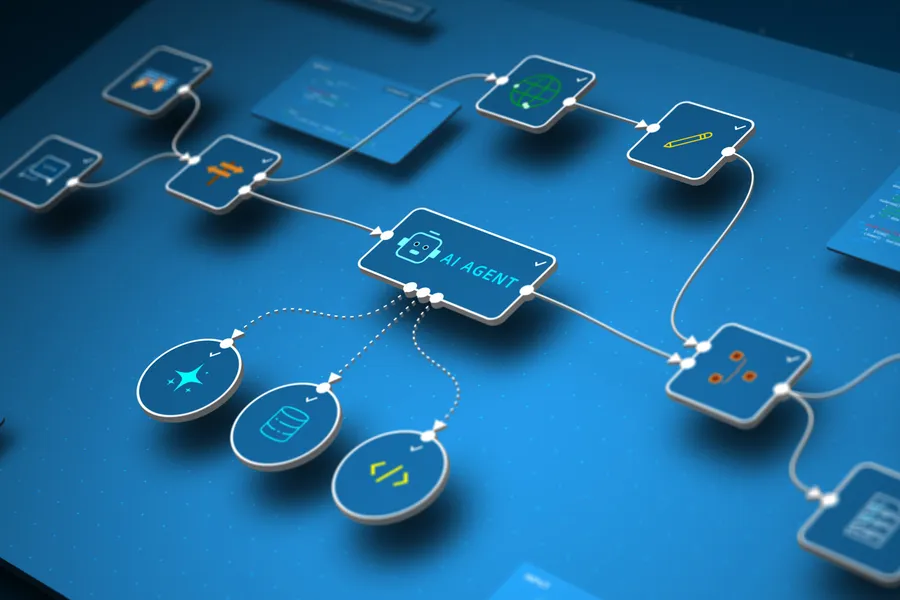
Most agentic systems today share a common architecture. They start with a foundation model like Claude at the core, then add wrappers that give the agent access to specific tools. Those tools might be a calculator, a file system, or a company's financial database. The agent uses the model to decide what to do and the tools to carry it out.
Adoption is accelerating. A November 2025 report by MIT Sloan School of Management and Boston Consulting Group found that 35% of surveyed businesses had already deployed AI agents, and another 44% planned to implement them soon.
Why AI builders should care
The distinction between agentic AI and generative AI matters for product decisions. If you are building a chatbot that answers questions, a generative model may be enough. If you are building a system that takes actions on behalf of users, you need an agentic architecture.
Training these systems is the hard part. Isola points out that the biggest challenge is a lack of labeled training data. There is no dataset that spells out exactly where to move a mouse, which buttons to click, or how to negotiate a price. Agents often must learn by trial and error in live environments, which is slow and risky.
Future directions point toward multimodal models and sensor-actuator integration. Current agents are built on text-trained language models. To handle video, physical forces, or radar data, the field may need fundamentally different architectures. Or, as Isola puts it, maybe a super-smart reasoning system with a camera and keyboard will be enough.
Practical implications
Coding agents are the most successful early application. These agents iterate through a feedback loop: they try a solution, check if it works, and retry until they get it right. This pattern works because the agent can verify its own output automatically.
But automation needs boundaries. Isola warns that in high-stakes domains like medicine, security, and high-level business policy, the technology may not be ready for full automation. Builders should plan for human-in-the-loop oversight in these contexts.
The wrapper pattern is the most practical architectural choice for most teams. Instead of training a new model, you wrap an existing foundation model with tools and memory. This lets you ship faster while keeping the core model's capabilities.
Caveats
Current agentic AI has real limitations. The underlying architecture is still a language model trained on text, which may not capture physical or multimodal complexity. Builders should not assume that today's agents generalize to every domain.
There is also a risk of de-skilling. When agents handle coding, math, or planning, humans may lose those skills before the technology is reliable enough to replace them. Bugs and data leaks are already happening, especially when users give vague instructions or skip verification.
Deploying agentic AI in production requires careful risk assessment. The technology is powerful, but it is not a drop-in replacement for human judgment in critical workflows.
FAQs
What is agentic AI today, and how does it work?
Agentic AI is AI that takes actions in the world, either digital or physical. It works by wrapping a foundation model (like Claude) with task-specific tools and memory. The model decides what to do, and the tools carry out the action. This is different from generative AI, which only produces text or images. MIT News explains that most agents today are digital, such as customer service bots that can access a company's data and take actions on behalf of users.
How is agentic AI different from traditional generative AI?
Generative AI produces outputs like stories, poems, or images. Agentic AI takes actions in the world, such as booking a flight or editing a file. The core difference is action versus output. As Phillip Isola describes, an agent starts with a generative model at its core but adds wrappers that give it the ability to interact with tools, applications, and physical systems.
What are the main risks and safety concerns with agentic AI?
Key risks include bugs introduced by autonomous actions, data leakage when agents access sensitive systems, and de-skilling if humans rely too heavily on agents for cognitive tasks. Isola warns that vague instructions or lack of verification can lead to mistakes, and that these problems are already happening in production deployments.
What role does human oversight play in agentic AI deployments?
Human oversight is critical, especially in high-stakes domains like medicine, security, and business policy. Isola emphasizes that the technology may not be ready for full automation in these areas. Builders should plan for human-in-the-loop verification to catch mistakes, prevent data leaks, and ensure the agent acts as intended.
Sources
- Q&A: What is agentic AI today, and what do we want it to be?
- 6 Agentic AI Trends Transforming the Business Landscape in 2026 - WNS
- 237 | Breaking Analysis | Gen AI is Passe', Enter the Age of Agentic AI
- I prefer to use ”agentic AI” over ”AI agents” | Timo Kovala - LinkedIn
- What is an Agentic AI? Complete Guide - Scaler
- What's the Hype Around Agentic AI and What Changes When You Use It
- What Can Higher Ed IT Do About the Agentic AI Cheating Crisis?
- SAP Sapphire showcases ‘new SAP’ with agentic AI infrastructure ecosystem & tools
- Q&A: Box CEO embraces shift to ‘headless’ software in the agentic AI era
- Dell CEO Michael Dell: Agentic AI Acceleration Is Extending The Supply Chain Crisis
- Agentic AI – an infinite regress of cost/benefit challenges?
- Enterprise Agentic AI Platform: The Complete Guide - Magure
- Top 30 Agentic AI Interview Questions and Answers for 2026 | DataCamp
- Episode 24: Agentic AI and the Future of Intelligence with Richard Socher
- Why security leaders are cautious about agentic AI
- What Is Agentic AI? Definition, 6 Levels & Examples (2026)