Claude Fable 5.1: Smarter and Cheaper for Long Agent Runs, But Still Expensive
Published by AINave Editorial • Reviewed by Ramit
Anthropic released Claude Fable 5.1 and Mythos 5.1 on September 1, 2026, pairing stronger coding and scientific reasoning with a 75% cut to cache read pricing and new options for keeping data on your own infrastructure. The standard API token rates stay the same, so the real cost story is about long-running agentic workloads, not per-token price.
What Fable 5.1 and Mythos 5.1 Actually Change
Fable 5.1 is the broadly available flagship, with safeguards that block high-risk cybersecurity and scientific research. Mythos 5.1 is the same underlying model but with lighter guardrails, available only through Anthropic's trusted-access program for approved cybersecurity and life-sciences organizations TechSpot. Both models are accessible via the API, cloud platforms, and the Claude desktop app.
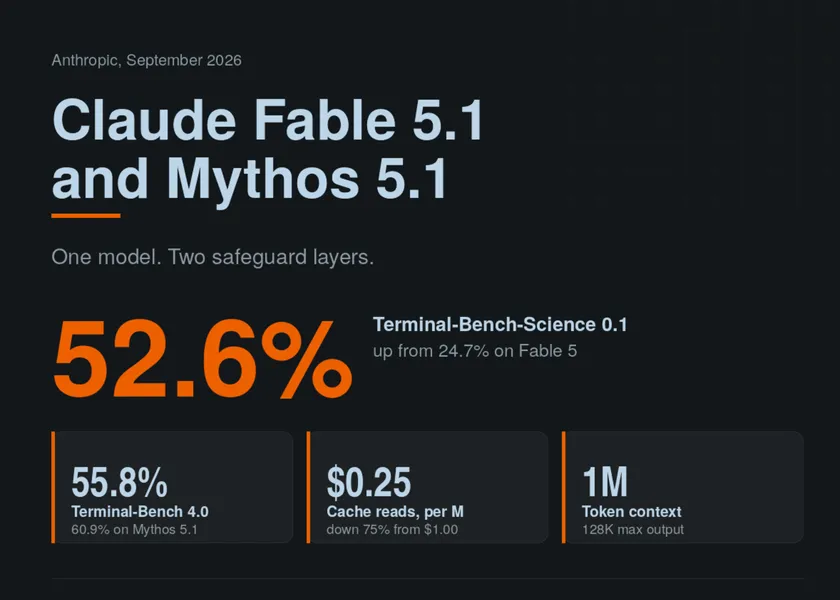
Anthropic reports substantial gains on internal benchmarks. On Terminal-Bench 4.0, a command-line coding benchmark, Fable 5.1 scored 55.8% against Fable 5's 42%, and Mythos 5.1 scored 60.9% under its permissive safety settings TechSpot. The more dramatic jump came on Terminal-Bench-Science 0.1, which measures agentic scientific research: Fable 5.1 scored 52.6%, more than double Fable 5's 24.7% Anthropic. These are vendor-reported numbers, not independent validations, but they align with the model's claim of handling multistep tool-using tasks better.
The Cache Pricing Change That Actually Matters for Builders
Standard API pricing remains unchanged at $10 per million input tokens and $50 per million output tokens TechSpot. The big shift is in cache reads: they dropped from $1 to $0.25 per million tokens, a 75% reduction. Cache writes stay at $12.50 per million for a five-minute cache and $20 for a one-hour cache.
This matters because agentic workloads repeatedly send the same context -- code repositories, system instructions, tool definitions, conversation history. Anthropic says cached material can account for half or more of token use in long tasks, and expects effective cost reductions of about 25% for typical workloads and up to 45% for heavily agentic applications TechSpot. If you're running agents that revisit previous steps and use large context windows, this directly lowers your bill.
Enterprise Frontier Safeguards and Data Control
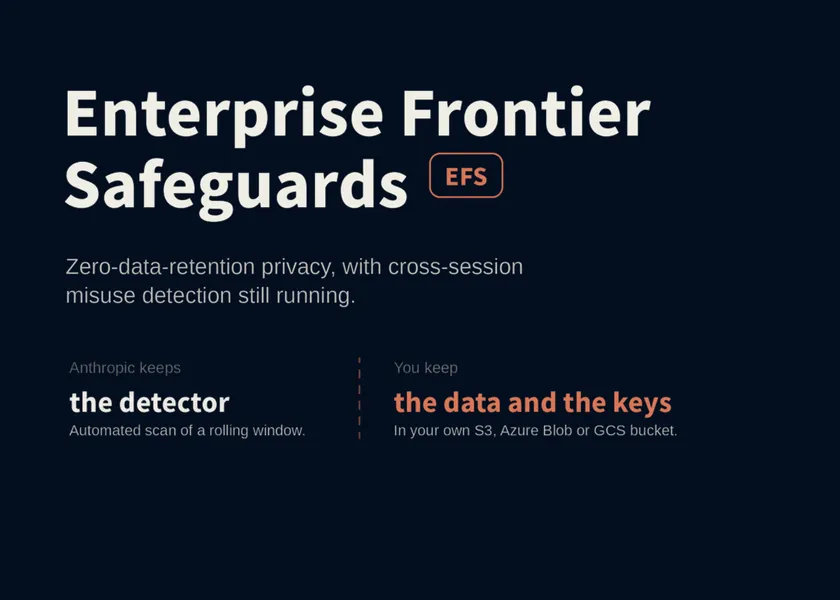
Anthropic introduced Enterprise Frontier Safeguards (EFS), which let customers store monitoring data on their own infrastructure while keeping Anthropic's misuse-detection systems active TechSpot. This is a shift from earlier requirements that data stay on Anthropic's side for advanced models. For regulated industries, this could reduce friction, but the exact privacy boundaries still depend on how Anthropic's safety classifiers interact with your environment. The company also says it improved the classifiers to produce fewer false positives, which matters for legitimate cybersecurity and biology work TechSpot.
Watermarking and EU Compliance
Fable 5.1 and Mythos 5.1 are the first Claude models with invisible watermarks in text and file outputs, required for models released after August 2, 2026 under the EU AI Act TechSpot. The watermark influences word selection when multiple plausible options exist and survives copying and light editing. A detection API is available to regulators, researchers, and fact-checkers to verify that content came from Claude, without exposing user or organization data. A positive match proves Claude generated the content; a negative result doesn't prove human authorship.
Caveats to Keep in Mind
Fable 5.1 remains expensive compared to Anthropic's own Opus and Sonnet models, and to many competitors like GPT-5.6 Sol Geeky Gadgets. The benchmark improvements are Anthropic's own claims, so treat them as directional. Mythos 5.1's access restrictions mean it's not an option for most teams. And while EFS give customers more data control, the safety classifiers still run on Anthropic's side, so complete privacy isolation isn't guaranteed. For builders, the practical decision comes down to whether your workload is long and complex enough to benefit from the cache savings -- if not, you're paying full flagship rates.
FAQs
Sources
- New Anthropic Claude Fable 5.1 Tops Terminal Bench Science Tests
- Anthropic releases Claude Fable 5.1, cuts cached token pricing by 75%
- Claude Fable 5.1 Benchmarks: What the Numbers Actually Say
- Claude Fable 5.1 tops the Artificial Analysis... | Artificial Analysis
- Anthropic launches Claude Fable 5.1 and Mythos 5.1, more powerful...
- Claude Fable 5.1 and Mythos 5.1 launch with lower... | AlternativeTo
- Anthropic Launches Claude Fable and Mythos 5.1 for Advanced...
- Anthropic launches Claude Fable 5.1 after inking $35B cloud deal with Lambda
- Anthropic releases Claude Fable 5.1 and Mythos 5.1, cutting cache read prices by 75%
- Anthropic Fable 5.1 and Mythos 5.1 Are Better and 45% Cheaper
- Claude Fable 5.1 and Mythos 5.1 arrive with better coding skills and cheaper cache pricing
- Anthropic's latest Fable 5.1 model jumps to the top of LLM leaderboards
- Introducing Claude Fable 5.1 and Claude Mythos 5.1 \ Anthropic
- Anthropic Debuts Claude Fable 5.1 and Mythos 5.1 With Split Safeguards
- Anthropic launches Claude Fable 5.1 and Mythos 5.1 models claimed to be 'world's most advanced models for coding and knowledge work'
- Anthropic's Fable 5.1 is a bit cheaper, a bit smarter... - The New Stack
- Anthropic Launches Claude Fable 5.1 With Lower Costs and Fewer False Positives