Anthropic's Enterprise Frontier Safeguards: Zero Data Retention Meets Cross-Session Misuse Detection
Published by AINave Editorial • Reviewed by Ramit
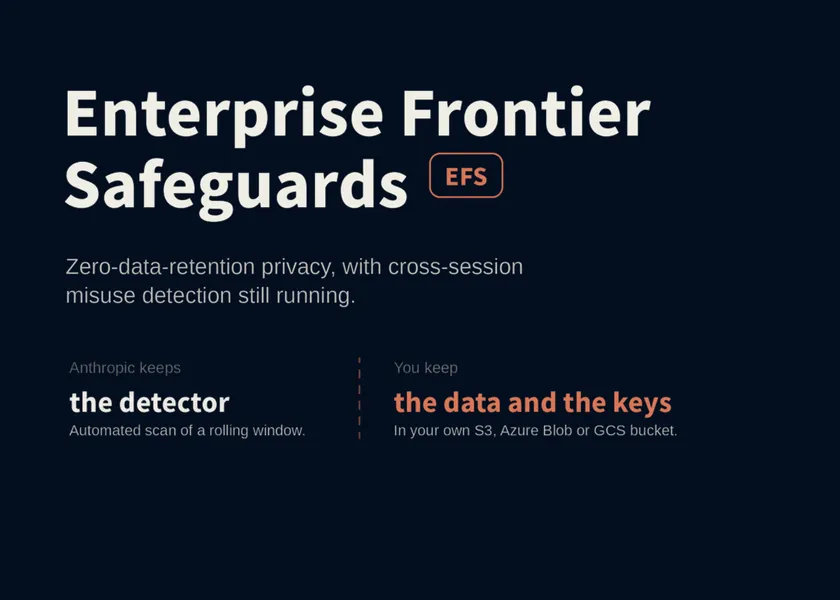
Enterprise AI buyers have been stuck between two requirements: zero data retention (ZDR) for privacy and cross-session misuse detection for security. Anthropic's new Enterprise Frontier Safeguards (EFS) architecture tries to give both by storing monitoring data in cloud infrastructure the customer controls while keeping detection with Anthropic. For builders deploying Claude in regulated environments, this changes the data-control calculus.
What EFS actually does
EFS stores monitoring data in customer-controlled cloud infrastructure, not Anthropic's servers. Detection logic stays with Anthropic. Custody, keys, and human review stay with the customer. This is a direct response to the tension where effective misuse detection historically required the vendor to hold data long enough to correlate across sessions. Anthropic's stated reason for retention is detection quality, not training data. The company introduced 30-day data retention starting with Claude Fable 5, and says it has never trained on enterprise data without explicit permission.
Why this matters for builders
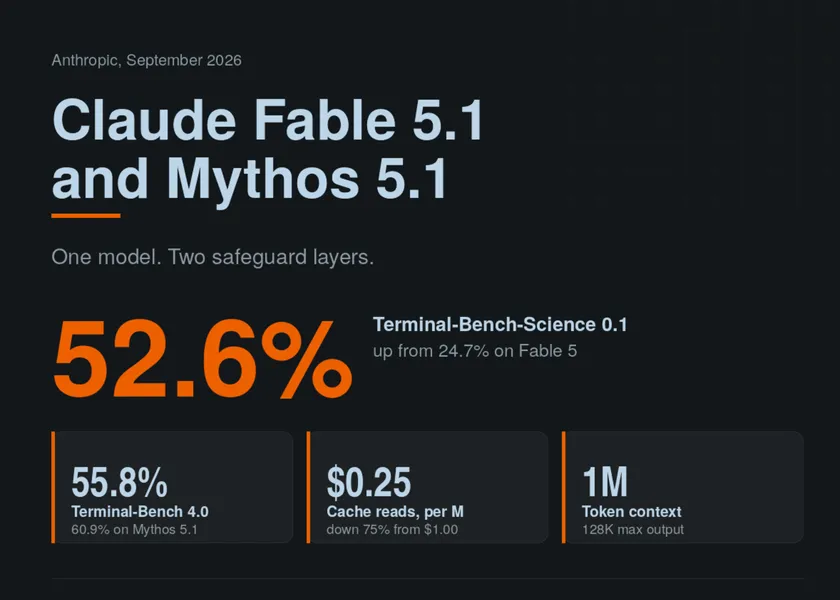
EFS is one of three enterprise concessions shipped alongside Claude Fable 5.1 and Mythos 5.1, alongside pricing and precision. Fable 5.1 reduces cache reads by 75% to $0.25 per million tokens, which works out to roughly 25% lower cost on typical workloads and up to about 45% on highly agentic ones. Its cybersecurity safeguards now produce around 60% fewer interventions per Claude Code session than Fable 5's, partly because Fable 5.1 is permitted to identify software vulnerabilities without developing exploits.
Rollout and availability
EFS is not deployable today. It rolls out in phases with the goal of broad availability later this fall, and access is request-based. Until full deployment, eligible customers can run Claude Fable 5 and Fable 5.1 under ZDR. Anthropic built EFS with more than 100 customers across financial services, healthcare, manufacturing, telecom, law, retail, and the public sector, together with AWS, Google Cloud, and Microsoft Azure. Contributors included the Analysis and Resilience Center for Systemic Risk, whose membership includes CISOs at Goldman Sachs, Morgan Stanley, Citi, Bank of America, and Wells Fargo, plus teams at Comcast, KPMG, Mastercard, Salesforce, and Visa. Anthropic says the design conversations covered a quarter of the Fortune 100 and every US global systemically important bank.
Caveats to watch
The architecture is promising but still evolving. Rollout is phased and details may change. The 30-day retention window is a compromise: it enables cross-session detection but may still be a concern for the strictest data residency requirements. Pricing and performance benefits are tied to Fable 5.1, not EFS itself. Builders should evaluate whether the phased timeline and request-based access fit their deployment schedules.
FAQs
Sources
- Anthropic Introduces Enterprise Frontier Safeguards (EFS): Zero-Data-Retention Privacy Plus Cross-Session Misuse Detection
- Developing Enterprise Frontier Safeguards with our customers
- Enterprise Frontier Safeguards | Claude by Anthropic
- Anthropic Announces Enterprise Frontier Safeguards...
- Anthropic Unveils Enterprise Frontier Safeguards for AI Security
- Anthropic plans to change enterprise data retention policy, source says
- Anthropic Introduces Enterprise Frontier Safeguards for ...