Broadcom sticks to AI revenue targets despite Anthropic slowdown talk
Published by AINave Editorial • Reviewed by Ramit
Broadcom CEO Hock Tan isn't changing his AI revenue forecast, even after Anthropic's CEO publicly asked the industry to slow down. Tan told CNBC's Mad Money that demand for compute infrastructure and frontier-model inference remains durable, and the company's Broadcom AI semiconductor revenue targets of $115 billion for fiscal 2027 and $230 billion for fiscal 2028 are unchanged. For AI builders, this signals that the hardware supply chain expects continued growth in training and inference workloads, regardless of public debates about pace.
The slowdown debate that spooked the market
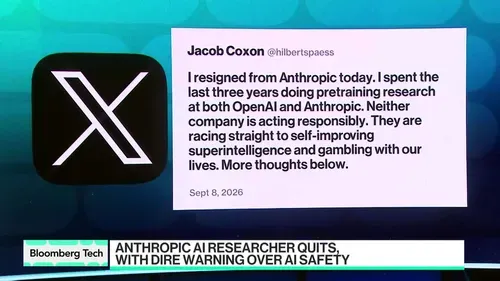
Anthropic CEO Dario Amodei published a weekend essay advocating for moderation in frontier AI model development, a position that received support from OpenAI's Sam Altman and Elon Musk. The message rattled investors, sending Broadcom shares down 4.8% and the broader iShares Semiconductor ETF down 5.6% on Monday. The concern was straightforward: if frontier labs slow down, demand for the custom chips and networking hardware that Broadcom sells could soften.
Tan pushed back directly. "No, not in the least," he said when asked if the debate changed his outlook. He described demand for compute infrastructure and inference as "very strong and very durable."
Why Broadcom's targets matter for builders
Broadcom's AI revenue comes from custom AI accelerators and networking chips used in AI systems. The company expects AI semiconductor revenue to jump from about $56 billion in fiscal 2026 to $115 billion in fiscal 2027, then double to $230 billion in fiscal 2028. Those are aggressive numbers, and they depend on customers like Anthropic and Google continuing to scale.
Tan said Anthropic is on track to become Broadcom's largest custom chip customer in 2027 and sustain that position in 2028. Google has historically been Broadcom's biggest custom chip partner, co-designing tensor processing units. The shift underscores how much compute Anthropic expects to consume for both training and inference.
For builders, the key takeaway is that Broadcom sees inference demand as the durable driver. Tan specifically highlighted inference productization: "I don't know about training, but when you want to productize inference, I see it continuing to be very, very strong." That suggests the hardware roadmap is being built around serving deployed models, not just training new ones.
Governance and the tool analogy
Tan agreed with Amodei on the need for AI governance and safeguards, but he framed AI as a tool rather than an uncontrollable force. "It's not a live animal that will run wild by itself," he said. He compared AI's potential productivity impact to the Industrial Revolution, arguing it will raise living standards.
That perspective matters for builders because it implies regulatory pressure is likely to focus on application-layer safeguards rather than hardware restrictions. Tan's position suggests Broadcom expects continued demand regardless of policy debates.
What to watch
These revenue targets are Broadcom's own forecasts, not independent projections. The company has a track record of beating expectations, but the numbers assume massive continued investment from a small number of hyperscale customers. If Anthropic's public call for slowdown translates into actual spending reductions, Broadcom's targets could face pressure. For now, Tan is betting that the gap between public statements and private compute commitments remains wide.
FAQs
Sources
- Broadcom CEO addresses Anthropic's slowdown push, says AI revenue targets haven't changed
- Broadcom CEO Says AI Revenue Targets Stand Despite Model...
- Why OpenAI and Anthropic CEOs say AI development... - YouTube
- AI Stocks Slide In Premarket Amid Push For Slowdown In Development
- Home \ Anthropic
- Broadcom CEO dismisses AI slowdown concerns, stands by long-term revenue goals
- Broadcom Affirms AI revenue goals amid Anthropic pause
- Anthropic wants AI to slow down. Its $517 billion spending plan says otherwise
- Broadcom: $100 Billion In AI Revenue Is A Lot To Ask
- Broadcom CEO addresses Anthropic's slowdown push, says AI revenue targets haven't changed
- Broadcom CEO addresses Anthropic's slowdo... - aVenture News
- Broadcom CEO addresses Anthropic's slowdown push, says AI ...
- Broadcom CEO addresses Anthropic's slowdown push, says AI ...
- Broadcom CEO dismisses AI slowdown concerns, stands by long-term revenue goals
- Broadcom CEO Hock Tan Says Anthropic 'On Track to... - Benzinga