DeepSeek-V4.1-Flash: Open-model efficiency gains for long-context AI agents
Published by AINave Editorial • Reviewed by Ramit
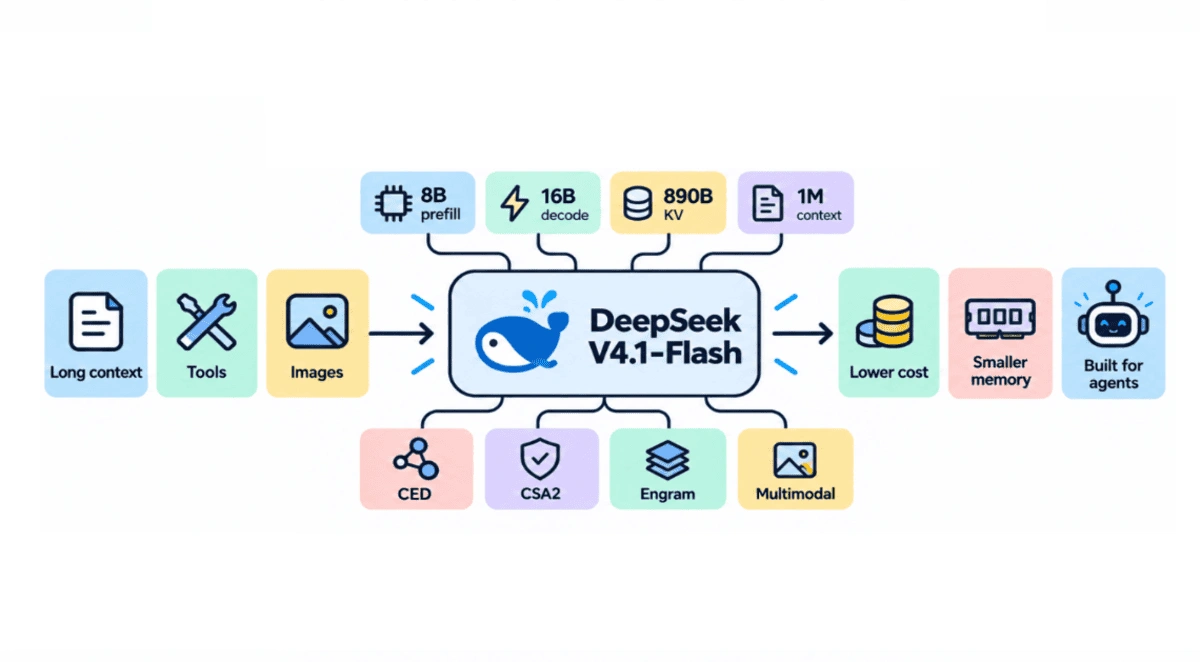
DeepSeek released DeepSeek-V4.1-Flash, a 552-billion-parameter Mixture-of-Experts (MoE) model that rethinks inference architecture for long-context AI agents. The key innovation isn't just raw benchmark scores - it's how the model dramatically reduces memory, KV cache size, and compute cost when processing hundreds of thousands of tokens. At 1 million tokens of context, DeepSeek-V4.1-Flash maintains a global KV cache of just 890 bytes per token, down to roughly one-quarter of the HBM needed by V4-Flash according to DeepSeek. That shift makes it viable for agents that need to read large codebases or logs before generating short responses.
A model built for long-running agents
V4.1-Flash uses a Causal Encoder-Decoder (CED) architecture with 20 encoder layers and 20 decoder layers. During prefill (reading the prompt), only 8 billion parameters are active per token. During decode (generating), 16 billion parameters are active. This asymmetry means the model spends less compute ingesting information and more compute when reasoning and generating - exactly the profile you want for agents that process 500,000 tokens before producing 5,000 tokens of output. The MoE backbone keeps total parameters at 552B, but the majority stay inactive for any given token. The model was trained from scratch on 45 trillion multimodal tokens.
How CSA2 and Engram memory cut costs
Two architectural additions make the biggest difference. Compressed Sparse Attention 2 (CSA2) allows attention layers to share KV information and reuse sparse-attention indices across layers, rather than each layer computing and storing redundant data. Combined with a hierarchical sparse indexer that narrows relevant tokens before later layers search, and FP4 KV caching, the global KV cache drops to 890 bytes per token. DeepSeek also adds a 196-billion-parameter Engram conditional memory component accessed sparsely - the model retrieves only needed information, adding capacity without adding proportional compute to every token. Other techniques like SWA Bounded Replay cut persistent KV storage to around one-eighth of V4-Flash, and Single-Pass mHC reduces memory traffic by roughly 50%.
What this means for builders
The MIT license and accompanying reference inference code make V4.1-Flash open for modification and deployment. For teams building long-running AI agents - coding assistants, terminal automation, cybersecurity analysis - the reduced memory and compute translate to lower serving costs and faster generation. DeepSeek claims strong agent-focused benchmark scores (DeepSWE 74.2, CyberGym 88.1, AutomationBench 54.8), but these are vendor-reported and not independently verified. The KDnuggets reviewer notes that GLM-5.3-Flash offers better overall performance at a lower price, while V4.1-Flash stands out specifically for output speed and architectural efficiency. The real value may be that these ideas - asymmetric compute, cross-layer KV reuse, sparse conditional memory - can spread through the open-source community and influence future models and inference engines.
What to watch for
V4.1-Flash is not the cheapest or smartest model across every metric, but it demonstrates a clear direction: optimize for the cost of long-context agent workloads. The benchmarks are useful directional signals, but builders should run their own evaluations on their specific tasks and hardware. The open-source ecosystem will likely experiment with the published techniques in ways that could benefit the entire field.
Sources
- Why DeepSeek-V4.1-Flash Is Such an Exciting Open Model Release - KDnuggets
- DeepSeek’s New Flash Model Shrinks the Cost of Long Context - Artiverse
- deepseek-ai/DeepSeek-V4.1-Flash · Hugging Face
- DeepSeek | Introducing DeepSeek-V4.1-Flash: smarter, faster, more efficient.
- What Is DeepSeek V4.1 Flash? 1M Context
- DeepSeek's new ultra-low-cost model presents challenges for US frontier labs
- Why Developers Are Switching to DeepSeek V4 Flash for Open-Source AI
- DeepS V4 Flash Vision EXP AI Model Processes Images For $0.00008
- DeepSeek-V4 arrives with near state-of-the-art intelligence at 1/6th the cost of Opus 4.7, GPT-5.5
- DeepSeek Open-Sources First V4 Vision Model: Benchmark Claims Need Independent Proof
- What It Actually Costs to Run DeepSeek V4.1 Flash Locally? - YouTube
- DeepSeek V4 Preview Release | DeepSeek API Docs
- DeepSeek V4 Explained: V4-Pro 1.6T vs V4-Flash 284B (2026)
- Why DeepSeek V4.1 Flash Gives Different Results Across Clients
- DeepSeek V4.1 Flash Reportedly Launching Soon with Native Vision