World ID for Zoom: Human Verification as AI Video Improves
Published by AINave Editorial
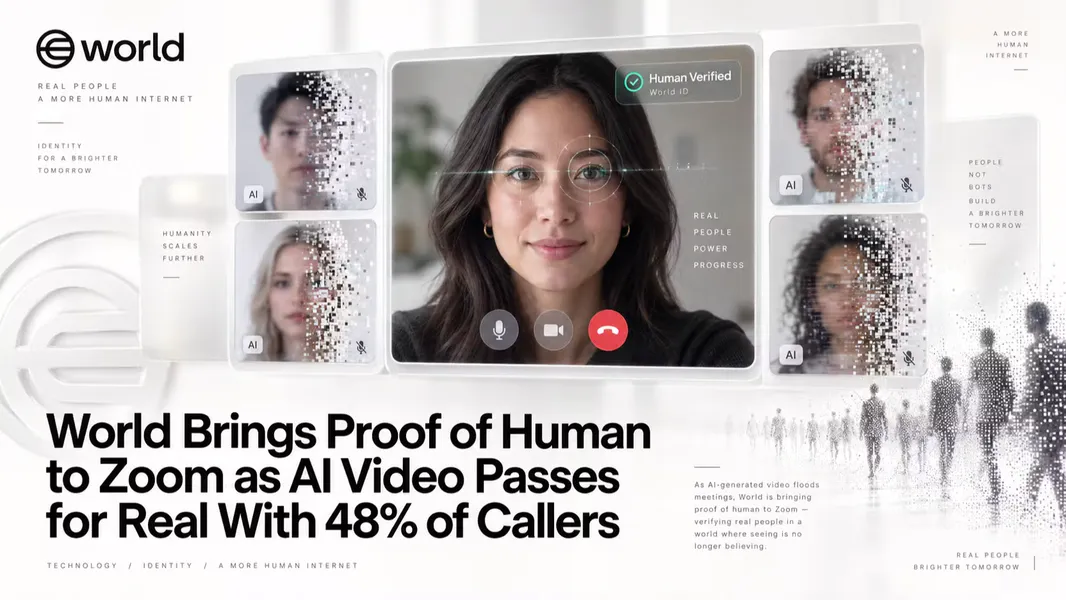
Tavus says its Griffin-Lite model persuaded 26 of 54 people after a one-minute live video call that they had spoken with a person. World’s response, World ID for Zoom, points to a different model of trust: verify a person’s credential instead of judging whether the video looks real.
A small test, a consequential signal
Tavus told participants they would speak with another participant about what they were looking forward to; in fact, the other side used AI to generate a face, voice and replies in real time. Asked afterward whether their partner was human, 26 said yes, with an average confidence of 79% among those who did. The 48% figure is therefore a result from this 54-person test, not a general estimate of how often people mistake AI video for a human.
The contrast with Tavus’s previous system is striking: the article says it convinced one caller out of 41. But the experiment measures judgments in a specific setup, not how well people detect deepfakes across different calls or circumstances.
Tavus also reports results from NVIDIA’s VideoFDB benchmark. On its generation track, which scores fluency, matched emotion and nonverbal behavior, Griffin-Lite scored 3.83 out of 5, against 2.80 for the next-best system and 3.92 for the human reference. On the perception track, which covers understanding, visual grounding and conversational flow, it scored 3.73, compared with 3.44 for the strongest baseline and 4.20 for humans. The gap suggests that producing convincing social signals and understanding a conversation remain distinct capabilities.
World checks a credential, not the pixels
World ID for Zoom is described as matching a signed image from a person’s original Orb verification with a fresh phone selfie and the live frame shown to other meeting participants. After the check, a Verified Human badge appears on the participant tile; hosts can require verification in a waiting room or request it during a meeting, according to the feature description.
That approach changes the question from “Does this video look genuine?” to “Can this caller prove they are a verified human?” It sidesteps a contest in which increasingly convincing generated faces and voices can make visual inspection less reliable. It does not, by itself, establish that a verified person is acting honestly or that the credential prevents impersonation in every setting.
Privacy is part of the product’s claim. World says biometric data is not shared with Zoom, while verification status and the user’s World ID username leave the device. That description comes from World; the available reporting does not independently verify the implementation.
The same idea extends to AI agents
World describes a related use for agents: a verified person can delegate a proof using zero-knowledge proofs, allowing a website to check that a unique human stands behind an agent’s request without learning that person’s identity. Its developer tool, AgentKit, is in beta, while the article describes Okta’s Human Principal service as early-access beta and Vercel’s human-in-the-loop approval work as being added to its Workflow SDK.
The useful distinction is between identifying an agent and establishing who authorized it. A human-backed proof could help a service apply limits or permissions to requests without requiring the agent to pretend to be a person. Whether that translates into reliable authorization depends on adoption and how services use the proof; the article describes an emerging approach, not a demonstrated fix for fraud or unfair access.