World ID for Robots: Edge Verification Without Exposing Identity
Published by AINave Editorial • Reviewed by Ramit
World ID for robots is now live. World and peaq have integrated World ID with peaqOS, letting robots verify that a real, unique human is present without learning who that person is. The check uses a zero-knowledge proof delivered through World App, and machines running peaqOS can perform it natively with no API key and no per-verification charge. For builders deploying autonomous machines in public spaces, this removes a persistent trade-off between security and privacy.
How World ID works with peaqOS at the edge
World ID is a human verification system that has onboarded nearly 18 million people via Orb across 160 countries. peaqOS is a machine-identity layer that has given over 3.3 million machines their own decentralized identifiers (DIDs) and wallets, processing more than 200 million transactions across 60 applications. The integration connects these two layers so that a robot can request a World ID proof from a person standing in front of it. The person presents the proof through World App, and the robot receives a confirmation that the human is real and unique, but nothing else. The process is coordinated through peaq's Machine Market, and the interaction can produce an auditable record with proof metadata redacted.
The cost and privacy advantage for autonomous systems
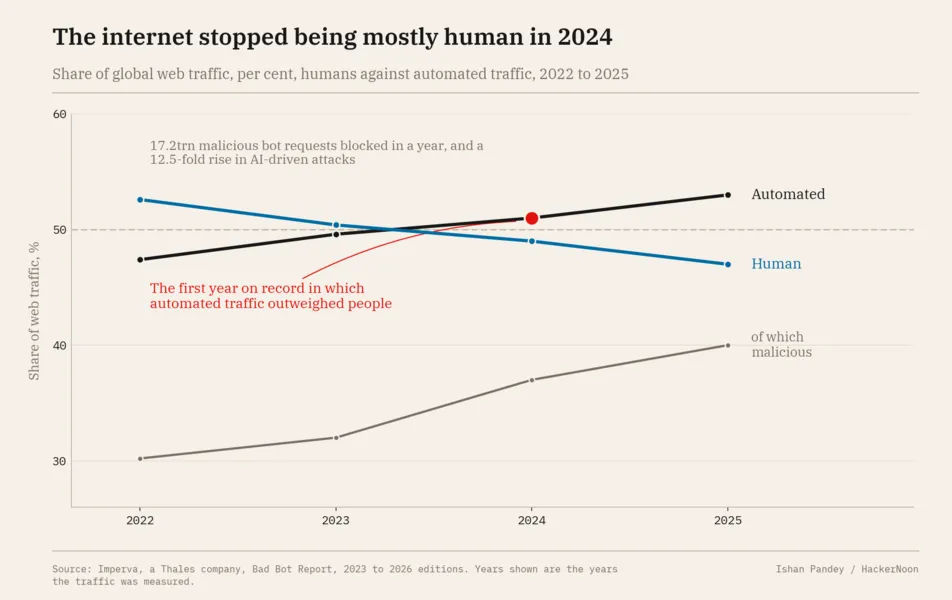
Automated traffic accounted for 53% of all web requests in 2024 and 2025, and Thales blocked 17.2 trillion malicious bot requests in a single year. Physical robots face a similar verification problem: they need to know who they are handing something to, but collecting identity data creates breach risk. Customer personal data costs about $160 per record exposed, and healthcare has been the costliest sector for breaches for thirteen consecutive years. The World ID integration eliminates per-verification cost, making the check a default rather than a feature an engineer has to justify. It also removes the need to store identity data entirely, because the machine receives a proof, not a name or face.
Medication handoffs and one-per-human enforcement
The integration leads with a medication delivery scenario. A patient verifies through World App before the order is accepted. The pharmacist verifies before loading the medication into the robot's sealed compartment. When the robot arrives, the patient verifies again, and the system confirms the recipient is the same human associated with the order before unlocking. At no point does the robot learn the patient's name or medical condition. The same pattern works for enforcing one-per-human rules at promotional giveaways or shared machines like lockers and charging points, where an operator can verify uniqueness without asking for an account.
Reach, fallback, and regulatory questions
Four factors will determine how far this goes. Reach: a person must have a World ID, which requires in-person Orb verification. World has been expanding Orb distribution with a smaller form factor, but density varies by city. Fallback: any physical system needs an answer for a person whose phone is dead, and designing that path without reintroducing pickup codes is an open engineering problem. Presence: a zero-knowledge proof confirms authorization, not physical proximity. World's face-continuity features, shipped in April 2026, may address that. Regulation: biometric verification attracts scrutiny, but the architecture minimizes data retention by converting images to a code on the Orb, sending it to the user's device, and deleting the copy. The machine receives no identity at all, which is a stronger regulatory position than any system that retains what it collects.
The integration is small in engineering terms and unusually well-aimed. World already had proof of human, peaq already had machine identity, and the work was connecting them so a robot can ask a question it has always needed to ask and receive an answer that contains nothing it should not have. The real test is whether the 3.3 million machines already carrying peaq identities actually start asking, and whether the pattern escapes delivery into shared machines and healthcare.