Runware’s Sonic Inference Pod brings portable infrastructure to AI inference
Published by AINave Editorial • Reviewed by Ramit
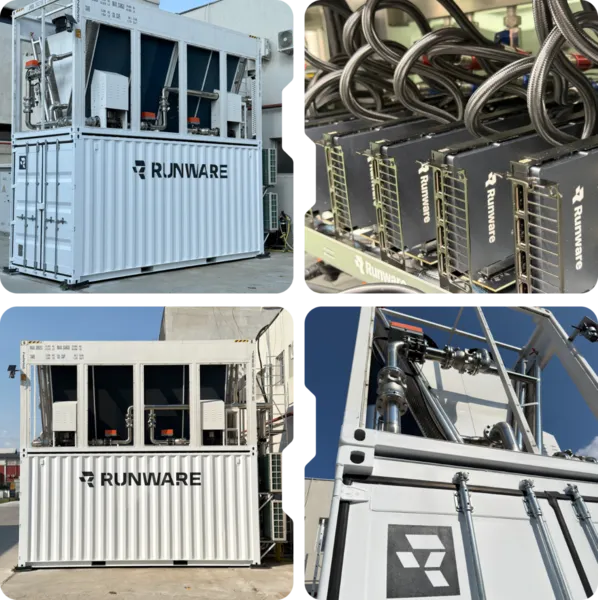
Runware has launched the Sonic Inference Pod, a modular and transportable data-center unit for AI inference. For AI builders, the important change is architectural: instead of waiting for a large fixed facility, capacity can be added through smaller units placed closer to users. That may help with latency and regional capacity, but the available evidence does not yet prove the claimed cost or performance advantage.
A portable data center designed for inference
Runware describes the Sonic Inference Pod as a self-contained compute unit that can be deployed wherever suitable power is available. The company says it can add capacity by deploying more pods, rather than expanding a traditional data center. Runware reports 10 pods in deployment across the U.S., Europe, and Asia-Pacific, with 160 sites available to host additional units. Higgsfield AI and Wix are among the companies using Runware’s inference services.
The company also says the pods use closed-loop cooling with no water. Runware’s CEO frames this as a way to meet rising inference demand without relying entirely on new, large-scale grid and facility expansion. That is a company position, not an independently verified environmental result.
Distributed compute could change the latency equation
The practical appeal is distributed compute for AI. Runware says requests can be routed across one network to the nearest available pod, while traffic can move elsewhere if a pod goes offline. For products serving users across multiple regions, that design could reduce dependence on a single distant facility and provide another route to AI inference at the edge.
This matters most for interactive workloads, including image generation and agent workflows where repeated requests make latency and capacity constraints visible to users. A pod-based model could also let a product team expand regionally in smaller increments. Dedicated customers can reportedly receive an entire pod, although the supplied material does not describe contract terms, hardware specifications, or service-level commitments.
Faster deployment, with important unknowns
Runware says its pods can be built in days, contrasting that with the months or years associated with traditional data-center construction. Adding pods may therefore be operationally simpler when demand is uneven or when a team needs capacity in a new geography.
The trade-off is that portability does not remove infrastructure risk. The sources provide no independent figures for latency, throughput, energy efficiency, uptime, maintenance costs, or total cost of ownership. Runware claims higher-quality inference at lower cost than some serverless inference platforms and GPU clouds, but builders should treat that as a vendor claim until the comparison includes the same models, hardware, utilization, networking, and operational support.
For teams evaluating infrastructure, the sensible question is not whether pods replace hyperscale data centers. The launch is better understood as a possible complementary layer for regional inference and rapid capacity expansion. It becomes a compelling option only when Runware can show workload-level benchmarks, pricing, failure behavior, and data-handling details that match a builder’s requirements.
Sources
- Is the future of data centers portable? Runware builds a pod to find out
- Runware Introduces Portable Sonic Inference Pod to Revolutionize AI...
- Runware launches Sonic Inference Pod to bring modular AI data...
- Runware Introduces Modular AI Pods to Scale Inference... - #Mezha
- Runware's Portable AI Pods Aim To Make Data Centers More Flexible
- Is the future of data centers portable? Runware builds a pod to find out
- Runware Unveils the Sonic Inference Pod, a Modular Data Center Built Specifically for AI Inference
- Runware | One API for all AI
- Is the future of data centers portable? Runware builds a pod to find out