NVIDIA SIGGRAPH breakthroughs push physical AI from graphics to real-time robotics
Published by AINave Editorial • Reviewed by Ramit
NVIDIA's SIGGRAPH research slate this year shifts from making worlds look real to making them behave realistically in real time, with direct implications for AI builders working on simulation, robotics, and digital twins. The company presented 21 accepted papers focused on physically grounded AI systems that can drive both virtual characters and real humanoid robots using the same model.
What happened
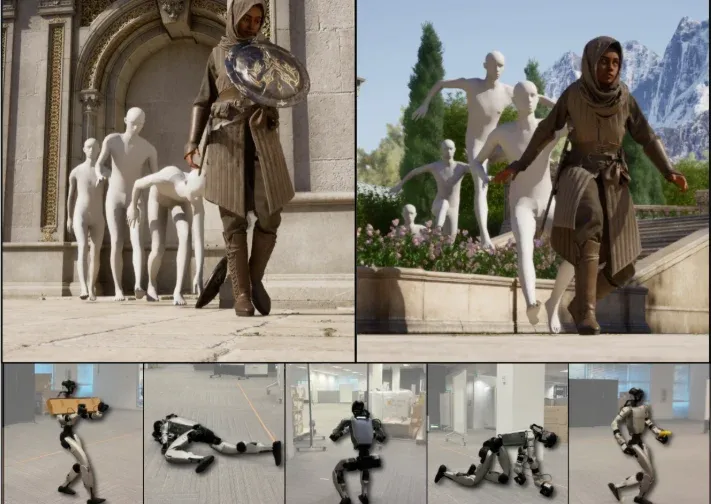
NVIDIA disclosed a suite of real-time, physically grounded AI research at SIGGRAPH, including 21 accepted papers centered on AI-driven world construction that is grounded in 3D and physics NVIDIA blog. The centerpiece is MotionBricks, a real-time motion model trained on more than 350,000 motion clips that runs at game-engine speeds and can drive both on-screen animation and a Unitree G1 humanoid robot in real time parent article.
The GPC framework trains generative controllers on large-scale motion datasets to provide transferable motor skills, described as a foundation model for motor control. ArtiFixer turns messy real-world 3D captures into clean, complete virtual scenes and includes a method to predict photoreal global illumination directly from scene geometry without ray tracing. A new solver in Nvidia Newton brings hard-to-simulate materials like snow, sand, and elastic solids to life. VideoNeuMat provides reusable, relightable materials from generative video models, while ARDY enables autoregressive diffusion-based, text-prompt-driven steering of 3D character motion in real time. Papers and code are openly available for download parent article.
Why AI builders should care
These are not just graphics demos. They provide open-source toolchains for building physically accurate simulations and motor control models. The same MotionBricks model that drives an animated character on screen also drives a real Unitree G1 humanoid robot, showing a direct path from simulation to real-world deployment. GPC as a foundation model for motor control could reduce the need for task-specific training, letting builders reuse a single controller across different robots or tasks. ArtiFixer and the Newton solver improve the fidelity of virtual environments, which is critical for training physical AI systems that need to generalize to the real world.
Practical implications
For AI builders, these papers and code are openly available, so teams can integrate them into their own pipelines. MotionBricks can be used for character animation in games or for generating training data for robotics. ArtiFixer can clean up 3D scans for digital twins, reducing manual cleanup time. The Newton solver enables more realistic material simulation for snow, sand, and elastic solids, which matters for autonomous driving or construction robotics. VideoNeuMat and ARDY give creators control over materials and motion from text prompts, lowering the barrier for generating high-quality virtual content.
Caveats
Source evidence is primarily from press coverage and NVIDIA demonstrations; specifics may evolve as papers and code are released. The models may require significant compute resources. The GPC framework is described as a "start" of a foundation model, not a production-ready system. The real-world robot control demonstration is impressive but may have limitations not disclosed in the press materials. Builders should evaluate the open-source code directly before committing to integration.
FAQs
Sources
- Nvidia brings graphics research breakthroughs to simulation and physical AI
- At SIGGRAPH, NVIDIA Advances Graphics and Simulation With...
- NVIDIA Graphics Research Accelerates Simulation & Physical AI...
- AI advancements in graphics and simulation for robotics... | LinkedIn
- NVIDIA REFUSED To Send Us This - NVIDIA A100 - YouTube
- Nvidia: Data Centers Made It Great, Physical AI Could Make It Generational
- With The SpaceX IPO Imminent, Nvidia And Tesla Accelerate The Race For Physical AI
- NVIDIA and Doosan Expand Physical AI Across Robots, Reactors, and Circuit Board Materials
- Nvidia Korea R&D Center Launches Hiring: Huang Brings Physical AI, HBM4 Deals to Seoul
- Cadence Teams With Nvidia And Google To Redefine AI System Engineering
- NVIDIA Research Shapes Physical AI
- NVIDIA Research Advances Physical AI with Innovative Graphics...
- NVIDIA unveils DLSS 5 and Cosmos AI push at SIGGRAPH keynote
- NVIDIA’s SIGGRAPH push brings AI agents deeper into creative workflows
- Nvidia Cosmos 3 Launches With Open Weights and Enterprise AI Caveats