Codex on Amazon Bedrock Adds Governed Agentic Coding for Enterprises
Published by AINave Editorial • Reviewed by Ramit
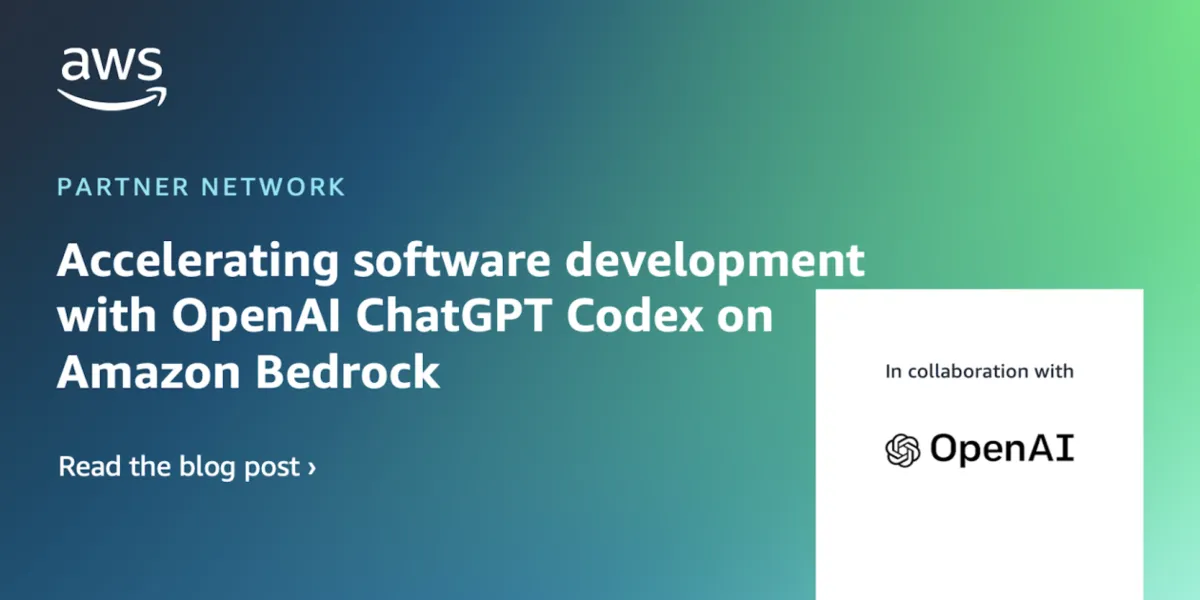
OpenAI ChatGPT Codex is now available on Amazon Bedrock, giving enterprise teams a managed, serverless API for using OpenAI frontier models in software development workflows. For builders, the important change is the deployment path: teams can bring agentic coding into an existing AWS governance model instead of managing a separate inference stack.
Codex moves beyond autocomplete into SDLC work
The AWS announcement positions Codex as an AI coding agent that can handle multifile context, reason through multistep tasks, and support work across the software development lifecycle. That is a different operating model from code generation with Codex limited to isolated suggestions. A developer might use it to investigate a bug, modify several related files, or help with tests and documentation, while a human remains responsible for review and merge decisions.
The underlying capability and the surrounding platform should be kept separate. Codex provides the coding agent and model access; Bedrock provides the managed API, authentication, networking, monitoring, and billing layer. The supplied evidence does not include independent testing of task success, latency, or production deployment outcomes, so teams should not treat the announcement as proof that Codex will deliver a specific productivity improvement.
AWS governance is the main enterprise differentiator
For organizations with strict controls around source code and model traffic, the integration addresses several operational concerns. Amazon Bedrock describes a zero operator access design intended to remove the technical means for AWS or OpenAI operators to access customer prompts and completions. That is a meaningful policy and architecture claim, but teams should still map it against their own data handling, retention, and compliance requirements.
Bedrock IAM fine-grained access control can restrict which users or systems invoke the model. Teams that need private connectivity can use PrivateLink for Bedrock to keep traffic between a VPC and Bedrock on the AWS network rather than sending it across the public internet.
CloudWatch provides visibility into usage, latency, and errors, while CloudTrail records API calls for auditing and security investigations. Together, these controls make an enterprise AI coding assistant easier to place inside existing operational processes, although they do not replace code review, repository permissions, secret scanning, or agent sandboxing.
The cost model fits variable developer workloads
Codex on Amazon Bedrock uses pay-per-token pricing with no seat licenses or upfront commitments, and charges can be consolidated with other AWS workloads. That may suit teams with uneven usage or automated coding jobs, but token pricing also makes long-running agent tasks harder to budget than a fixed per-developer plan. Cost controls should include usage alerts, model selection rules, and limits on unattended execution.
Codex runs locally through its CLI, desktop app, or IDE extension, while requests are routed to Bedrock through the Bedrock Responses API using AWS authentication. A typical setup uses the AWS_BEARER_TOKEN_BEDROCK environment variable. Data residency is tied to the Amazon Bedrock Region selected, so regional availability and organizational policy still matter.
For an existing AWS customer, this is a practical single-platform route to an enterprise AI coding assistant. The strongest case is not that Bedrock makes the model smarter. It is that AWS governance and security for Codex reduce the infrastructure and approval work required to deploy it. Teams should pilot a narrow repository workflow, measure token cost and review burden, and validate the security boundary
Sources
- Accelerating software development with OpenAI ChatGPT Codex on Amazon Bedrock
- OpenAI | Research & Deployment
- AWS Simplifies AI App Development with OpenAI and... | LinkedIn
- How Codex ran OpenAI DevDay 2025
- GitHub - openai/codex: Lightweight coding agent that runs in your...
- You Can Finally Use Codex on Your Phone : How to Set It Up
- OpenAI brings Codex to mobile devices, adds more customization features
- OpenAI launches ChatGPT Work with GPT-5.6 integration
- OpenAI tweaks chat access in the ChatGPT app for Mac
- OpenAI models and Codex on Amazon Bedrock are now generally available | Artificial Intelligence
- OpenAI models, Codex, and Managed Agents come to AWS | OpenAI
- Use Codex with Amazon Bedrock | OpenAI Help Center
- OpenAI frontier models on Amazon Bedrock – AWS
- GPT-5.5, GPT-5.4, and Codex from OpenAI are now generally available on Amazon Bedrock - AWS
- OpenAI putting Codex inside ChatGPT, 6 new business plugins now available