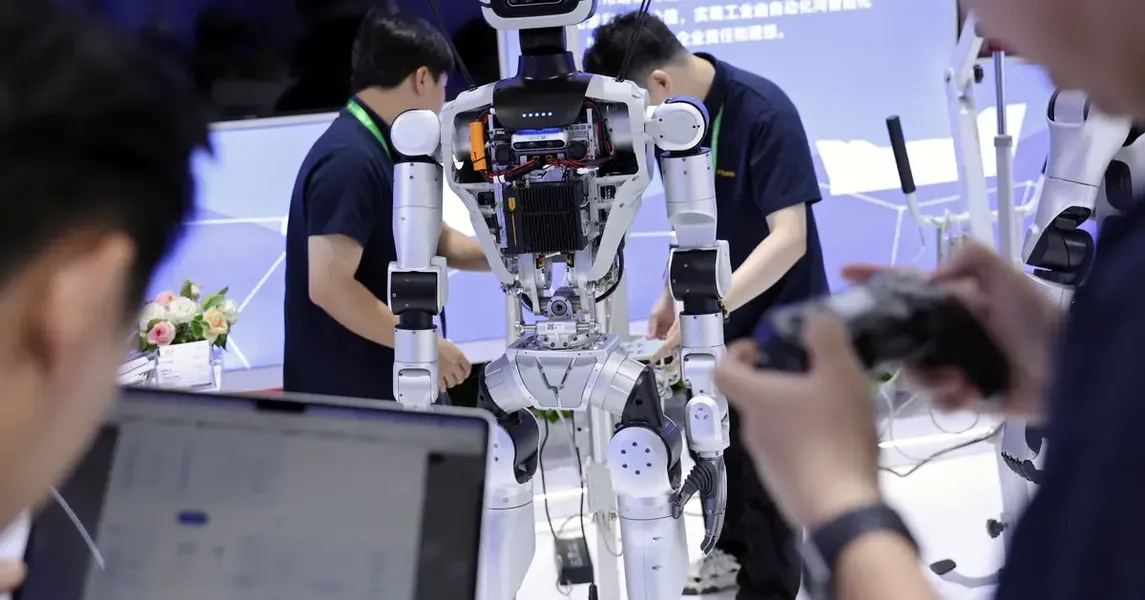
China leads embodied AI robotics in 2024, reshaping the global competition
Published by AINave Editorial • Reviewed by Ramit
China installed a record 295,000 industrial robots in 2024, delivering roughly 54% of the global total, signaling a decisive lead in embodied AI-the integration of AI with robotics for autonomous real-world operation. This distribution of robot deployments signals where investment, supply chains, and policy focus will concentrate, affecting hardware access, partnerships, and regional strategies for AI builders and robotics developers. The United States is pushing a national robotics strategy to counter Beijing, German manufacturers are betting on reliability and data security of domestic robots, and India faces the challenge of preserving its cheap-labor manufacturing edge amid automation trends. Builders should watch how regional ecosystems for sensors, AI software stacks, and hardware platforms coalesce around where deployments are strongest, as this shapes which tools and partners will become dominant in the coming years. The following sections summarize what happened, why builders should care, practical implications, and caveats, followed by frequently asked questions grounded in the cited evidence.
What happened
China's 2024 industrial robot installations reached a record high, accounting for about 54% of the global total. This scale reflects a broader push to integrate embodied AI across manufacturing and automation. In response, US robotics firms are urging policymakers to adopt a national strategy to bolster domestic capabilities and reduce dependence on external suppliers. German manufacturers expect that customers will value reliability and data security of domestic robots, potentially outcompeting Chinese options in some markets. India installed 9,100 industrial robots in 2024, underscoring the stakes for maintaining a low-cost labor advantage in the face of automation pressure. These dynamics collectively point to a shifting global landscape for robotics supply chains and AI-enabled automation.
Why AI builders should care
The geographic concentration of robot deployments highlights how national strategies and policy environments will shape where AI-enabled robotics ecosystems form. A domestic push in the United States could accelerate hardware-software integration and reduce reliance on foreign components, while Germany's emphasis on safety and security may create premium markets for compliant robots. China's scale fosters a dense supplier ecosystem for sensors, actuators, and AI software stacks, making it a likely hub for embodied AI development. Builders should consider which hardware platforms, APIs, and regulatory settings are likely to dominate in key regions and plan partnerships accordingly.
Practical implications
Developers should map regional adoption trajectories to time their AI software integration and hardware partnerships. Partnerships with Chinese suppliers may offer cost and scale advantages but carry geopolitical and data security considerations. Western alternatives may command higher margins where trust and regulatory compliance matter. Investors and product teams should monitor policy developments, particularly in the United States, which could unlock funding and procurement opportunities for domestic robotics initiatives. India's comparatively low installation rate suggests opportunities for affordable AI-driven automation that preserves productivity without eroding the cheap-labor advantage.
Caveats
The evidence centers on 2024 installation metrics and policy responses. Broader 2025-2026 data and non-Chinese sources may offer additional nuance. Some sources discuss AI/robotics trends without quantifiable metrics beyond 2024. Competitive dynamics could shift with new policies, trade rules, or breakthroughs in technology.
FAQs
Why did China lead in industrial robotics in 2024? China installed a record 295,000 industrial robots in 2024, representing 54% of the global total, driven by strategic investment in embodied AI and automation across manufacturing sectors. Source: Semafor article. Semafor article.
What is embodied AI and how does it relate to robotics? Embodied AI refers to AI systems integrated with physical robotics, enabling autonomous operation in the real world. China's robotics push is framed as part of a broader embodied AI leadership strategy in manufacturing and automation.
How is the United States responding to China's robotics lead? US robotics firms are pushing for a national robotics strategy to counter Beijing's lead, with policy proposals and strategic investments aimed at accelerating domestic robotics development and reducing external dependency.
Which countries are investing in robotics for manufacturing? China has the largest installed base and continuing investments. The United States, Germany, and India are highlighted as key actors with distinct strategies and competitiveness positions.
What role do German manufacturers play in competing with Chinese robots? German manufacturers expect domestic robots to win on reliability and data security, potentially outcompeting Chinese options in their home market and in regions where those attributes are prioritized.
How might robotics leadership affect global supply chains? Leadership in robotics could shift manufacturing competitiveness, influence policy and investment, and alter the geography of production, with implications for supply chain resilience and cost structures. Source: Semafor article. Semafor article.
Sources
- Countries grapple with China’s robotics lead
- Countries grapple with China's robotics lead - biztoc.com
- Is China Leading the Robotics Revolution? | ChinaPower Project
- China surges ahead as global robotics powerhouse
- China's Robotics Leads Global AI Pack - 中国科技网
- Countries grapple with China’s robotics lead
- Why It’s Nearly Impossible to Build a Robot Without China
- Embodied AI: China's ambitious path to transform its robotics industry
- Will Robots Replace Workers? Lessons from China - VoxDev
- How competitive is China in robotics today? - Reddit
- 2025/74 "The AI-Robotics Revolution, China-US Rivalry and Southeast ...
- The AI-Robotics Revolution, China-US Rivalry and Southeast Asia
- Embodied AI: China's Big Bet on Smart Robots
- China Robotics Firms Line Up IPOs to Pitch Next Phase of AI
- MagicLab Robotics Unveils Its Embodied AI Vision in Silicon Valley, Expands Global Reach to 50 Countries