OpenAI's Ohio data-center plan: what builders need to know about the world's largest hyperscale footprint
Published by AINave Editorial • Reviewed by Ramit
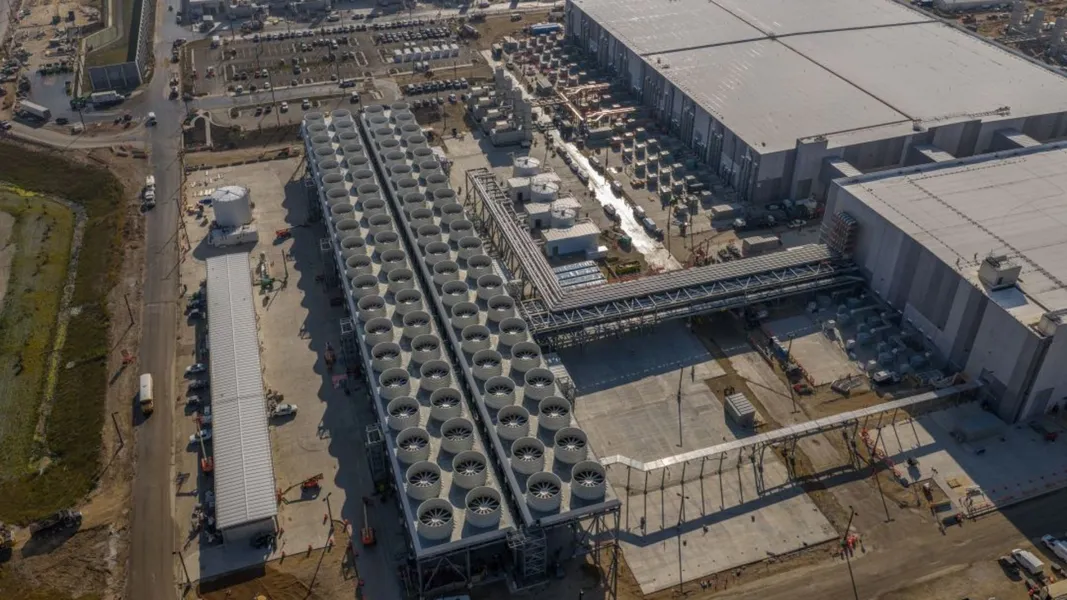
OpenAI announced plans to lease space at SB Energy's PORTS-Pike Technology Campus in Pike County, Ohio, for a hyperscale AI data center that will eventually reach 8 gigawatts of computing capacity. The project, which U.S. Secretary of Energy Chris Wright called the largest AI data center in the world, is backed by a $1.5 billion investment from Nvidia and a phase-one cost estimate of $30 billion to $40 billion. For AI builders, the headline is not just the scale: it's the financing structure, the exclusive Nvidia hardware commitment, and the multi-year timeline that reveal how frontier AI infrastructure is being built.
The plan: 8 GW of compute on a former nuclear site
The campus sits on the former Portsmouth Gaseous Diffusion Plant, a Cold War-era nuclear facility that is being cleared of radioactive contamination. SB Energy, a Japanese-owned infrastructure builder, owns the site and will construct and operate the data center. OpenAI will lease the space. By project end, the center will have 8 gigawatts of computing capacity for servers and equipment, plus 2 gigawatts for power conversion, cooling, and other systems, for a total of 10 gigawatts of infrastructure. The center will exclusively host Nvidia AI computing hardware.
Nvidia is investing $1.5 billion in SB Energy and providing credit support for the land, power, and buildout needed for the first 4.25 gigawatts, about half the total power. OpenAI will fund the remaining power capacity. SB Energy will pay for necessary power grid upgrades and new transmission lines. OpenAI stated that electricity and infrastructure costs will not be passed onto residents.
Why this matters for AI builders
This project is a signal about compute capacity assurance at the frontier. OpenAI is locking in dedicated Nvidia hardware at a scale that dwarfs any existing AI data center. For builders relying on OpenAI's API, this could mean more stable capacity for future models, but it also deepens the vendor lock-in between OpenAI and Nvidia. The project also highlights the massive capital and coordination required: phase one alone costs $30 billion to $40 billion, and full buildout depends on permits, environmental reviews, and grid upgrades that could take years.
For most AI builders, the near-term impact is minimal. The campus won't reach its full 8 GW capacity until the late 2020s or early 2030s. But the project sets a benchmark for hyperscale AI infrastructure and shows that OpenAI is thinking in terms of dedicated compute, not just rented cloud capacity.
Timeline, cost, and community commitments
Phase one construction is ramping up this year and aims for 800 megawatts of power by 2028. Full campus construction will continue through 2032. The build is expected to create about 35,000 construction jobs, with priority for regional workers, and roughly 2,500 permanent staff once operational. OpenAI will contribute $40 million to a resident-steered community grant fund, matching a previous $40 million commitment from SB Energy. OpenAI will also give every Ohio college student access to ChatGPT.
What remains uncertain
The project depends on getting required infrastructure, permits, environmental reviews, and financing. Local opposition to hyperscale data centers exists across Ohio, with some communities attempting bans. The campus design is still ongoing, and OpenAI has not shared its potential square footage. Full power usage will require new power plants, natural gas generation, and new transmission lines. The exact timeline for reaching 8 GW of computing capacity remains contingent on these factors. For now, the Ohio project is a reminder that frontier AI compute is becoming a national infrastructure play. Builders should watch the timeline and capacity milestones, but the real impact on API pricing and availability will take years to materialize.
FAQs
Sources
- OpenAI to build world's biggest AI data center in Ohio. What we know
- OpenAI to build world's biggest AI data center in Ohio. What we know
- OpenAI announces plans for data center in Ohio, other sites in the...
- 'People Are Worried' About OpenAI Data Centers: Sam Altman
- Openai to Build Data Center on Top of A Sick Child | TikTok
- Sam Altman on Building OpenAI to a Billion Users - YouTube
- UAE and OpenAI build world's largest AI data center | LinkedIn
- NVIDIA Guarantees up to $105B for 8-GW Ohio AI Campus Leased by OpenAI
- Nvidia in talks to back $500B OpenAI data center — days after CEO Jensen Huang voiced support for controversial open-source AI used by China
- Nvidia Weighs $250 Billion OpenAI Backstop for Ohio Data Center
- Meta joins OpenAI and BlackRock in sealing union pacts for AI data centers
- Nvidia’s $250B Guarantee for OpenAI Ohio Campus Proves Debt Markets Said No
- OpenAI.fm
- Nvidia, SB Energy Announce Massive Ohio Data Center for OpenAI
- OpenAI announces massive Ohio data center with Nvidia guarantee
- Nvidia’s rumored $600 billion OpenAI deal could reignite its biggest AI controversy
- Nvidia in talks with OpenAI to guarantee $250B for US' biggest data center project that also has Japan's 'promise'