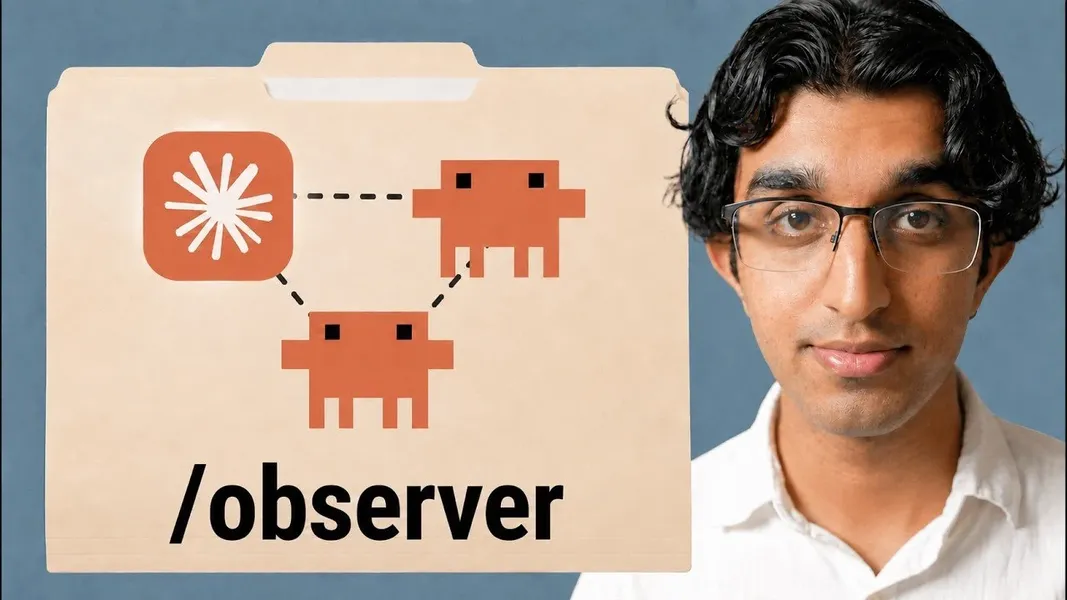
Anthropic observer agents: real-time supervision for high-stakes AI tasks
Published by AINave Editorial • Reviewed by Ramit
Anthropic has introduced observer agents, a supervisory layer that pairs a monitoring agent with a primary worker agent to oversee long-running AI tasks. The observer monitors every tool call and result in real time and can intervene or halt the task if the worker deviates from predefined constraints or ethical guidelines. The system is integrated into Anthropic's cloud code infrastructure and can be activated with a simple command to pair an observer with a worker.
What happened
Observer agents are specialized sub-agents designed to ensure that worker agents operate within operational boundaries and avoid unethical or incorrect methods. According to Ray Amjad, this approach enhances reliability and accountability, particularly in scenarios where precision and compliance are essential. The observer tracks every tool call and result generated by the worker, providing continuous oversight. If the worker deviates, the observer can issue corrective feedback or halt the task entirely. This separation of roles (execution by the worker, oversight by the observer) aims to create a transparent and accountable system.
Why AI builders should care
For teams building AI products that involve long-running or high-stakes tasks, observer agents offer a mechanism to enforce constraints and ethical guidelines without manual supervision. This is especially relevant for regulated industries, research environments, and any workflow where a mistake could have significant consequences. The activation is straightforward within Anthropic's cloud code infrastructure, suggesting low integration friction for teams already using similar cloud workflows. The real-time oversight can reduce the risk of unethical behavior or constraint violations, which is critical for maintaining trust and compliance.
Practical implications
Observer agents track all tool calls and results, enabling detailed oversight and potential halting of tasks when constraints are breached. This capability is valuable for tasks requiring strict adherence to methodologies, such as autonomous research, regulatory compliance, and large-scale data processing. The system can be activated with a simple command, making it accessible for teams that need to add a supervisory layer without extensive reconfiguration. However, the continuous monitoring introduces additional cost, system complexity, and potential latency, which must be weighed against the benefits of improved task integrity and error reduction.
Caveats
The primary source for this information is a single article from Geeky Gadgets, and details on implementation, performance benchmarks, and real-world effectiveness are not provided. The trade-offs of cost, complexity, and latency are mentioned but not quantified. Teams should evaluate observer agents on a per-use-case basis, considering the criticality and duration of tasks. The system is integrated into Anthropic's cloud code infrastructure, but specifics on how it interacts with other Anthropic services or third-party tools are not available. As with any new AI oversight mechanism, independent testing and validation are recommended before deploying in production.