AI Content Moderation: A Sub-600M Model Ensemble Challenges Giants with a 3-Class Taxonomy
Published by AINave Editorial • Reviewed by Ramit
A bootstrapped AI company called Hindsight claims its sub-600M parameter ensemble model outperforms content moderation models from Azure, Google, Mistral, OpenAI, and Meta on detecting weaponized coded language, achieving 97.9% accuracy. The system uses a three-class taxonomy (Red Flags, Yellow Flags, Safe) instead of binary safe/unsafe, and was trained almost entirely on a 2023 MacBook Pro using Apple's Metal Performance Shaders. For AI builders, this is a case study in how focused data prioritization and a small ensemble can rival cloud-scale models on a narrow but critical task.
What Hindsight Built
Hindsight's architecture is a 3-base Small Language Model ensemble with fewer than 600 million total parameters. The system pairs one model's decoupled embedding architecture with two independently trained models, feeding richer tokens into its layers during inference. According to the company, this allows it to parse malicious intent that other models miss, including leetspeak, phonetic masking, misspellings, and extremist dog whistles. The team trained 164 model variants, with only four validation trainings on AWS g5.xlarge instances; the rest were developed on a 2023 MacBook Pro using Apple's MPS framework, an M3 Max chip, and 64GB of RAM.
Why the Three-Class Taxonomy Matters
Most AI content moderation models use a binary safe/unsafe classification, which forces platform operators into a trade-off between over-censoring (false alarms) and allowing hidden threats through (missed flags). Hindsight's Red Flags, Yellow Flags, and Safe taxonomy adds a middle ground. Red flags are clear violations requiring immediate action, yellow flags are suspicious content that needs human review, and safe content passes through. This granularity is especially useful for detecting weaponized coded language, where intent is often ambiguous.
Hardware Frugality and Training Approach
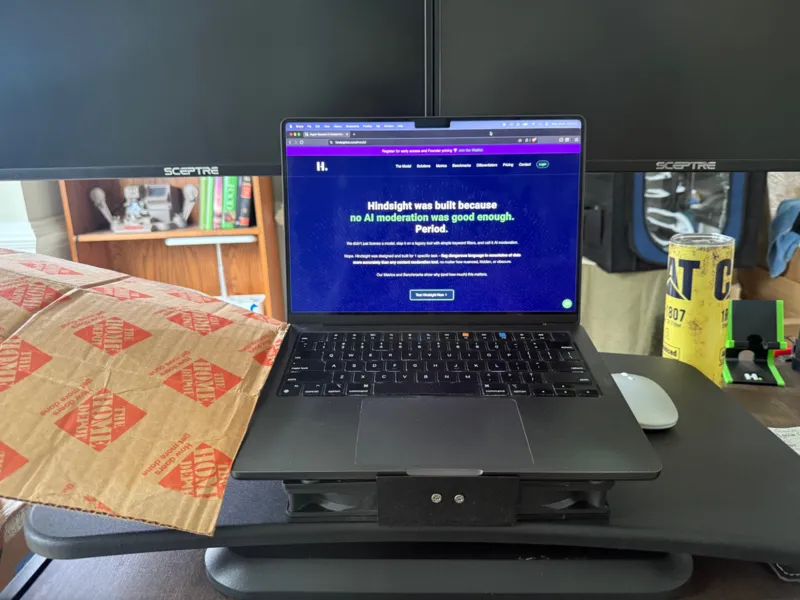
Hindsight's founder Dean Gebert trained the models on a MacBook Pro with an M3 Max chip and 64GB RAM, using Apple's Metal Performance Shaders framework. Training times were 4 to 6 times longer than cloud GPU equivalents, but the aggressive pace of 2-3 new model variants per day allowed rapid iteration. The total cloud compute cost was minimal: only four validation runs on AWS g5.xlarge instances. This demonstrates that for specialized tasks, a lean hardware setup with careful data prioritization can produce competitive results without enterprise cloud budgets.
Practical Implications for Builders
For platform operators in e-commerce, dating apps, social media, or any user-generated content environment, Hindsight's approach offers a potential alternative to expensive, general-purpose moderation APIs. The company plans an early-September launch with a cap of four commercial partners, each receiving a fine-tuned model for their specific platform and risk profile. Hindsight also offers a contractual $1M USD professional liability guarantee if a missed flag results in a damaging liability, which is rare in the SaaS space and signals confidence in the model's accuracy.
Caveats and What's Not Yet Clear
The article describing Hindsight's claims is sponsored content on HackerNoon, meaning the benchmarks and comparisons are vendor-reported and not independently verified. The 97.9% accuracy figure is against which specific models, datasets, and evaluation protocols is not detailed. The launch timeline and partnership cap may change. Builders should treat this as an interesting signal but wait for independent evaluation before committing to the platform. The core lesson -- that a small, well-tuned ensemble can outperform general-purpose giants on a narrow task -- is worth watching, but the specific numbers need third-party confirmation.