AI coding tools for non-developers: 34% of software builders lack formal programming background
Published by AINave Editorial • Reviewed by Ramit
A Zapier-Centiment survey of about 800 U.S. employees finds that 34% of people shipping software using AI tools have no formal programming background. That means one in three builders creating production software today never took a college programming course or worked as a developer. For technical teams, this changes the risk profile of internal tools and customer-facing applications.
Who is building software now
Non-traditional builders rely on a familiar set of tools. 82% use general-purpose chatbots like ChatGPT or Claude Code, 71% use AI coding assistants inside existing editors such as GitHub Copilot, and 40% use dedicated AI coding software like Cursor. source These workers are not just prototyping. 49% have shipped four or more tools in the past year, and 54% say most or all of those tools remain in use today.
What non-developers are actually building
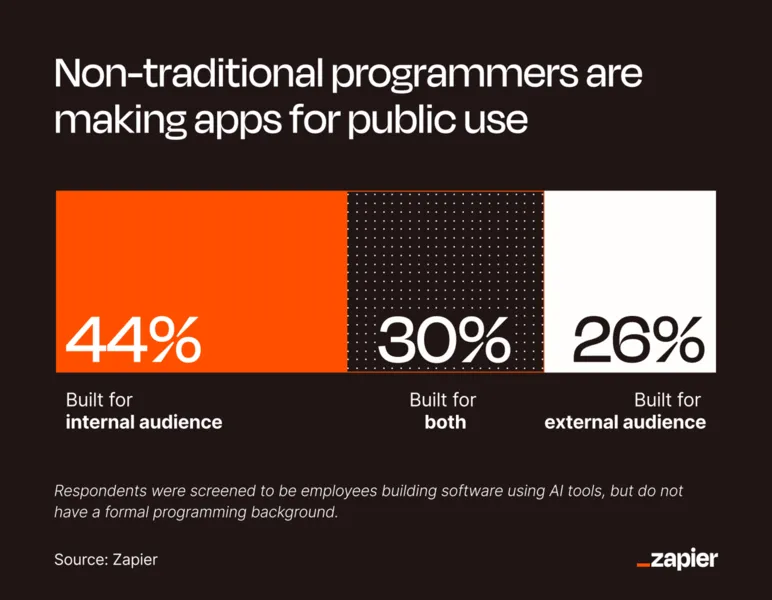
The most common outputs are data analysis or visualization tools (41%), forms and surveys (39%), and AI-powered chatbots or assistants (37%). source Speed is a clear pattern: 30% go from initial idea to working tool in less than a day. And 56% build tools that customers or the general public will see, not just internal utilities.
The security gap that comes with speed
Building the initial app is now easy. Getting it to talk to the rest of the company's tools without handing over credentials to an AI model is where non-developers struggle. source The survey confirms the pain points: 38% report code errors or bugs, 37% have security or data privacy concerns, and 29% see incorrect or unusable outputs. For product teams and operators, the takeaway is clear. A governed AI integration layer that handles authentication securely is essential before these tools connect to production databases, customer data, or internal APIs.
Career impact and staying power
AI skills pay off. 20% of non-traditional builders say their skills helped land a promotion or raise. source 39% feel more confident taking on challenges outside their job description, and 36% say they have a competitive advantage over peers who do not use the tools. The trend is not slowing down. 67% plan to continue using AI tools in the next one to two years, and 36% expect to use them significantly more.
Caveats to keep in mind
This evidence comes from a single survey conducted by Centiment for Zapier in May 2026, with a sample of 818 U.S. workers. The margin of error is approximately +/-4%, and the data is self-reported and unweighted. Projections about global or enterprise adoption should be treated with caution until validated by larger independent studies.
The important shift is real: a third of people shipping software today never learned to code formally. The question for engineering leaders is how to support this trend without compromising security or reliability.
FAQs
Sources
- 34% of people shipping software using AI tools have no formal programming background
- Ai In The Software Development Industry: 2026 Verified Stats
- AI Tools Statistics 2026: Users, Adoption, Market Share & Trends
- AI in Software Development Statistics: Is AI Really Helping ...
- AI in Software Development: 25+ Trends & Statistics (2026)
- Vibe Coding for Non-Developers: 63% of Users Now Have No Coding...
- Zapier flags AI builders, Google splits data: July 7 dispatch — Runbook
- Tips and techniques on how to grow your business.
- #artificialintelligence #futureofwork #claudecode #vibecoding #aiagents...
- AI App Builder | Vibe Code Apps & Websites with AI, Fast
- The State of AI in Software Development 2026 (Report)