AI-Assisted Brain Surgery: Real-Time Computer Vision Guides Pituitary Tumor Removal in London
Published by AINave Editorial • Reviewed by Ramit
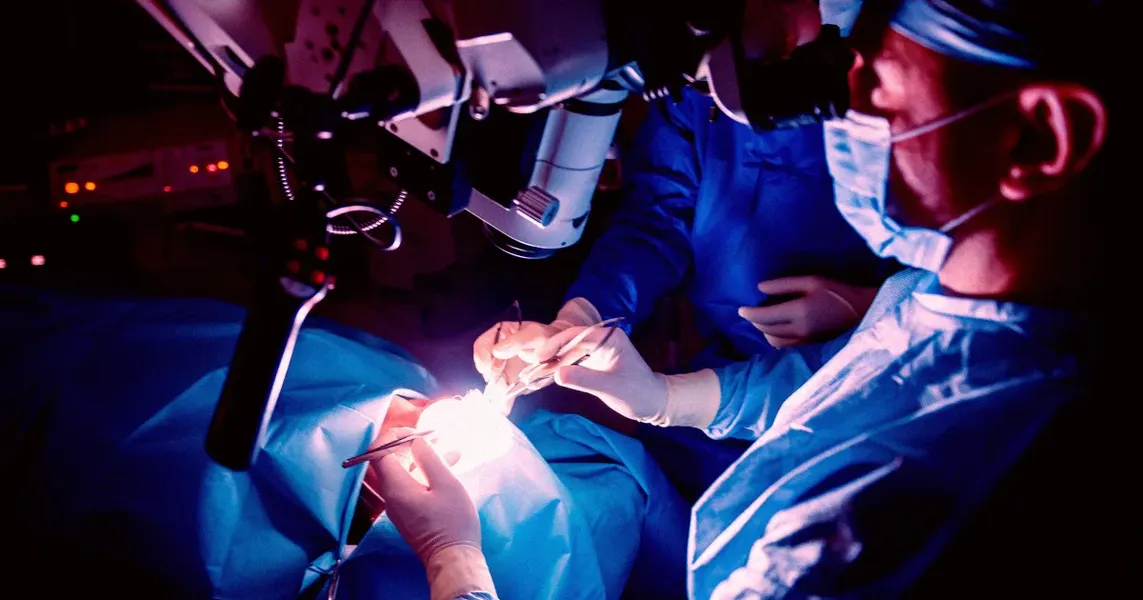
A team of neurosurgeons at the National Hospital for Neurology and Neurosurgery (NHNN) in London performed what is being called the first successful AI-assisted brain surgery in May 2026, using real-time computer vision to guide the removal of a pituitary tumor. The patient, 48-year-old Rhys Hibbert, regained his sight after the procedure. The AI did not operate autonomously it analyzed live video from a camera placed at the base of the skull and highlighted nerves, blood vessels, and safe zones for tissue extraction, helping surgeons avoid critical structures.
How the AI Tool Worked
The AI system was developed by Sophia Bano, an associate professor in robotics and AI at University College London. It was trained on hundreds of surgical videos of pituitary tumor removals, with researchers manually labeling vessels and nerves in each frame. During the operation, the system processed the live feed from the endoscope, tracked surgical instruments in real time, and overlaid color-coded guidance on the surgeon's display. According to the BBC, the tool functioned like "facial recognition for hidden anatomy" identifying structures that are invisible to the naked eye due to their position behind bone and tissue. The system ran on an NVIDIA IGX edge computing platform to achieve the low latency required for live surgery.
What This Means for Builders of Surgical AI
For teams building computer vision systems for medical applications, this case validates the feasibility of real-time inference in high-stakes environments. The model was not attempting to make decisions it performed a segmentation and overlay task that is computationally well-understood, but the deployment constraints are extreme. Any false positive or missed structure could lead to catastrophic outcomes. The NHNN team mitigated this by keeping the surgeon fully in control, using the AI as a second set of eyes.
Key technical takeaways: the training data was manually annotated by experts, which is expensive but necessary for precision. The inference hardware (NVIDIA IGX) is not off-the-shelf GPU hardware but a validated medical-grade system. Latency requirements likely forced a small model with limited context window. Builders exploring similar use cases should note that the AI's knowledge is statistical, not anatomical; it cannot adapt to patient-specific variations that deviate from its training distribution. The surgeon's pre-operative study of scans remains essential.
Practical Implications for Safety and Training
The AI's ability to flag critical anatomy in real time adds an intraoperative safety layer that was previously unavailable. Health officials noted that a margin of error of just one millimeter can cause blindness, stroke, or death in pituitary surgery. The AI helps reduce that risk by providing continuous visual cues.
However, experts quoted by BBC raised concerns about overreliance. A surgeon normally memorizes each patient's unique anatomy from pre-operative scans. An AI that generalizes across many patients could lead junior surgeons to trust the overlay more than their own judgment. The team behind the tool stressed that it is assistive, not autonomous.
Important Caveats: Single Case, No Peer Review
This remains a single case study reported through media coverage from The Guardian, BBC, and other outlets. No peer-reviewed publication has been released yet. The long-term outcomes, reproducibility across surgeons and hospitals, and failure modes of the AI under different surgical conditions are unknown. The training data was limited to pituitary surgeries from a single institution, so generalizability to other tumor types or anatomical variations is unproven.
This is a promising proof of concept. For builders, it confirms that real-time computer vision can augment neurosurgeons effectively, but it also highlights the gap between a research prototype and a generalized surgical AI product. The important question is not whether AI can guide surgery, but under what conditions it can do so safely and consistently.
FAQs
Sources
- Doctors Just Used AI to Perform Brain Surgery
- First patient to have brain surgery with real-time AI assistance - BBC News
- London neurosurgeons perform first successful AI-assisted operation to remove brain tumour | AI (artificial intelligence) | The Guardian
- World's first: How AI helped doctors remove UK man's brain tumour - The Week
- For the first time, AI guides surgeons through a brain tumor operation | TechSpot
- Doctors Just Did First Computer Vision-Guided Brain Surgery
- AI helps doctors perform rare brain surgery, remove tumour and restore 48-year-old's sight
- AI brain surgery world first: UCL system saw live video, not pre-op scans, restoring patient sight
- World-First AI Brain Surgery Helps Save Patient's Sight
- First patient to have brain surgery with real-time AI assistance
- AI-Assisted Brain Surgery: What the AI Actually Did | explainx.ai Blog | explainx.ai
- World-first: AI guides live brain surgery in the UK to save patient's sight | Euronews
- AI brain surgery: Machine intelligence assists neurosurgeon in real time
- AI helps doctors perform rare brain surgery, remove tumour and restore 48-year-old's sight
- AI Helps Surgeons Remove Brain Tumor in Real Time During Operation: ‘Groundbreaking Technology’