Strider Robotics: IISc Quadruped Robot Hits Real-World Industrial Pilots
Published by AINave Editorial • Reviewed by Ramit
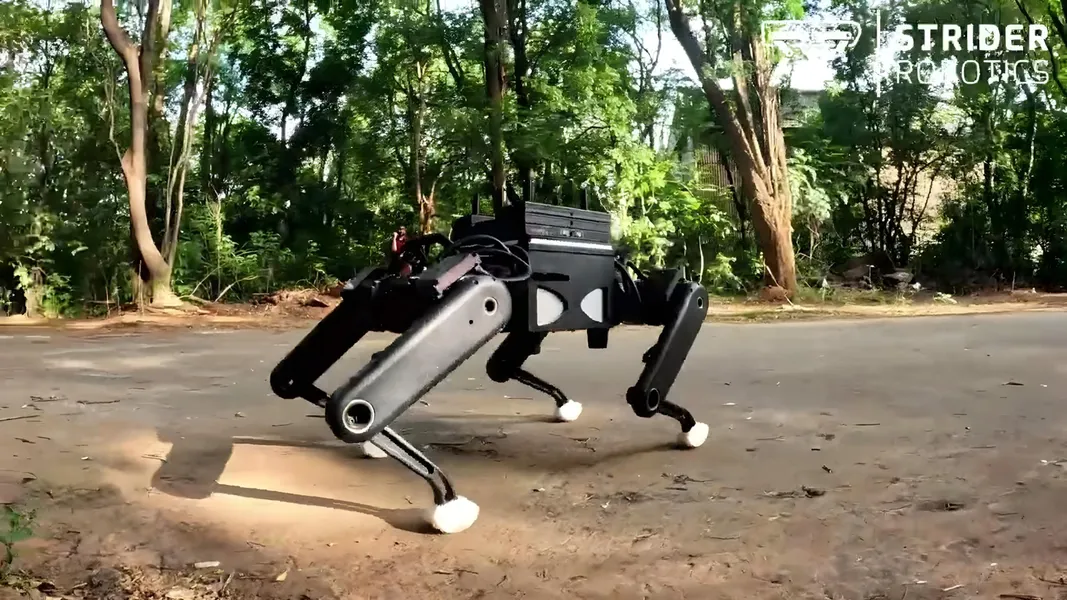
Strider Robotics, spun out of the IISc Stochastic Robotics Lab, has moved beyond prototypes. Its quadruped robot, capable of carrying a 40 kg walking payload, is now running commercial pilots at a live oil and gas facility and an automotive plant in India source. The company is not just selling hardware. It is also pitching a hardware-agnostic AI software stack that can run on third-party quadruped platforms such as Spot, ANYmal, and Unitree B2. For teams evaluating industrial inspection robots or building on top of legged platforms, the transition from demo to real field operations is the most important signal to watch.
What happened
Strider's quadruped has a 40 kg walking payload, enabling it to carry a full sensor package including a gas detector, thermal camera, acoustic sensor, and compute module source. That payload matches the Unitree B2 and is nearly three times the 14 kg capacity of Boston Dynamics' Spot.
The company was formally incorporated in 2024 and incubated at ARTPARK, the AI and Robotics Technology Park at IISc. Its technical lineage runs through the Stoch series of research quadrupeds built between 2018 and 2022 at the Stochastic Robotics Lab. The locomotion control is rooted in the lab's 2025 MULE paper, which describes an adaptive RL framework for quadrupedal robots dynamically adjusting to varying payloads and terrains.
The commercial pilots are running simultaneously across two distinct industrial environments: oil and gas facilities and automotive manufacturing. Strider's AI software stack covers inspection, autonomous navigation, mission planning, asset monitoring, and analytics. The company reports that its latest robot contains more than 80 percent indigenous content by component cost, aligning with India's Make in India initiative.
Why AI builders should care
For developers building robot-agnostic autonomy layers, Strider's software strategy is the most commercially interesting part of the announcement. The software stack is designed to run on third-party robots, not just Strider's own platform source. An operator who owns a fleet of Spots today is embedded in Boston Dynamics' ecosystem, which has more than 260 certified third-party integrations. A software layer that can run on Spot, ANYmal, and Unitree B2 simultaneously could enter that installed base without requiring a hardware swap.
The payload-adaptive RL-based locomotion, informed by the MULE research, addresses a real bottleneck. Traditional model predictive control approaches depend on predefined gait schedules that limit adaptability. The simulation-trained RL policy is designed to handle unpredictable loads over difficult terrain without preprogrammed maps.
Practical implications
The 40 kg payload opens missions that Spot's 14 kg limit cannot support. An inspection run that requires a gas detector, thermal camera, acoustic sensor, and compute module simultaneously exceeds Spot's capacity. At 40 kg, a single robot can carry a more complete sensor package, potentially replacing a human in environments with risks of gas leaks or equipment failure.
The two pilot contexts test adaptability. Oil and gas presents pipework corridors, confined spaces, and explosive-atmosphere zones. Automotive manufacturing has densely packed machinery and high-traffic floors. A platform that performs across both contexts is more likely to become a product line rather than a one-off demonstration.
India's low robot density, at 7 robots per 10,000 manufacturing workers according to the International Federation of Robotics, underscores the automation opportunity. Strider's domestic manufacturing positioning makes it a candidate for procurement programs seeking indigenous supply alternatives to U.S. or Chinese hardware.
Caveats
Strider has not publicly confirmed its ATEX or IECEx certification status for explosive-atmosphere zones. ANYbotics' ANYmal X has native ATEX Zone 1 certification. Spot is rated IP54 and Zone 2 compatible. Buyers evaluating Strider for the most hazardous classified zones should treat certification as an open verification gap.
Sustained operating time under full payload is also not publicly documented. High-torque electric actuators accumulate heat under cyclic load. Published research shows that standard RL locomotion policies can trigger thermal shutdown within minutes under heavy loads without thermal management built into the control policy. Buyers should ask for sustained operating time at full payload, ingress protection rating (IP67 is standard for outdoor industrial use), and the thermal management approach.
Specific pilot metrics such as mean time between failures, navigation accuracy in confined spaces, sensor data quality under motion, and human oversight burden per inspection cycle are not yet public. Those numbers, when released, will determine whether the technology is ready for scaled deployment.
FAQs
Sources
- Strider Robotics Takes IISc Quadruped Into Commercial Pilots at Oil and Gas Sites
- Strider Robotics demonstrates 40 kg payload quadruped robot as commercial pilots begin
- AUTONOMOUS ROBOTS | Strider Robotics
- Ignite - Startup@ARTPARK — ARTPARK @IISc - Leading AI & Robotics startup incubation
- Autonomous Quadrupedal Robots | Strider Robotics
- Strider Robotics - 2025 Company Profile, Team & Competitors - Tracxn
- Strider Robotics takes IISc quadruped into commercial pilots at oil and gas sites
- Strider Robotics demonstrates 40 kg payload quadruped robot ...
- Strider Robotics demonstrates 40 kg payload quadruped robot ...
- Strider Robotics begins industrial pilots with 40 kg quadrupeds
- Strider Robotics takes IISc quadruped into commercial pilots at oil and gas sites
- Strider Robotics Unveils 40 Kg Payload Quadruped Robot For ...