NVIDIA Vera Rubin Widens the AI Chip Gap as China Struggles to Catch Up
Published by AINave Editorial • Reviewed by Ramit
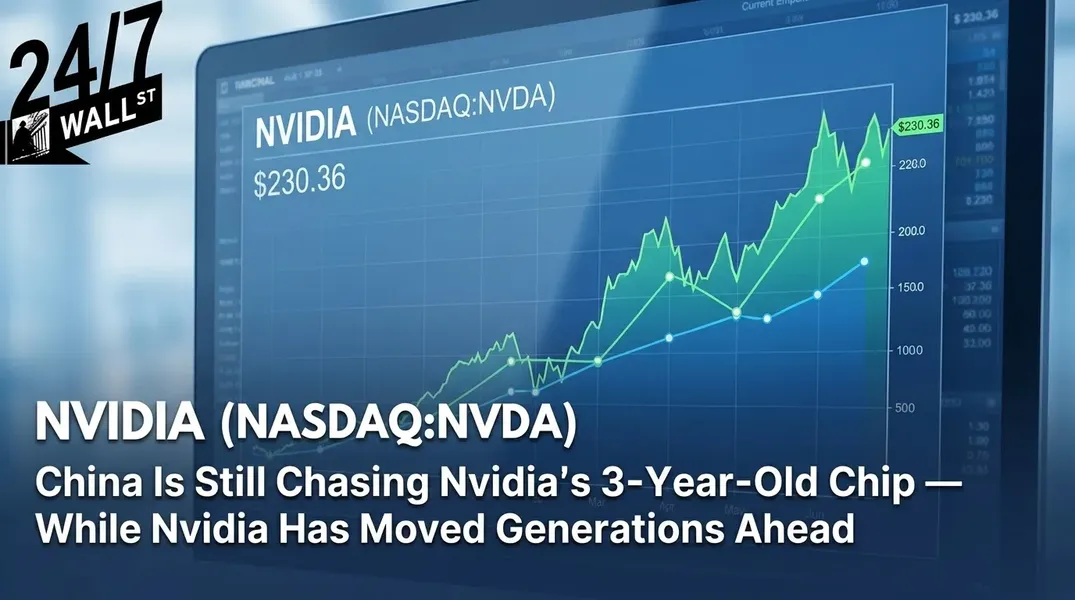
The gap between NVIDIA's best AI GPU and China's most advanced domestic chip is now measured in hardware generations, not performance percentages. NVIDIA's Vera Rubin, now in full production, delivers 4,000 TFLOPS of FP16 compute per GPU, while Huawei's Ascend 910C tops out at roughly 780 TFLOPS FP16. That's less than half the performance of NVIDIA's H200, a chip unveiled nearly three years ago. For AI builders planning capacity, this widening gap has direct consequences: the best silicon remains concentrated at one vendor, and export controls add supply risk for global deployments.
Three Generations Ahead and Still Pulling Away
NVIDIA's journey from H200 (roughly 1,700 TFLOPS FP16) through Blackwell and Blackwell Ultra to Vera Rubin represents a multi-year lead that competitors haven't closed. The parent article positions Huawei's Ascend 910C as still chasing H200-era performance, while NVIDIA is already shipping Vera Rubin at scale. The financial engine behind this lead is massive: the company posted Data Center revenue of $89.02 billion in Q2 FY27, up 117% year over year, with a gross margin around 74%. That kind of margin funds continued investment in hardware and software ecosystems, making the moat self-reinforcing.
What Export Controls Actually Mean for GPU Supply
China export controls are often cited as a risk to NVIDIA's growth, but the numbers tell a nuanced story. Hopper shipments to China were under 1% of total Data Center revenue in Q2, and the Q3 revenue guide of $108 billion explicitly assumes zero Data Center compute revenue from China. That doesn't mean China is irrelevant: Chinese AI firms still rely heavily on NVIDIA chips, and switching to domestic hardware brings major software costs. Meanwhile, reports indicate Beijing has banned top tech firms from buying NVIDIA chips, adding pressure on the limited remaining sales channels. For builders, the practical takeaway is that if you need NVIDIA GPUs inside China, availability is constrained and likely to remain so. Outside China, the supply picture is less affected, but geopolitical shifts can change that quickly.
What This Means for AI Infrastructure Builders
Vera Rubin sets the benchmark for future capacity planning. Its FP16 throughput directly impacts training time for large models, and the performance gap means domestic Chinese alternatives are not yet viable for leading-edge workloads. NVIDIA's financial strength amplifies this advantage: net margins of 55.6% and $21.34 billion in quarterly free cash flow allow aggressive investment in next-generation architectures and the CUDA ecosystem that builders depend on. The moat isn't just raw TFLOPS, it's the full software stack that makes those teraflops usable in production.
Limitations and What's Not Yet Verified
The Vera Rubin 4,000 TFLOPS FP16 figure comes from the parent article and should be confirmed against official NVIDIA disclosures. FP16 theoretical peak is a useful comparison point, but real-world training throughput also depends on memory bandwidth, interconnect topology, and software optimization. Huawei's Ascend 910C at 780 TFLOPS is similarly a peak specification; actual performance in large-scale training clusters may differ due to software maturity and tooling gaps. Export control dynamics remain fluid, and policy changes can alter the supply picture for builders on either side of the regulatory boundary.
FAQs
Sources
- China Is Still Chasing Nvidia’s 3-Year-Old Chip — While Nvidia Has Moved Generations Ahead
- China Is Still Chasing Nvidia’s 3-Year-Old Chip — While ...
- China Is Still Chasing Nvidia’s 3-Year-Old Chip — While ...
- The U.S. banned Nvidia's best chips from going to China. Now ...
- Nvidia's AI chip sales in China stall, as local chipmakers ...
- Why Nvidia still powers China's model race despite Huawei's ...
- China is still chasing Nvidia’s 3-year-old chip — while Nvidia has moved generations ahead
- China Bans Top Tech Firms From Buying Nvidia Chips, Report Says
- Nvidia denies report it is rolling out China AI chip by year-end
- Nvidia H200 Chips Enter China at 13% of Quota; Beijing, Not Washington, Controls Rest
- Nvidia H200 chips reach China in small shipments, FT reports
- NVIDIA’s China Problem: Alibaba, Baidu Adopt Their Own Chips
- DeepSeek's 160,000 Huawei Order Is A Real Threat To Nvidia In...
- Nvidia Chips Are Front and Center in China at Crucial Moment in the...
- NVIDIA Brings Simplified Local AI Support To NVIDIA GPUs Carrying...