NVIDIA Molt Brings a Compact PyTorch-Native Agentic RL Framework to Researchers
Published by AINave Editorial • Reviewed by Ramit
NVIDIA’s NeMo team has introduced the Molt agentic reinforcement learning framework, a PyTorch-native stack designed to reduce the engineering cost of changing agent training algorithms. The practical idea is simple: keep the RL code compact enough for a researcher, or an AI coding assistant, to trace from rollout to optimization without navigating a large layer of distributed glue.
Molt treats readability as a research feature
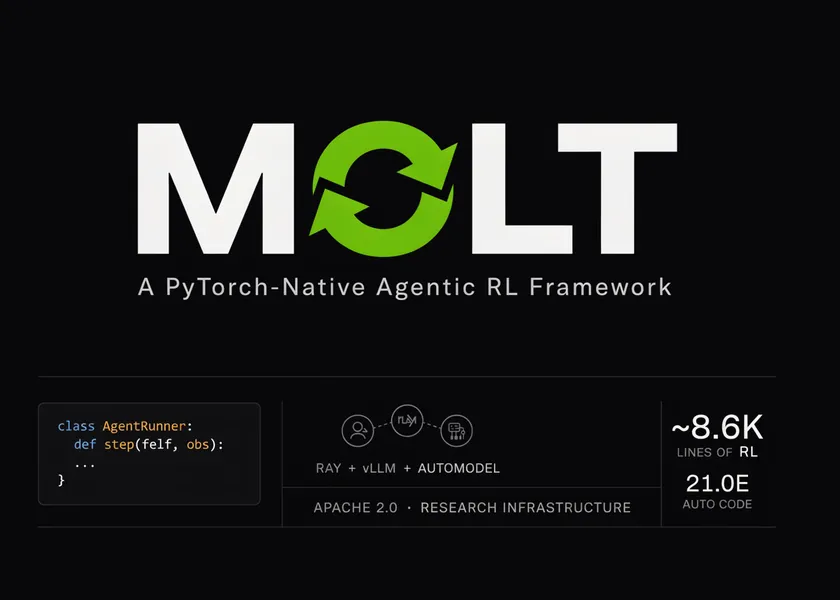
The project reports roughly 8.6K lines of RL code, compared with larger footprints reported for several other frameworks. That is not a performance benchmark, and it does not prove that Molt is easier to operate in every environment. It does establish a clear design goal: end-to-end traceability should make experiments easier to modify and debug.
Molt is positioned as research infrastructure, not a production training service. It uses Ray for placement and asynchronous coordination, vLLM for rollout, and NVIDIA AutoModel with FSDP2 for training. The components are not forked, with container pinning used instead of maintaining separate upstream branches.
The runtime is built for long agent trajectories
Molt supports two ways to define an agent loop. Env follows a Gymnasium-aligned interface where the framework manages the language model loop. ChatAgent lets the researcher own the loop through an OpenAI or Anthropic compatible SDK.
A loopback server translates those wire protocols into one token-exact accumulation. That matters for multi-turn agents that rewrite or compact context. Rather than retokenizing the final transcript and potentially changing the trajectory, Molt preserves token identity across segments.
The runtime combines an agent pool, vLLM engines behind a request router, a streaming pool, and a trainable policy actor. During partial rollout, engines can pause while actor shards are broadcast over NCCL, then resume retained requests. This design is aimed at keeping inference work in flight while training progresses.
Why agentic RL tooling teams should care
The strongest case for NVIDIA Molt is experimentation. Tool-use agents, code-execution environments, vision-language tasks, LLM-as-judge reward loops, and on-policy distillation all require researchers to change the interaction and reward logic repeatedly. Molt makes the user-facing experiment a Python module exporting an AgentRunner, with the reward remaining ordinary code.
Its correctness model also addresses a common problem in asynchronous agentic RL. Molt tracks token identity, policy-version semantics, and forward consistency. For mixture-of-experts policies, rollout routing decisions can be replayed during training so independent expert selection does not silently change the trajectory.
The hardware requirement changes the audience
The shipped recipes assume two nodes with eight H100 GPUs each, split between training and rollout. That makes the H100 multi-node setup a serious entry requirement. Frontier-adjacent labs, well-funded startups, enterprise research groups, and academic teams with multi-node GPU access are the natural users. A small product team testing an agent workflow will likely find a lighter RL stack more practical.
The decision rule is therefore narrow but useful: consider Molt when algorithm iteration and inspectability matter enough to justify dedicated distributed hardware. Do not treat the framework as evidence that production agent training has become turnkey. The supplied material does not independently establish performance parity, broad model support, or production readiness beyond the described research recipes.
Sources
- NVIDIA AI Releases Molt: A PyTorch-Native Agentic Reinforcement Learning Framework
- Molt: A Scalable PyTorch-Native Training Framework for Agentic...
- Molt: PyTorch-Native Agentic RL Training Framework - CCTest
- NVIDIA's Molt: 9.2K-Line RL Framework Scales… | gentic.news
- Molt: A Scalable PyTorch-Native Training Framework for Agentic...
- Molt: A Scalable PyTorch-Native Training Framework for Agentic...
- NVIDIA Molt open-sources agentic RL training that scales to trillion-parameter models
- Molt vs. Unsloth vs. Hugging Face TRL: The New... - YouTube
- Molt: NVIDIA's PyTorch framework cuts agentic... | UncensoredHub
- NVIDIA NeMo Open-Sources Molt, a Lean PyTorch... | AI Weekly
- NVIDIA Molt Open-Sources Agentic RL Training That Scales to...