Google Vids Opens AI Video Generation to Free Accounts
Published by AINave Editorial • Reviewed by Ramit
Google Vids is opening AI video generation to anyone with a Google or Google Workspace account, bringing Gemini Omni 1.1 Flash into a tool that previously had narrower availability. The useful change is not just access: Vids also gives users more control over clip length and scene continuity, while free access does not mean unlimited generations.
More control than a prompt and a clip
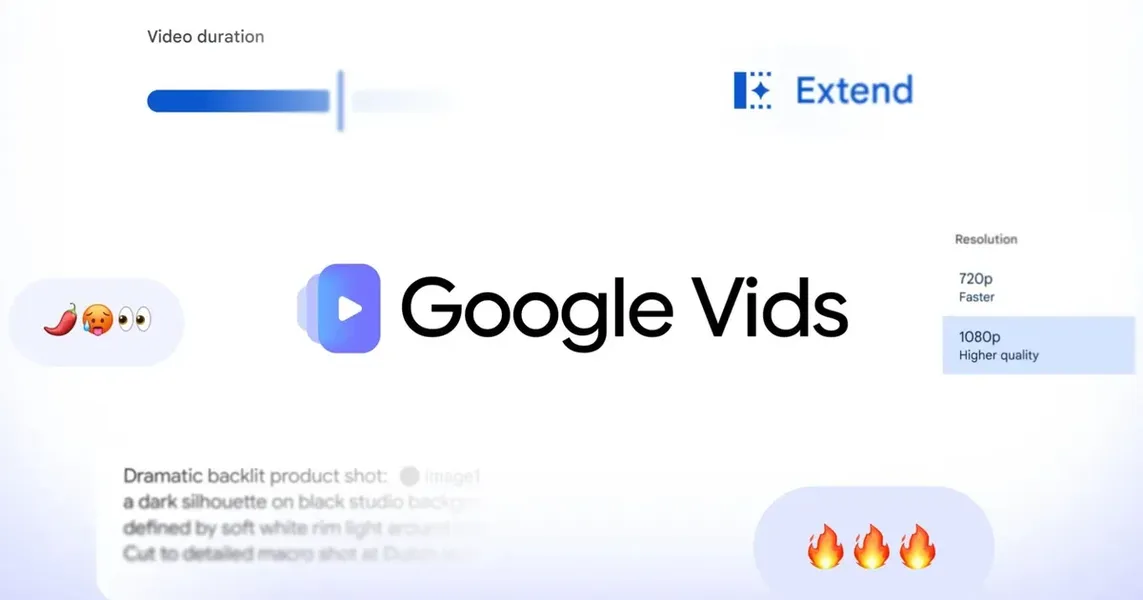
With Omni 1.1 Flash, users can generate video clips from scratch, specify how long a clip should be, or extend an existing scene. When extending a scene, Vids tries to preserve details such as characters, setting and lighting. That makes the controls relevant to fitting generated footage into a script or voiceover, rather than simply producing a standalone clip. The source does not establish how consistently those visual details are preserved.
New scenes can be generated in 1080p, and existing AI clips can be upscaled to HD. Templates can also help turn product photos or other existing material into a video without building everything from an empty timeline. Taken together, these features position Vids as a way to assemble a simple video from existing assets and generated footage, not just a text prompt interface. Google Vids supports clip generation, scene extension and HD output.
Free to try, with limits that depend on the plan
Google says account holders can use Vids and Omni 1.1 without paying. Its paid AI plans provide higher generation limits for personal accounts, while Workspace Business and Enterprise customers get additional capacity and administrative controls. The available information does not specify exact quotas, so “free” describes access, not an unlimited supply of generations. Google’s plan details distinguish free access from higher paid-plan limits.
That distinction matters for teams considering Vids for recurring production: access lowers the barrier to testing a workflow, but the source does not say how much video a free account can generate. Nor does it detail how the controls work across every kind of project. The concrete starting point is narrower: a Google account can try a tool that generates and edits clips, with paid tiers offering more capacity.
Voiceovers are planned; generated clips carry SynthID
Google says text-to-speech powered by Gemini 3.8 Flash-Lite is coming soon to Vids. It is intended to turn written scripts into voiceovers in more than 100 languages, but the feature is forthcoming, not a capability users can assume is available now. Google describes the multilingual voiceover feature as coming soon.
Omni 1.1-generated videos include a SynthID watermark inside their frames to identify them as AI-generated. That is a meaningful disclosure measure for those clips; the available information does not say that every video exported from Vids receives the watermark. The SynthID marker applies to videos generated using Omni 1.1.
The immediate shift is that more people can try AI video creation within Vids without first paying for access. For a sustained workflow, the practical constraint is still generation capacity, and Google has not provided the quotas needed to judge how far a free account will go.