Genesis 2.0: A brain-inspired chip takes on catastrophic forgetting with spike-based lifelong learning
Published by AINave Editorial • Reviewed by Ramit
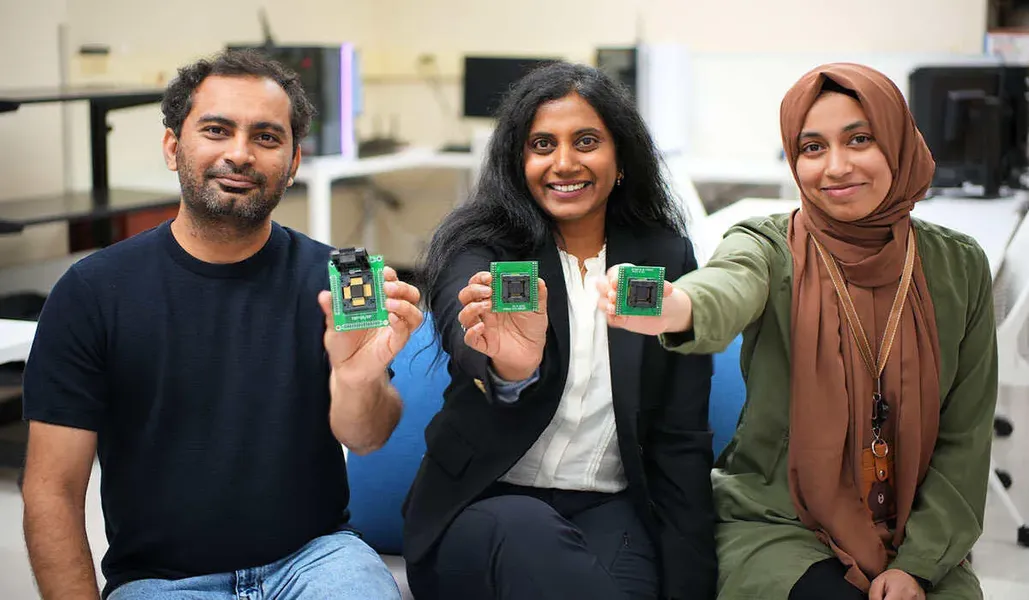
UT San Antonio researchers have unveiled Genesis 2.0, a brain-inspired chip designed to solve catastrophic forgetting in AI using energy-efficient spike-based processing. The chip, developed under the MATRIX AI Consortium led by Dhireesha Kudithipudi, operates at around 20 milliwatts and selectively retains important information rather than replaying all past data, mimicking how the human brain learns continuously without overwriting old knowledge.
How Genesis 2.0 works
Catastrophic forgetting is the tendency of neural networks to lose previously learned information when trained on new tasks. Most AI systems combat this by replaying old data, which is computationally expensive and energy-intensive. Genesis 2.0 takes a different approach: it uses spike-based processing that saves energy at rest, and it strengthens connections between past and new knowledge by identifying which information is significant as new tasks arrive. The team worked closely with neuroscientists to design algorithms that align with the hardware, making tradeoffs to ensure the chip works in real-world applications.
The chip was fabricated using IBM's 65-nanometer process in partnership with SUNY Albany. It consumes under 20 milliwatts, roughly the power of a single LED or phone screen, enabling long operation without recharging. The chip also retains information without needing to offload data to the cloud, which matters for devices that operate offline.
Why this matters for AI builders
For builders working on edge AI, wearable devices, or autonomous systems, the key takeaway is the hardware-software co-design approach. Genesis 2.0 demonstrates that continuous learning can be implemented at the chip level with low power, potentially reducing the need for frequent retraining or cloud connectivity. This is especially relevant for applications like field-deployed drones, wearable sensors, and implantable healthcare devices, where energy and connectivity are constrained.
However, Genesis 2.0 is still a research chip. The team notes that they investigated one type of emerging memory, and future work could combine different memory types for even greater efficiency. The project is supported by a five-year Air Force Research Laboratory grant and NSF funding, indicating continued development.
Caveats and what's missing
The available information comes from a single journalistic article with no independent validation. Deployment scale, long-term reliability, and real-world benchmarks are not yet published. The chip's performance on standard AI tasks or its ability to generalize across diverse domains remains unclear. Builders should treat this as a promising research direction rather than a production-ready solution.
Decision rule for builders
If you're building on-device AI that must adapt to changing environments without forgetting, the Genesis 2.0 approach is worth watching. It validates that spike-based, selective retention can work at low power, but you should wait for independent benchmarks and commercial availability before betting on it.