CUDA Agent uses agentic RL to generate GPU kernels that beat torch.compile
Published by AINave Editorial • Reviewed by Ramit
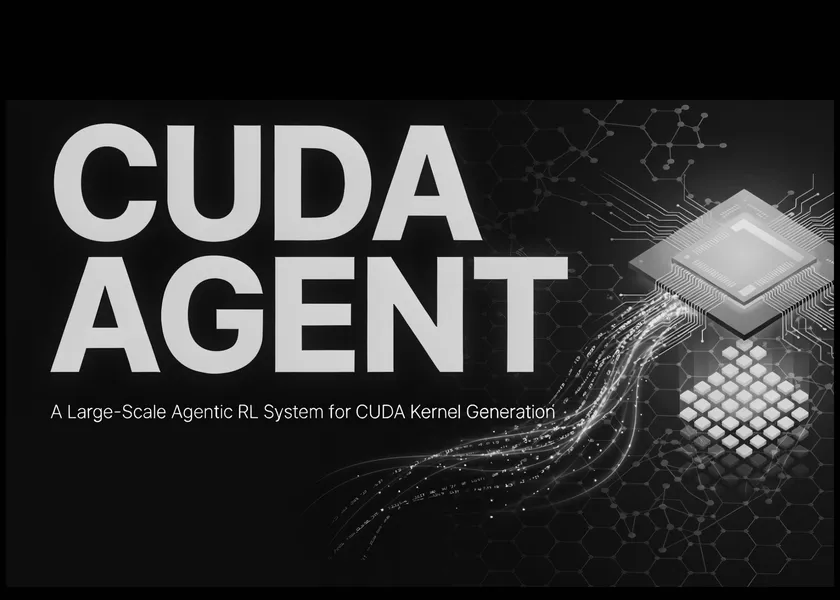
ByteDance Seed and Tsinghua AIR have released CUDA Agent, an agentic reinforcement learning system that trains a large language model to write GPU kernels that outperform traditional compilers. On the KernelBench benchmark, CUDA Agent achieves a 98.8% pass rate and a 2.11x geometric-mean speedup over torch.compile, closing a gap where frontier models produce correct but slow CUDA code. The system uses a permission-locked sandbox with profiling and correctness checks, trained with PPO for 150 steps. Public artifacts include the CUDA-Agent-Ops-6K dataset and training recipes, but the trained weights are not released.
How CUDA Agent trains LLMs to beat torch.compile
The baseline model, Seed1.6, is a 23B active / 230B total parameter MoE that passes 74% of KernelBench tasks but is slower than torch.compile on most of them, with a 0.69x geometric-mean speedup. CUDA Agent inserts the model into a real CUDA development environment with tools like Bash, Read/Write, and Edit, and trains it using PPO with a discrete reward signal. The reward is -1 for correctness failure