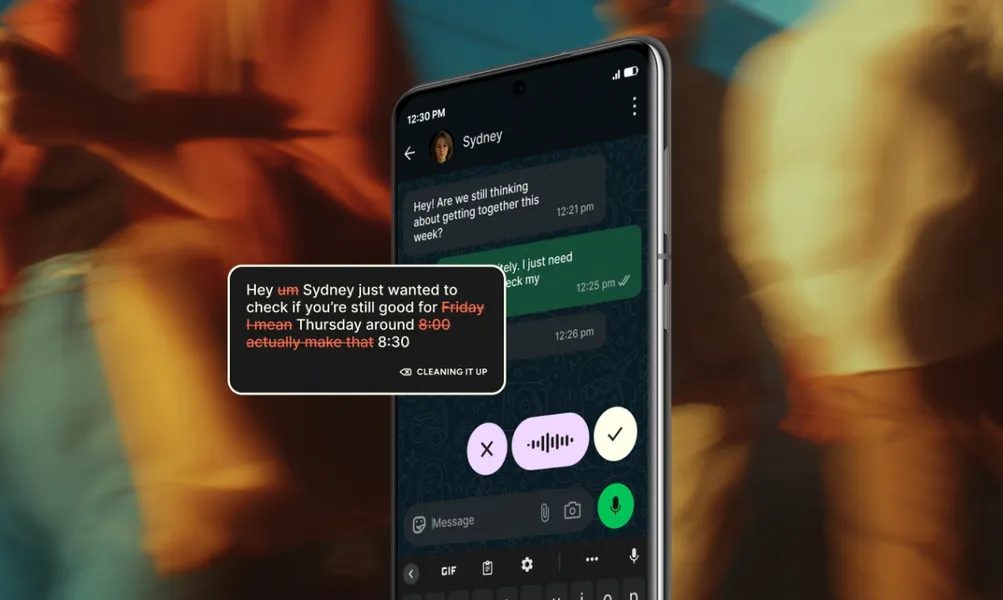
Wispr raises $280M at $2B valuation, expands beyond dictation into ambient AI workflows
Published by AINave Editorial • Reviewed by Ramit
Wispr, the AI dictation startup behind Wispr Flow, has raised a $280 million Series B led by Menlo Ventures at a $2 billion valuation, bringing total funding to $361 million. The company also announced Canto, a new proprietary speech-understanding model that it says will reduce error rates in Wispr Flow from about 30% to under 10%. This funding signals that Wispr is betting heavily on dictation as a gateway to broader ambient AI workflows, including meeting note-taking, on-device interaction, and potential integrations with productivity tools.
Canto targets the accuracy gap in speech understanding
Canto is Wispr's first proprietary speech model, launched after several weeks of user complaints about quality dips in Wispr Flow's dictation output. The company claims the model will cut word-level error rates from around 30% to less than 10%, though this is a vendor claim without independent verification. If achieved, this would bring Wispr close to the accuracy of high-end enterprise dictation tools while maintaining consumer-friendly latency and cross-platform support. The improvement matters because even small error rates compound when dictating longer texts or complex commands, making trust in the output essential for workflow adoption.
Beyond dictation: meetings, hardware, and interfaces
Wispr is expanding into meetings with a newly released note-taker tool that can display summaries and action items, competing directly with Granola, Fireflies, and Read AI. The company sees potential to integrate with other tools to create documents or email drafts from meeting output. On the hardware side, Wispr is partnering with makers like the Oasis ring to enable dictate-on-device experiences, letting users input text without speaking aloud. Separately, the company launched Wispr Interface Labs last month under Ariya Rastrow, a former Amazon Alexa engineer, to explore new human-computer interaction interfaces.
What this means for AI builders
For builders shipping AI-powered productivity or voice products, Wispr's trajectory reinforces a key thesis: dictation is not a niche feature but an input method that can replace typing across many workflows. The company's pivot from pure dictation to ambient AI workflows suggests that winning the voice input layer means also owning the output layer, such as summaries, action items, and document drafts. Wispr also emphasizes privacy as a foundation, arguing that trust is essential for ambient access to life. This positions them differently from big-platform competitors, but sustained differentiation will depend on execution and actual accuracy improvements.
Caveats to watch
The 30% to under 10% error reduction is Wispr's claim, not an independent benchmark. The competitive landscape is crowded: Apple, Google, Microsoft, Anthropic, and OpenAI all have voice or dictation offerings, some with larger distribution. Wispr's meeting note-taker is new and faces established players with existing user bases. The hardware partnerships and Interface Labs are early-stage, with no public timelines for broader rollout.
FAQs
Sources
- Wispr raises $280M at $2B valuation as it looks beyond dictation
- Wispr talks its way to a $2 billion valuation. The company says dictation’s only the beginning
- AI dictation startup Wispr raises $280M
- Wispr Secures $280M Series B, Expands Beyond Dictation with New...
- Wispr raises $280M to power up natural... - SiliconANGLE
- Wispr raises $280M at $2B valuation as it looks beyond dictation
- Wispr talks its way to a $2 billion valuation. The company says dictation’s only the beginning
- Wispr's $2B Valuation Ends Dictation — Cowlpane
- Wispr Raises $280 Million At $2 Billion Valuation As Revenue Grows...
- Wispr raises $280M at $2B valuation as it looks beyond dictation