Forterra's Lancer UGVs in Ukraine test the limits and lessons of ground autonomy in modern warfare
Published by AINave Editorial • Reviewed by Ramit
Forterra, a US builder of autonomous vehicles, has deployed over 100 of its Lancer autonomous ground vehicles in Ukraine for nine months, in what the company and analysts call the largest combat deployment of autonomous ground vehicles by a US defense tech company. The deployment offers a rare real-world test of ground autonomy under fire, revealing both its current value and its sharp limits.
What happened
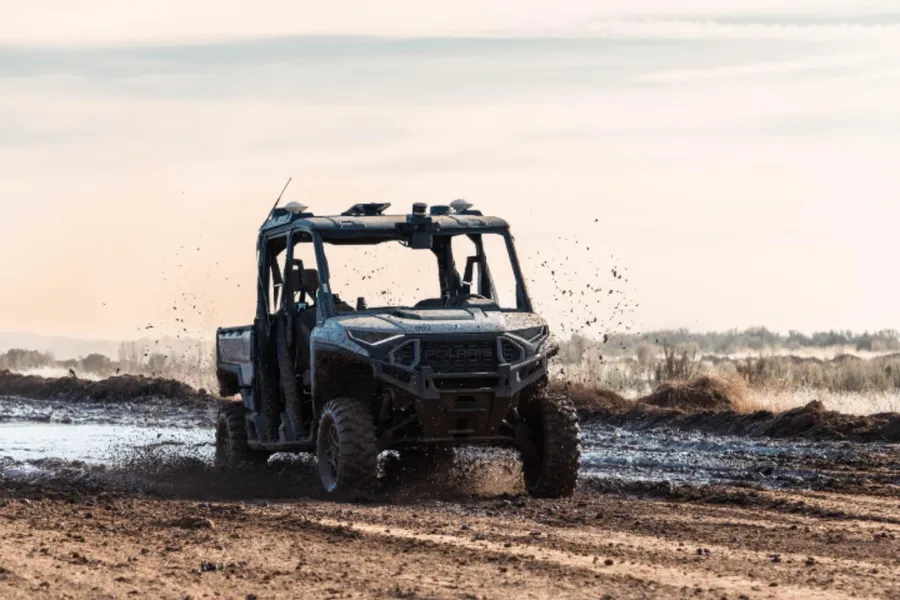
The Lancer vehicles are based on Polaris ATVs, gas-powered, and can carry up to 750 kilograms of cargo. Each unit includes a Starlink antenna for teleoperation. Since arriving in Ukraine last October, the fleet has logged more than 2,500 miles across over 1,100 missions, carried 777,440 pounds of total weight, and completed 52 casualty evacuations.
Ukrainian forces initially relied on manual control but shifted toward teleoperation due to drone-enabled no-go zones and the risk to autonomous units. The vehicles can navigate diverse terrain autonomously, but they cannot yet identify unexpected enemy forces and react appropriately. As one Ukrainian soldier told TechCrunch: "We actually need to be able to respond to the enemy threats, live, while it's in front of the enemy, which the autonomy doesn't know how to do yet."
Forterra has raised over $500 million in venture funding from XYZ Venture Capital and Moore Strategic Partners. The company is exploring how to combine classical robotics algorithms with generative AI to improve real-time decision-making in contested environments.
Why AI builders should care
This deployment is a case study in how teleoperation and selective autonomy can reduce risk to soldiers while expanding reach for logistics and resupply. The experience highlights current autonomy limits: vehicles can handle terrain but struggle with unpredictable threats. Developers are experimenting with combining traditional robotics algorithms with generative AI to improve situational awareness and decision-making in contested environments.
For AI builders working on physical systems, the key takeaway is that autonomy in high-stakes environments still requires a human in the loop for critical decisions. The data gathered from these missions is also valuable for training models that can handle edge cases not found in open-source datasets.
Practical implications
Teleoperation remains a practical bridge to full autonomy in high-risk environments, particularly where no-go zones and anti-access dynamics constrain unmanned systems. Autonomous systems are being used to move supplies, evacuate casualties, and support logistics in contested zones, suggesting a shift in how military contractors approach risk, maintenance, and data gathering.
Developers should consider data curation, update strategies, and resilience to electronic warfare when integrating AI with physical robotics in the field. Forterra's experience with updating software from afar and maneuvering in challenging conditions offers lessons for any team deploying autonomous systems in unpredictable environments.
Caveats
Autonomy remains limited in identifying and reacting to unexpected threats; Ukrainian operators rely heavily on teleoperation for mission-critical decisions. The deployment is ongoing, and figures may evolve as the conflict and technology develop. Source evidence is largely from TechCrunch reporting and related defense-technology coverage; details may change as deployments continue.
FAQs
Sources
- The first American autonomous ground vehicles are fighting in Ukraine
- Ukraine’s unmanned ground vehicles are reshaping the war / The...
- Armed robots take to the battlefield in Ukraine war
- AGVs: The Future of Minelaying and Terrain Shaping | Forterra
- Aerial Drones Change How Wars Are Fought—Unmanned Ground...
- The first American autonomous ground vehicles are fighting in Ukraine
- US Marine Corps buys first autonomous ground vehicle fleet to run frontline missions
- USMC awards $20 million contract for first autonomous ground vehicles
- Marine Corps inks first contract for autonomous ground vehicle production
- AI war machines hit the ground running: Marine Corps quietly orders...
- JUST IN: Seattle Company Announces Contract Fielding Autonomous...
- The First American Autonomous Ground Vehicles Are Fighting I
- Forterra Deploys 100+ Autonomous Ground Vehicles to Ukraine ...
- The first American autonomous ground vehicles are fighting in ...
- Autonomous Ground Vehicles (AGVs) | SOF News