Canada and Germany invest $300M in safe-by-design AI through LawZero and Scientist AI
Published by AINave Editorial • Reviewed by Ramit
Canada and Germany have committed over $250 million to fund LawZero, a Montreal-based non-profit founded by AI researcher Yoshua Bengio, to build a new kind of safe-by-design AI model called Scientist AI. The model aims to focus on objective truth and act as a guardrail for other AI systems, but experts caution that controlling risks like hallucinations, misinformation, and autonomous actions remains a major challenge with no silver bullet.
What the funding covers
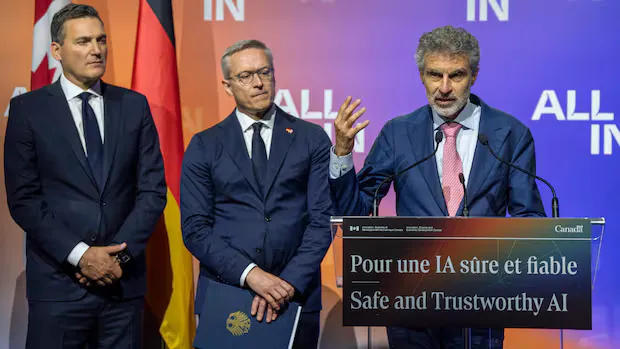
The Canadian government is investing $150 million in LawZero, and Germany is adding 100 million euros, announced at the All In AI conference in Montreal this week. The goal is to develop Scientist AI, a model designed to understand facts without pursuing goals of its own, unlike typical AI models that optimize for user approval. It could also serve as a guardrail for other systems, providing a safety layer for deployments.
Bengio described the urgency: "I want my children and my grandchildren to have a future." The announcement came alongside the merger of Canada's Cohere and Germany's Aleph Alpha, which experts see as capacity building for North American and European AI sovereignty.
Why it matters for AI builders
The safe-by-design approach is a different bet from the capability-first race dominating American and Chinese AI companies. If Scientist AI works as intended, it could offer an alternative model for builders who need trustworthy guardrails without relying on proprietary safety layers from large labs.
However, the project is still in early stages. There is no released model or public benchmark yet. The investment signals a policy push toward responsible AI in Canada, but implementation details are thin.
Practical implications and caveats
For AI builders, this development matters most as a signal that government funding is going toward safety research outside of big tech. If LawZero succeeds, it could provide open or low-cost safety infrastructure for other products. That said, experts like Jaxson Khan from the University of Toronto note that "there's no silver bullet to this problem right now. We have very powerful, even transformative, AI systems."
Controlling AI dangers like hallucination and misinformation will require more than any single project. International coordination is necessary, and even then, outcomes are uncertain. The investment is meaningful but does not guarantee that safe-by-design AI will become practical or widely adopted.
The context of this funding
The announcement came the same week Prime Minister Mark Carney called for a global non-industry body to oversee AI risks. The merger of Cohere and Aleph Alpha underscores a broader trend: countries are trying to build indigenous AI capacity while also investing in safety. Whether LawZero can deliver on its ambitious goals remains to be seen, but it is the largest direct government bet yet on a specific safe-by-design AI project.
Sources
- Canada is investing $150M to make AI safer. Will it work?
- 'It explains, it is not rogue': Canada to invest $150M in AI company in ...
- 'It explains, it is not rogue': Canada to invest $150M in AI company in ...
- Canada, Germany Invest $300M in Safe AI Research
- Canada investing $150M in non-profit focused on safe AI - MSN
- Canada is investing $150M to make AI safer. Will it work?
- Orqa and Remote Robotic Systems Launch $150M Partnership to Build Canadian Sovereign Capability in Drones, AI, and Counter-UAS Systems
- Canada is investing $150M to make AI safer. Will it work?
- Canada investing $150M in non-profit focused on safe AI - YouTube
- Canada, heatwaves, AI and Ceuta: Von der Leyen delivers... | Euronews
- thebalancemoney.com/investing-4072978
- Canada investing $150M in non-profit focused on safe AI
- investopedia.com/investing-4427685